

2 Rand – South Africa
South Africa
Context
Years: 1989–1995
Issuer: South Africa 
Period:
(since 1961)
Currency:
(since 1961)
Total mintage: 191,677,892
Material
References
KM: #Click to copy to clipboard139
Numista: #830
Value
Exchange value: 2 ZAR = $0.13
Inflation-adjusted value: 21.26 ZAR
Obverse
Description:
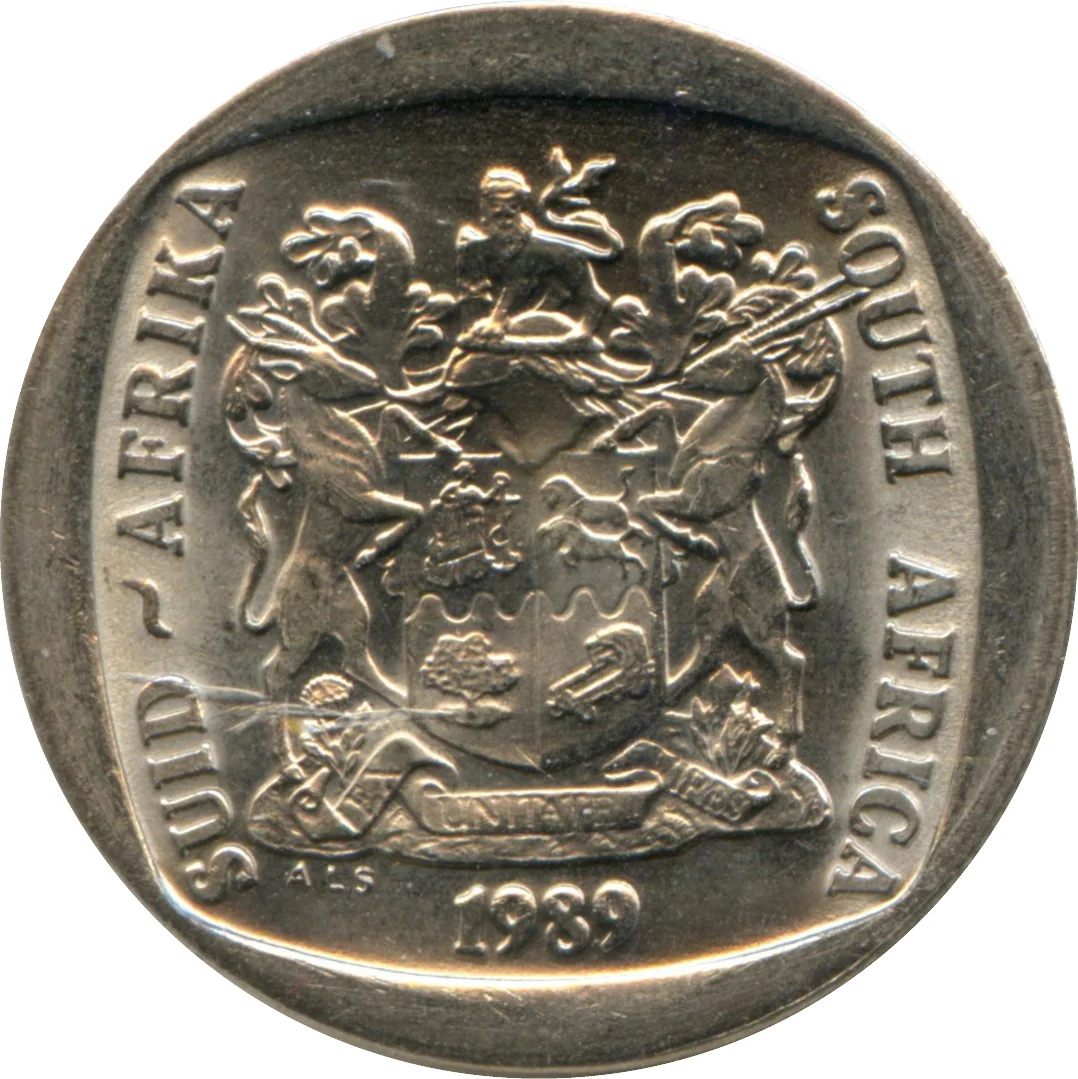
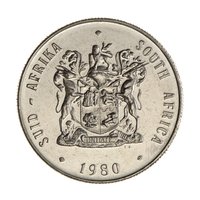
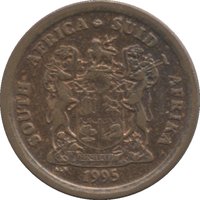
South Africa’s coat of arms in a square, with the motto "Ex Unitate Vires" and the country name in Afrikaans and English.
Inscription:
SUID-AFRIKA 1989 SOUTH AFRICA
EX UNITATE VIRES
ALS
EX UNITATE VIRES
ALS
Translation:
In Unity There is Strength
Script: Latin
Engraver: Arthur Sutherland
Reverse
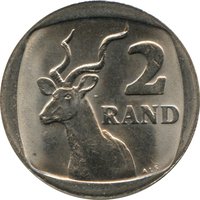
Description:
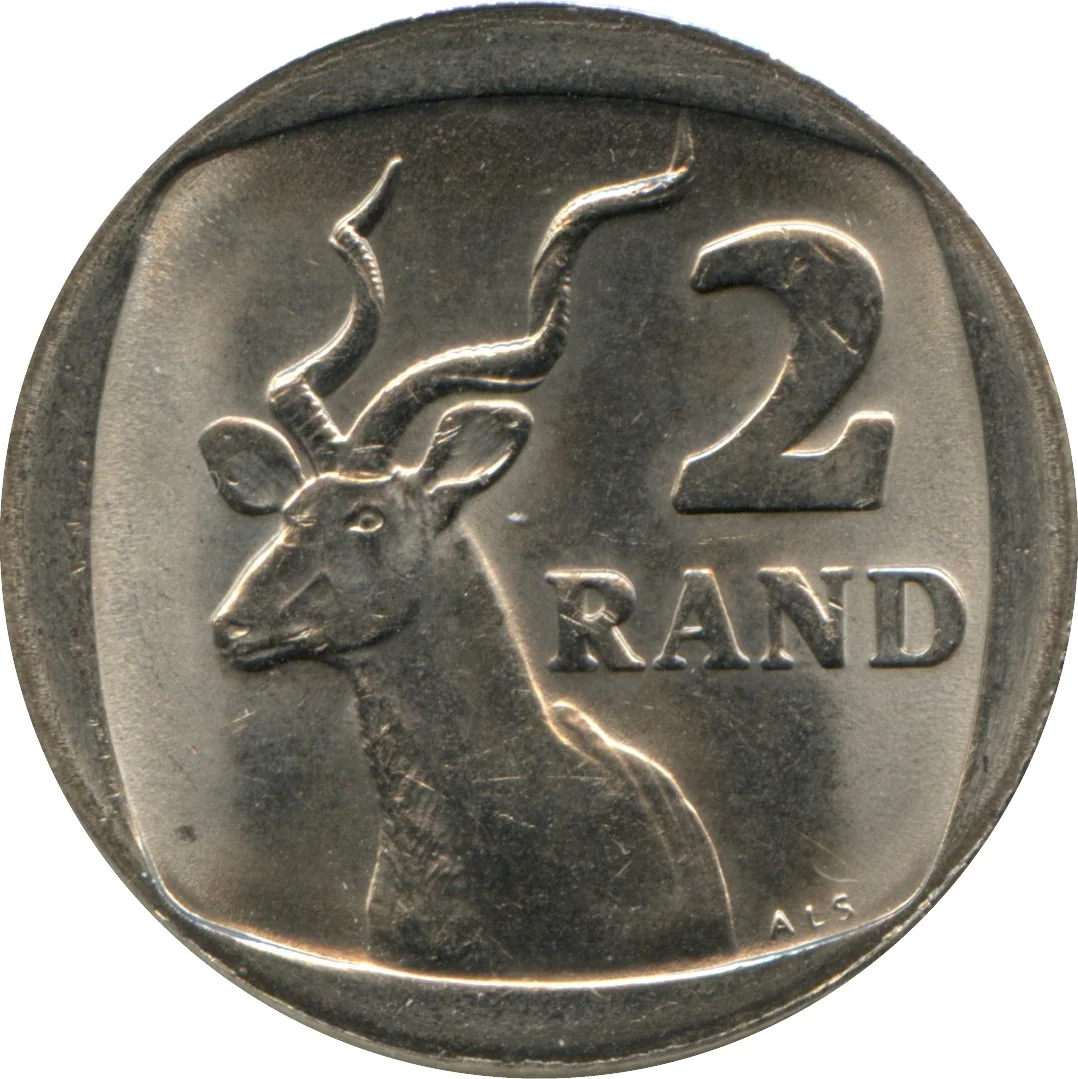
Greater kudu, a large spiral-horned antelope.
Inscription:
2
RAND
ALS
RAND
ALS
Script: Latin
Engraver: Arthur Sutherland
Edge
Alternating segments of smooth and reeded parts (5 each)
Categories
| Animal> Cow |
| Symbols> Coat of Arms |
Mints
| Name | Mark |
|---|---|
| Pretoria | — |
| South African Mint | — |
Mintings
| Year | Mint Mark | Mintage | Quality | Collection |
|---|---|---|---|---|
| 1989 | — | 65,233,000 | ||
| 1989 | — | 13,000 | Proof | |
| 1990 | — | 70,655,000 | ||
| 1990 | — | 12,230 | BU | |
| 1990 | — | 10,000 | Proof | |
| 1991 | — | 39,243,000 | ||
| 1991 | — | 15,000 | BU | |
| 1991 | — | 12,000 | Proof | |
| 1992 | — | 2,115,000 | ||
| 1992 | — | 15,087 | BU | |
| 1992 | — | 10,000 | Proof | |
| 1993 | — | 92,000 | ||
| 1993 | — | 10,902 | BU | |
| 1993 | — | 7,790 | Proof | |
| 1994 | — | 994,000 | ||
| 1994 | — | 6,786 | BU | |
| 1994 | — | 5,804 | Proof | |
| 1995 | — | 13,213,000 | ||
| 1995 | — | 8,477 | BU | |
| 1995 | — | 5,816 | Proof |
Historical background
In 1989, South Africa's currency, the Rand, operated within a complex and strained economic and political environment. The country was still under international financial sanctions and a cultural boycott, imposed in response to the apartheid regime. These measures severely restricted foreign investment and access to global capital markets, placing persistent downward pressure on the Rand. The South African Reserve Bank (SARB) was forced to maintain high interest rates and engage in frequent market interventions to defend the currency's value and manage the nation's substantial foreign debt, which was under constant threat of being called in by foreign creditors.
Economically, the late 1980s were marked by stagnation, high inflation (averaging around 14-15%), and a deep recession that had begun earlier in the decade. The cost of maintaining the apartheid state, coupled with the economic isolation, led to falling gold prices—a critical export—and a growing budget deficit. This "siege economy" meant the Rand was highly volatile and sensitive to both domestic political developments and shifts in the limited foreign capital flows. The dual exchange rate system, with the financial Rand (a separate, discounted currency for foreign investors) insulating the commercial Rand from some capital flight, remained a key but controversial feature of the financial landscape.
Politically, 1989 was a pivotal year of transition. P.W. Botha suffered a stroke and was succeeded by F.W. de Klerk in September, setting the stage for the unbanning of liberation movements and the release of Nelson Mandela in 1990. This political uncertainty created a climate of cautious optimism mixed with deep anxiety among investors. The currency markets were acutely sensitive to any signs of reform or, conversely, of increased internal conflict, leading to sharp fluctuations in the Rand's value as the year closed, anticipating the profound changes that would soon dismantle apartheid and reshape the nation's economic foundations.
Economically, the late 1980s were marked by stagnation, high inflation (averaging around 14-15%), and a deep recession that had begun earlier in the decade. The cost of maintaining the apartheid state, coupled with the economic isolation, led to falling gold prices—a critical export—and a growing budget deficit. This "siege economy" meant the Rand was highly volatile and sensitive to both domestic political developments and shifts in the limited foreign capital flows. The dual exchange rate system, with the financial Rand (a separate, discounted currency for foreign investors) insulating the commercial Rand from some capital flight, remained a key but controversial feature of the financial landscape.
Politically, 1989 was a pivotal year of transition. P.W. Botha suffered a stroke and was succeeded by F.W. de Klerk in September, setting the stage for the unbanning of liberation movements and the release of Nelson Mandela in 1990. This political uncertainty created a climate of cautious optimism mixed with deep anxiety among investors. The currency markets were acutely sensitive to any signs of reform or, conversely, of increased internal conflict, leading to sharp fluctuations in the Rand's value as the year closed, anticipating the profound changes that would soon dismantle apartheid and reshape the nation's economic foundations.
🌱 Very Common