

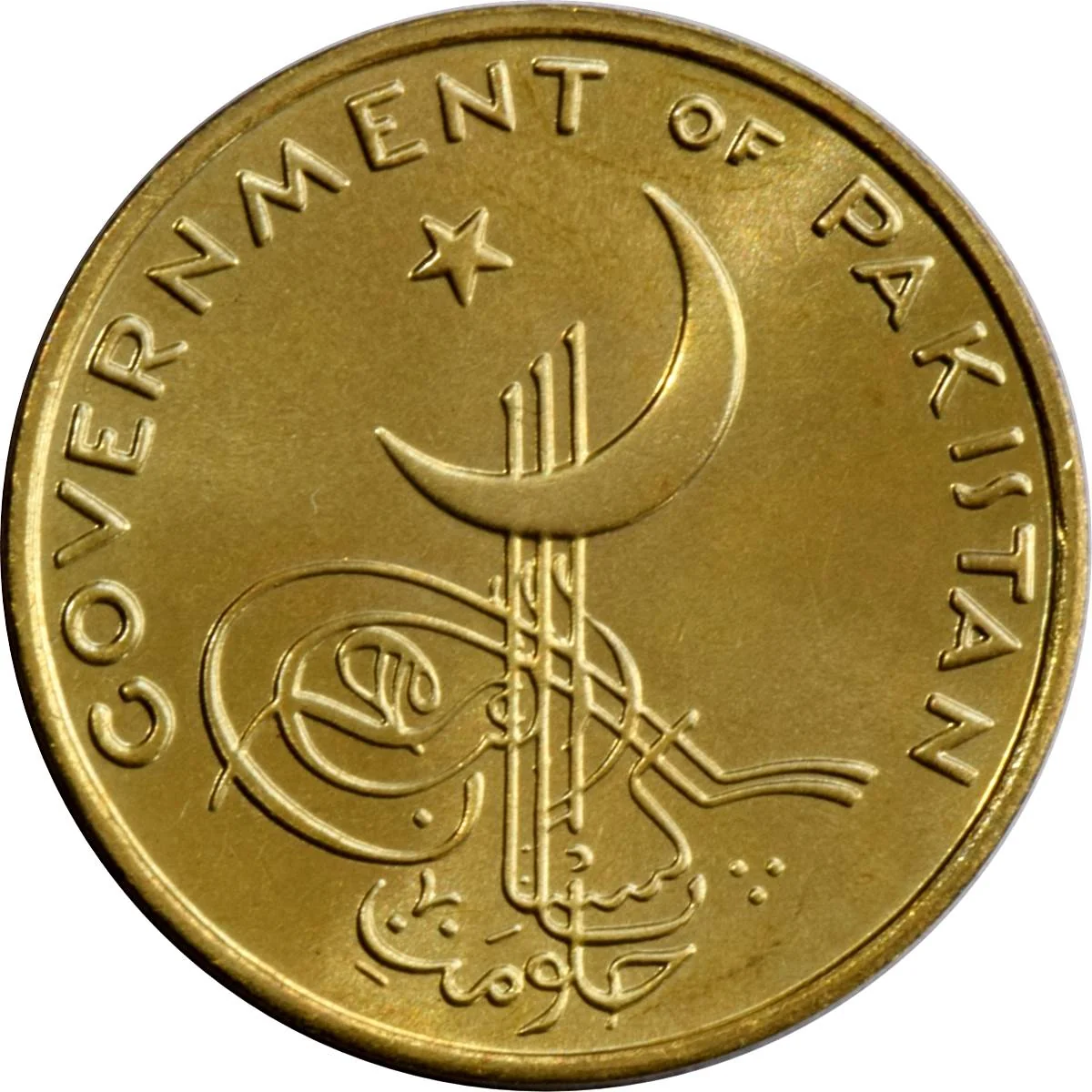
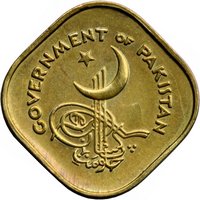
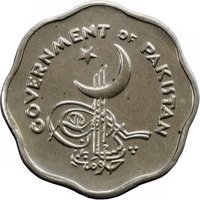
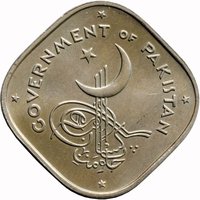
Obverse
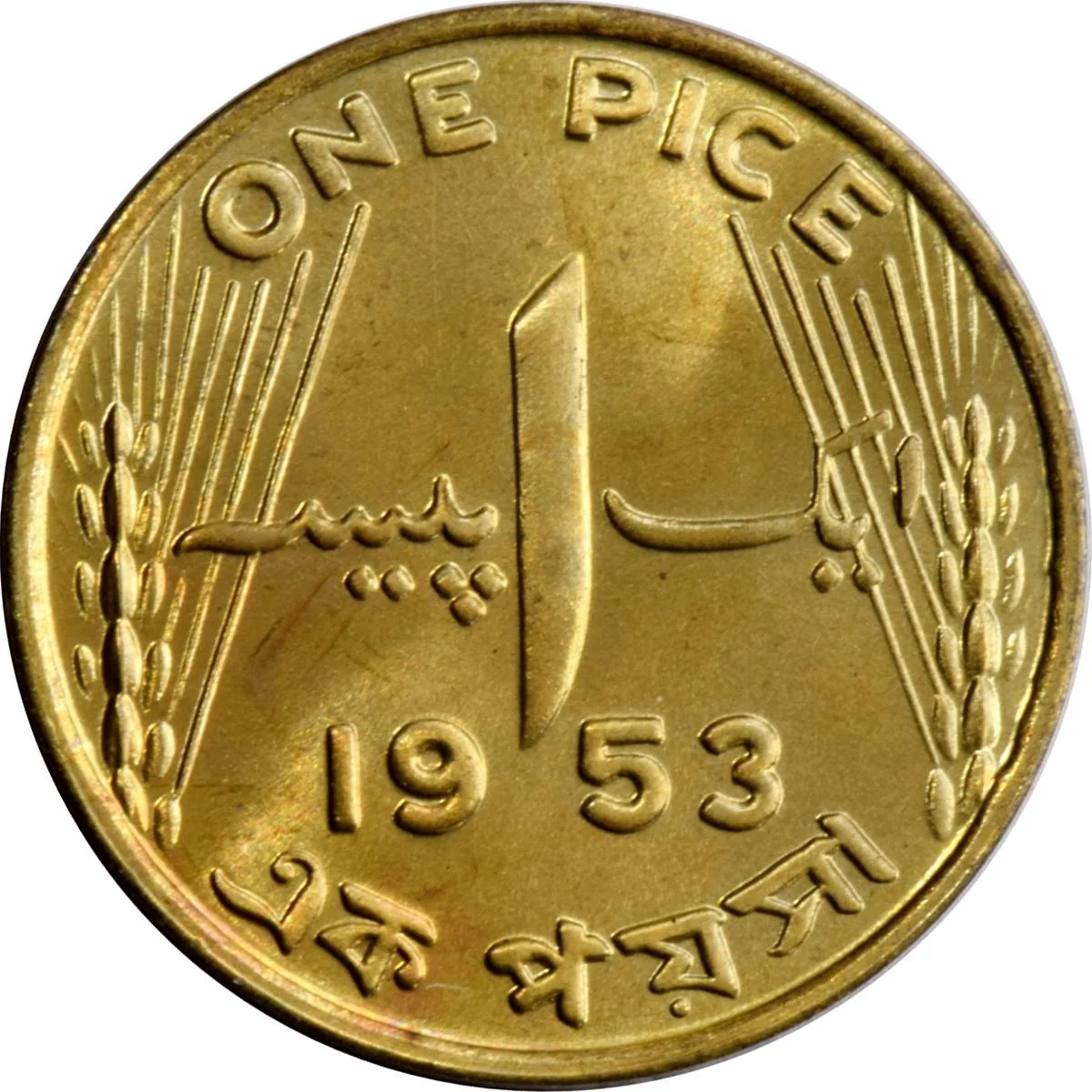
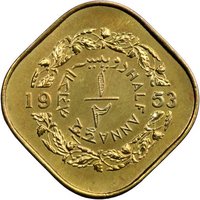
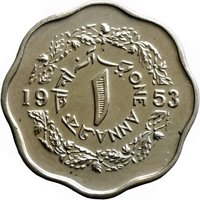
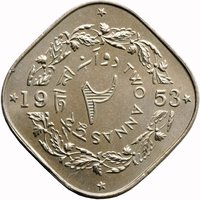
Reverse
Edge
Plain
Mints
| Name | Mark |
|---|---|
| Lahore | — |
Mintings
| Year | Mint Mark | Mintage | Quality | Collection |
|---|---|---|---|---|
| 1953 | — | — | ||
| 1953 | — | — | Proof | |
| 1955 | — | 31,280,000 | ||
| 1956 | — | 9,710,000 | ||
| 1957 | — | 57,790,000 | ||
| 1958 | — | 52,470,000 | ||
| 1959 | — | 41,620,000 |
Historical background
In 1953, Pakistan’s currency situation was fundamentally defined by its recent independence and the lingering structures of the colonial monetary system. The country continued to use the Indian rupee as its de facto currency for the first few years after partition in 1947, a necessity due to the absence of a separate central bank and minting facilities. This dependence created significant economic vulnerability, as monetary policy was effectively set by the Reserve Bank of India. The pressing need for a sovereign monetary system to manage the nation's economy, control money supply, and foster a separate identity was the dominant theme leading up to this period.
The landmark change occurred in 1948 with the establishment of the State Bank of Pakistan, which began operations on July 1st. However, the actual introduction of distinct Pakistani banknotes was a gradual process. The first notes, issued in 1948, were simply Indian rupees overprinted with "Government of Pakistan" in English and Urdu. It was not until 1953 that the first fully designed Pakistani rupee notes, featuring the crescent and star and Urdu text, were issued and began circulating widely. This year, therefore, represents a critical point of transition when the ad-hoc overprinted notes were being phased out in favor of a permanent, national currency.
Despite this progress, the economy in 1953 faced severe strains that impacted the currency's stability. The country was grappling with a major balance of payments crisis, inflationary pressures, and a shortage of foreign exchange reserves, exacerbated by a poor cotton crop—a key export. These challenges tested the new State Bank's ability to manage monetary policy. Consequently, while 1953 marked the consolidation of a sovereign currency in form, it also highlighted the profound economic difficulties the new monetary authority had to navigate in a fragile post-partition economy.
The landmark change occurred in 1948 with the establishment of the State Bank of Pakistan, which began operations on July 1st. However, the actual introduction of distinct Pakistani banknotes was a gradual process. The first notes, issued in 1948, were simply Indian rupees overprinted with "Government of Pakistan" in English and Urdu. It was not until 1953 that the first fully designed Pakistani rupee notes, featuring the crescent and star and Urdu text, were issued and began circulating widely. This year, therefore, represents a critical point of transition when the ad-hoc overprinted notes were being phased out in favor of a permanent, national currency.
Despite this progress, the economy in 1953 faced severe strains that impacted the currency's stability. The country was grappling with a major balance of payments crisis, inflationary pressures, and a shortage of foreign exchange reserves, exacerbated by a poor cotton crop—a key export. These challenges tested the new State Bank's ability to manage monetary policy. Consequently, while 1953 marked the consolidation of a sovereign currency in form, it also highlighted the profound economic difficulties the new monetary authority had to navigate in a fragile post-partition economy.
Series: 1953 Pakistan circulation coins
🌱 Very Common