

1 Pie – Pakistan
Pakistan
Context
Years: 1951–1957
Issuer: Pakistan 
Period:
(1947—1956)
Ruler: Elizabeth II
Currency:
(1948—1960)
Demonetized: Yes
Total mintage: 3,903,000
Material
References
KM: #Click to copy to clipboard11
Numista: #4860
Value
Exchange value: 1⁄192 PKR
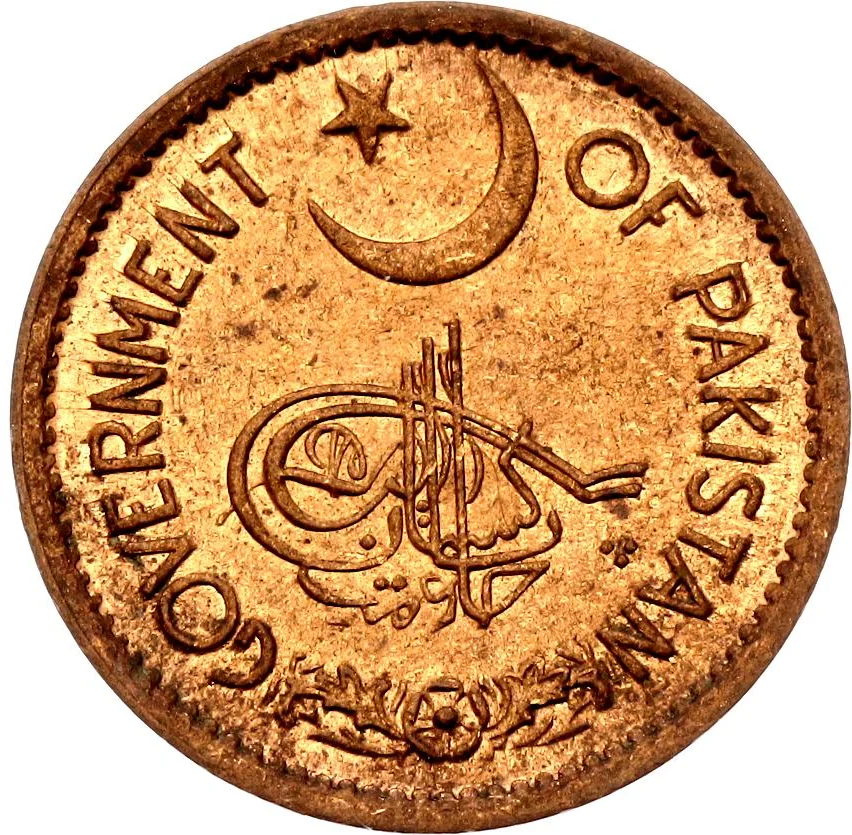
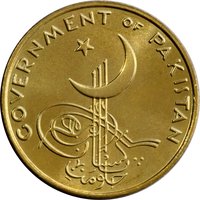
Obverse
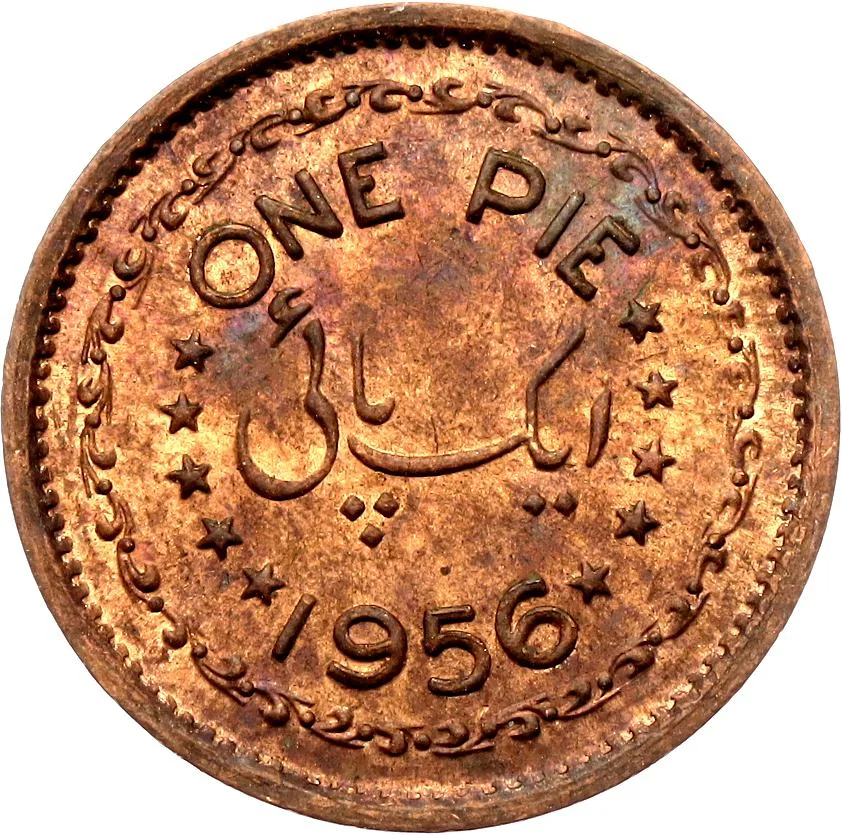
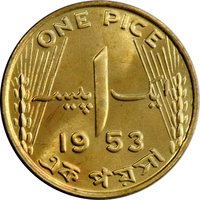
Reverse
Edge
Plain.
Mints
| Name | Mark |
|---|---|
| Lahore | — |
Mintings
| Year | Mint Mark | Mintage | Quality | Collection |
|---|---|---|---|---|
| 1951 | — | — | ||
| 1951 | — | — | Proof | |
| 1952 | — | — | ||
| 1953 | — | 110,000 | ||
| 1953 | — | — | Proof | |
| 1955 | — | 211,000 | ||
| 1955 | — | — | Proof | |
| 1956 | — | 3,390,000 | ||
| 1957 | — | 192,000 |
Historical background
In 1951, Pakistan's currency situation was fundamentally shaped by its recent independence in 1947 and the subsequent partition of British India. The country inherited the Indian Rupee as its currency, with notes stamped "Government of Pakistan" as a temporary measure. The urgent task of establishing a sovereign monetary system led to the passage of the Pakistan (Monetary System and Reserve Bank) Order in April 1948, which introduced the Pakistani Rupee (PKR) at par with the Indian Rupee. The State Bank of Pakistan commenced operations in July 1948, taking over the functions of a central bank and beginning the issuance of its own banknotes, a process still ongoing in 1951 as the stamped notes were gradually replaced.
Economically, the year 1951 represented a peak for Pakistan's early financial stability, largely due to the Korean War (1950-1953). The conflict caused a global commodity boom, and Pakistan, as a major jute and cotton exporter, benefited from sharply rising prices. This resulted in a substantial accumulation of foreign exchange reserves, strengthening the rupee's external value and providing the government with crucial revenue. This windfall created a temporary sense of economic security and facilitated imports of essential capital goods for early industrialization.
However, this prosperity was superficial and short-lived. The currency system and economy remained fragile, overly dependent on volatile agricultural exports. The high reserves of 1951 masked underlying structural weaknesses, including a narrow industrial base and a large subsistence agricultural sector. When the Korean War boom subsided in 1952, export earnings plummeted, leading to a severe balance of payments crisis. This rapid reversal exposed the vulnerability of the Pakistani rupee and forced the government to impose stringent import controls, marking the end of the brief post-independence financial buoyancy and the beginning of a recurring cycle of external deficits and economic challenges.
Economically, the year 1951 represented a peak for Pakistan's early financial stability, largely due to the Korean War (1950-1953). The conflict caused a global commodity boom, and Pakistan, as a major jute and cotton exporter, benefited from sharply rising prices. This resulted in a substantial accumulation of foreign exchange reserves, strengthening the rupee's external value and providing the government with crucial revenue. This windfall created a temporary sense of economic security and facilitated imports of essential capital goods for early industrialization.
However, this prosperity was superficial and short-lived. The currency system and economy remained fragile, overly dependent on volatile agricultural exports. The high reserves of 1951 masked underlying structural weaknesses, including a narrow industrial base and a large subsistence agricultural sector. When the Korean War boom subsided in 1952, export earnings plummeted, leading to a severe balance of payments crisis. This rapid reversal exposed the vulnerability of the Pakistani rupee and forced the government to impose stringent import controls, marking the end of the brief post-independence financial buoyancy and the beginning of a recurring cycle of external deficits and economic challenges.
🌱 Very Common