

10 Gulden – Netherlands
Netherlands
Context
Years: 1876–1889
Issuer: Netherlands 
Ruler: William III
Currency:
(1817—2001)
Demonetized: Yes
Total mintage: 3,719,657
Material
References
KM: #Click to copy to clipboard106
Numista: #8323
Value
Exchange value: 10 NLG
Bullion value: $1008.37
Obverse
Description:
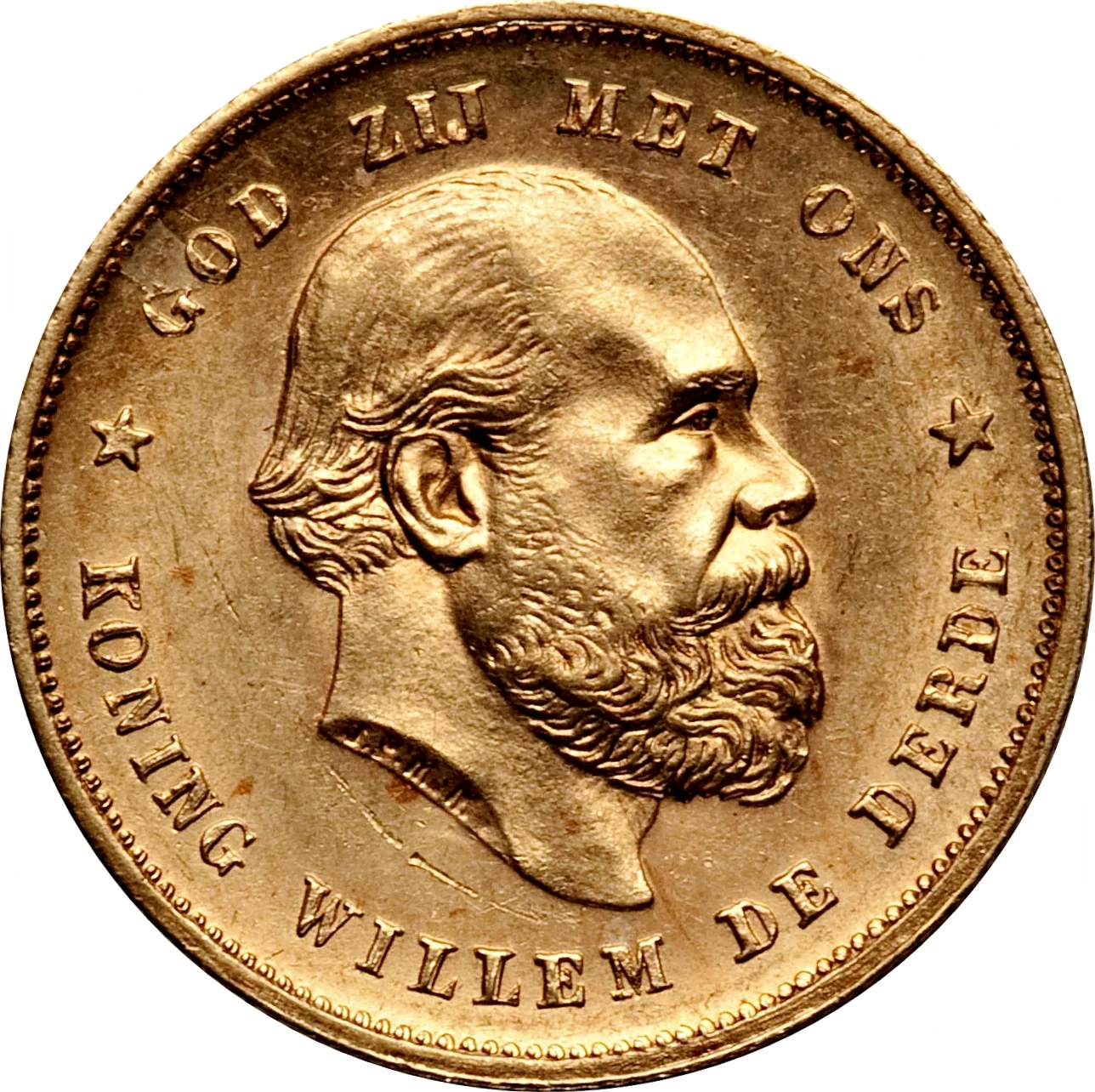
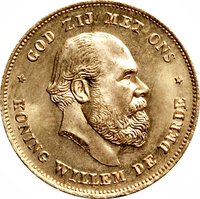
King Willem III, right-facing portrait.
Inscription:
★ GOD ZIJ MET ONS ★
KONING WILLEM DE DERDE
I.P.M.M.
KONING WILLEM DE DERDE
I.P.M.M.
Translation:
★ GOD BE WITH US ★
KING WILLEM THE THIRD
I.P.M.M.
KING WILLEM THE THIRD
I.P.M.M.
Script: Latin
Engraver: Johan Philip Mathias Menger
Reverse
Description:
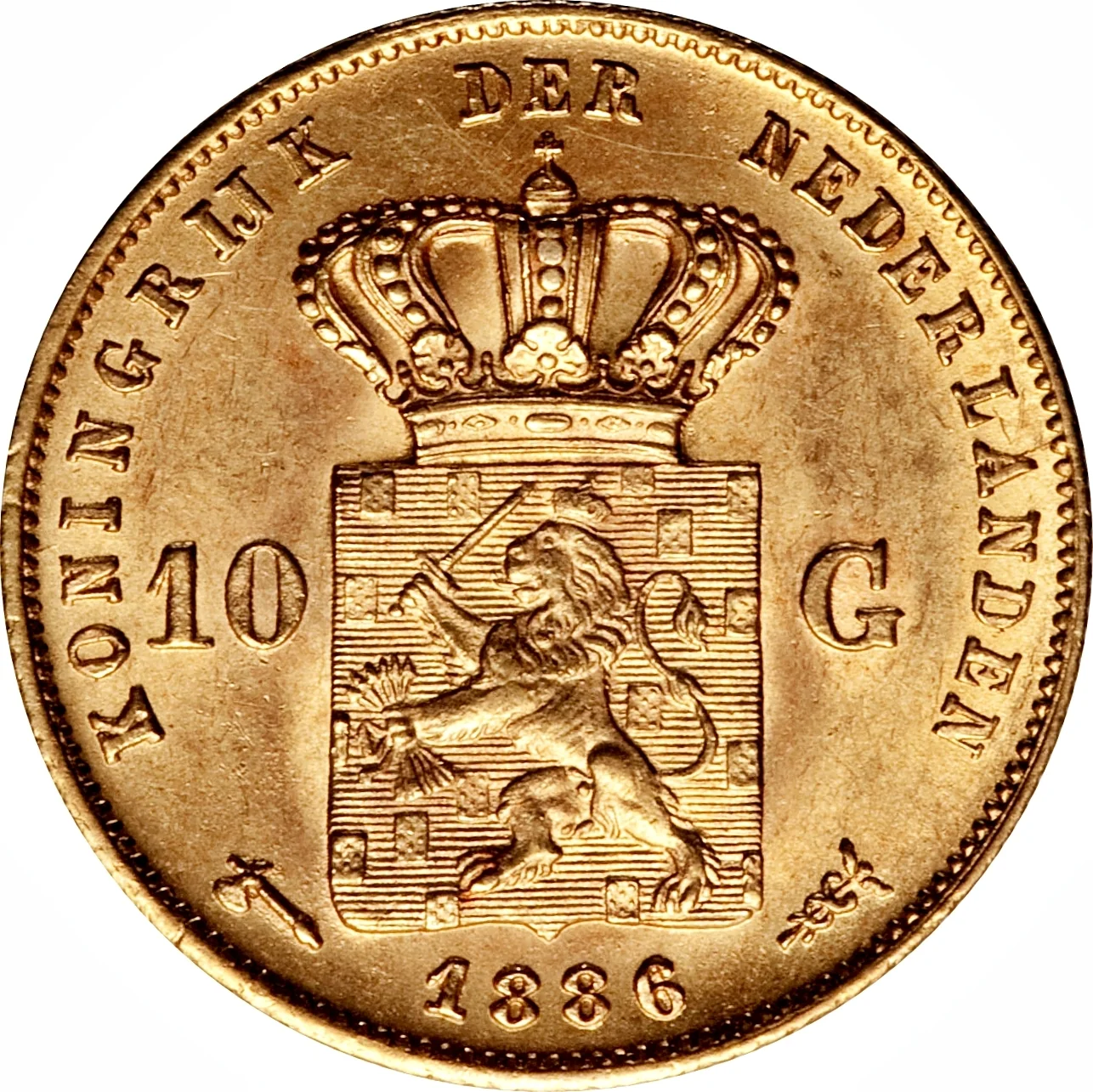
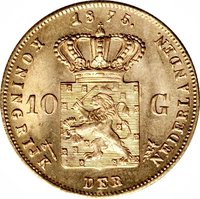
Dutch royal crest divides value.
Inscription:
KONINGRIJK DER NEDERLANDEN
10 G
1886
10 G
1886
Translation:
Kingdom of the Netherlands
10 Guilders
1886
10 Guilders
1886
Script: Latin
Language: Dutch
Engraver: Johan Philip van der Kellen
Edge
Reeded
Categories
| Symbol> Crown |
| Symbols> Coat of Arms |
Mints
| Name | Mark |
|---|---|
| Royal Dutch Mint | — |
Mintings
| Year | Mint Mark | Mintage | Quality | Collection |
|---|---|---|---|---|
| 1876 | — | 1,581,106 | ||
| 1877 | — | 1,108,149 | ||
| 1879 | — | 581,036 | ||
| 1880 | — | 50,100 | ||
| 1885 | — | 67,095 | ||
| 1886 | — | 51,141 | ||
| 1887 | — | 40,754 | ||
| 1888 | — | 35,585 | ||
| 1889 | — | 204,691 |
Historical background
In 1876, the Netherlands operated under a bimetallic monetary system, legally defined by the Mint Act of 1847. This system established both gold and silver as legal tender, with a fixed exchange rate between them set at 1:15.5. In practice, however, the international market value of silver had begun a significant and sustained decline due to increased global production, particularly from new mines in the Americas. This created a problematic divergence: silver coins, whose metallic value was falling below their face value, remained in circulation within the Netherlands, while gold coins, whose intrinsic value was higher, were increasingly hoarded or exported—a classic example of Gresham's Law ("bad money drives out good money").
The situation placed the Dutch financial system under strain. The risk of a silver-based currency, detached from the more stable gold standard adopted by major trading partners like the United Kingdom and Germany, threatened the Netherlands' international trade and financial stability. Domestically, the public and banks grew wary of the declining silver, leading to practical difficulties and a loss of confidence in the uniformity of the currency. Consequently, the government and the central bank (De Nederlandsche Bank) were effectively managing a silver currency while aspiring to align with the gold standard, creating a period of monetary ambiguity.
This context set the stage for a decisive reform. The pressures of 1876 culminated in the passing of the Coin Act of 1877, which demonetized silver and put the Netherlands firmly on the gold standard. Therefore, 1876 represents the final year of the struggling bimetallic system, a transitional moment where the economic and political consensus solidified around the necessity of adopting gold monometallism to ensure stability and align with the nation's key commercial partners.
The situation placed the Dutch financial system under strain. The risk of a silver-based currency, detached from the more stable gold standard adopted by major trading partners like the United Kingdom and Germany, threatened the Netherlands' international trade and financial stability. Domestically, the public and banks grew wary of the declining silver, leading to practical difficulties and a loss of confidence in the uniformity of the currency. Consequently, the government and the central bank (De Nederlandsche Bank) were effectively managing a silver currency while aspiring to align with the gold standard, creating a period of monetary ambiguity.
This context set the stage for a decisive reform. The pressures of 1876 culminated in the passing of the Coin Act of 1877, which demonetized silver and put the Netherlands firmly on the gold standard. Therefore, 1876 represents the final year of the struggling bimetallic system, a transitional moment where the economic and political consensus solidified around the necessity of adopting gold monometallism to ensure stability and align with the nation's key commercial partners.
🌱 Fairly Common