

10 Gulden – Netherlands
Netherlands
Context
Year: 1875
Issuer: Netherlands 
Ruler: William III
Currency:
(1817—2001)
Demonetized: Yes
Total mintage: 4,110,000
Material
References
KM: #Click to copy to clipboard105
Numista: #26721
Value
Exchange value: 10 NLG
Bullion value: $1009.89
Obverse
Description:
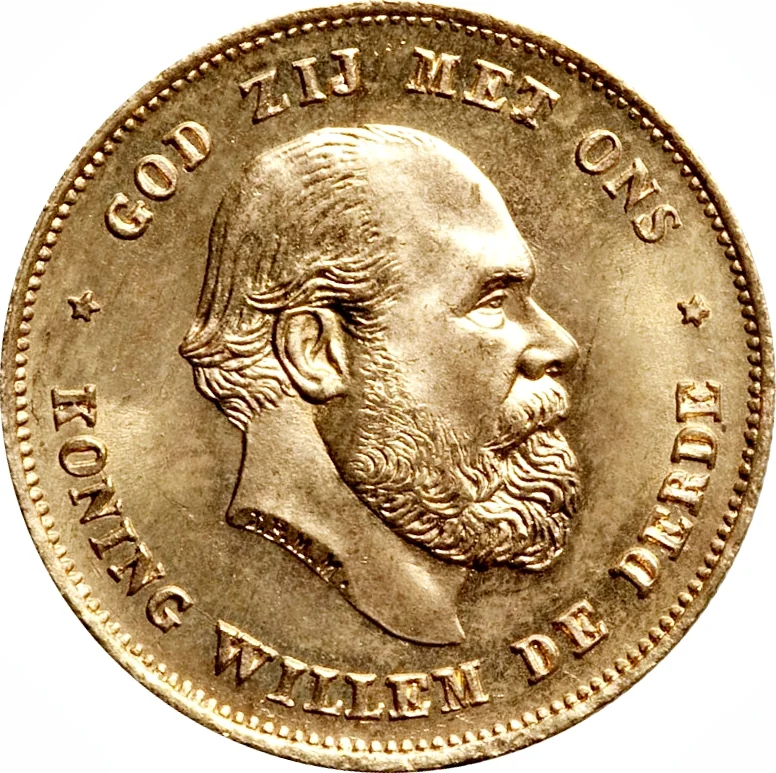
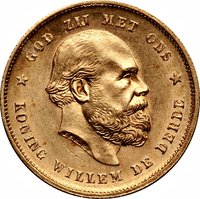
Portrait of King Willem III facing right, engraver's name cropped.
Inscription:
⋆ GOD ZIJ MET ONS ⋆
KONING WILLEM DE DERDE
I.P.M.M.
KONING WILLEM DE DERDE
I.P.M.M.
Translation:
⋆ GOD BE WITH US ⋆
KING WILLEM THE THIRD
I.P.M.M.
KING WILLEM THE THIRD
I.P.M.M.
Script: Latin
Language: Dutch
Engraver: Johan Philip Matthias Menger
Reverse
Edge
Milled
Categories
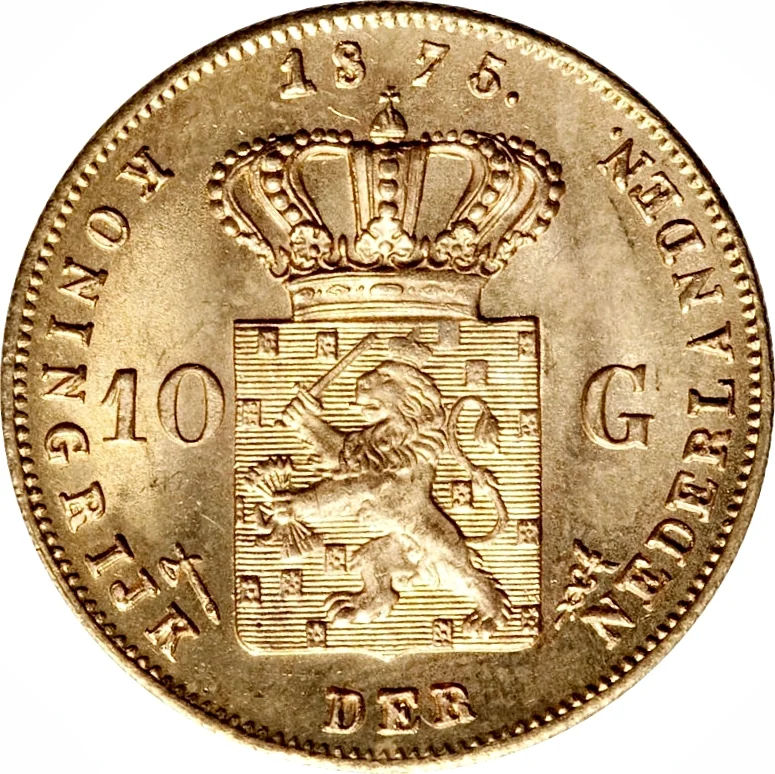
| Symbol> Crown |
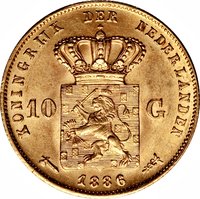
| Symbols> Coat of Arms |
Mints
| Name | Mark |
|---|---|
| Royal Dutch Mint | — |
Mintings
| Year | Mint Mark | Mintage | Quality | Collection |
|---|---|---|---|---|
| 1875 | — | 4,110,000 |
Historical background
By 1875, the Netherlands found itself in a complex and transitional monetary period, caught between the legacy of its silver-based system and the rising dominance of the international gold standard. For centuries, the Dutch guilder had been a stable and trusted silver currency, but the mid-19th century discovery of vast silver deposits led to its depreciation against gold. This instability was problematic for a major trading nation like the Netherlands, whose financial hub, Amsterdam, required fixed exchange rates with its key trading partners, most of whom were moving to gold.
Consequently, the Dutch government had taken decisive steps toward reform. In 1873, it passed the Coin Act, which formally suspended the free minting of silver guilders and prepared for a full transition to gold. By 1875, the country was operating under a de facto gold standard, though the legal framework was still being finalized. The central bank, De Nederlandsche Bank, held significant gold reserves and managed the currency with the primary goal of maintaining parity with the gold-based British pound and German mark, ensuring stability for international commerce.
Thus, the currency situation in 1875 was one of successful pragmatism. The Netherlands had effectively abandoned the silver standard without yet having fully enacted the new gold law (which would come in 1877). The guilder was stable, backed by conservative central bank policy and a deliberate alignment with the monetary systems of its powerful neighbours. This period represents the quiet culmination of a strategic shift, securing the Netherlands' position within the emerging global financial order centred on gold.
Consequently, the Dutch government had taken decisive steps toward reform. In 1873, it passed the Coin Act, which formally suspended the free minting of silver guilders and prepared for a full transition to gold. By 1875, the country was operating under a de facto gold standard, though the legal framework was still being finalized. The central bank, De Nederlandsche Bank, held significant gold reserves and managed the currency with the primary goal of maintaining parity with the gold-based British pound and German mark, ensuring stability for international commerce.
Thus, the currency situation in 1875 was one of successful pragmatism. The Netherlands had effectively abandoned the silver standard without yet having fully enacted the new gold law (which would come in 1877). The guilder was stable, backed by conservative central bank policy and a deliberate alignment with the monetary systems of its powerful neighbours. This period represents the quiet culmination of a strategic shift, securing the Netherlands' position within the emerging global financial order centred on gold.
🌟 Uncommon