

1 Frederik d'Or – Denmark
Denmark
Context
Years: 1829–1838
Issuer: Denmark 
Ruler: Frederick VI
Currency:
(1813—1854)
Subdivision: 1 Frederik d'Or = 5 Speciedaler
Demonetized: Yes
Total mintage: 19,625
Material
References
KM: #Click to copy to clipboard701
Numista: #83069
Value
Bullion value: $991.95
Obverse
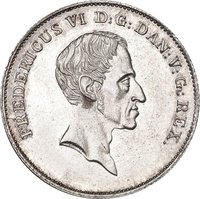
Description:
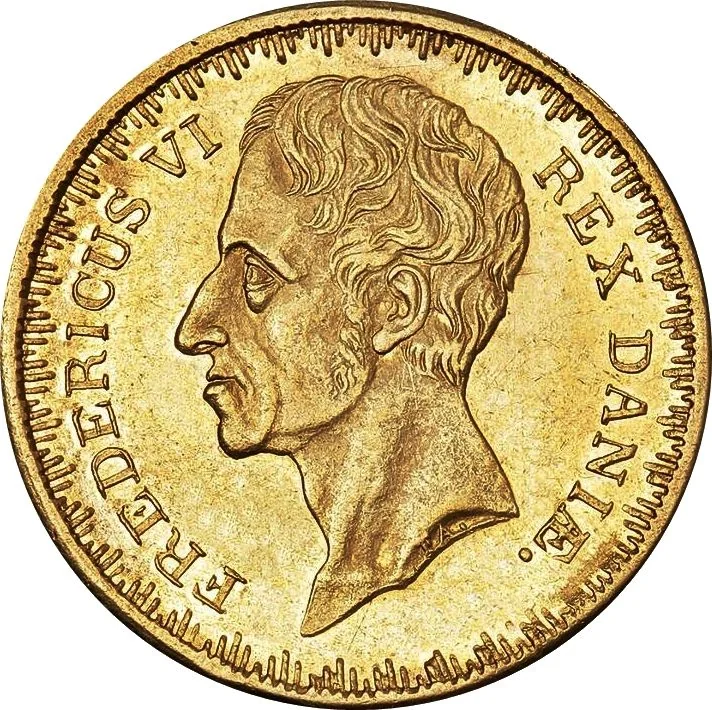
King Frederik VI left-facing portrait. Engraver initials on neck.
Inscription:
FREDERICUS VI | REX DANIÆ.
F.A.
F.A.
Translation:
Frederick VI, King of Denmark.
F.A.
F.A.
Script: Latin
Language: Latin
Engraver: Hans Frederik Alsing
Reverse
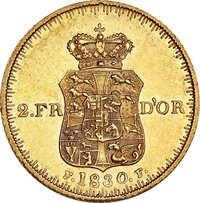
Description:
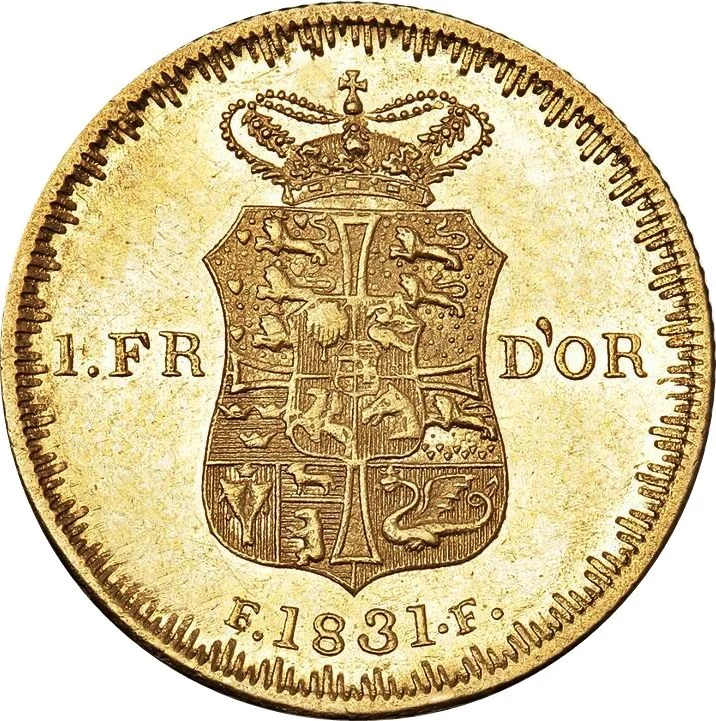
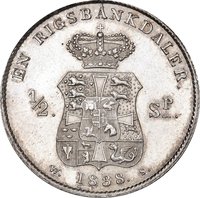
Crowned grater shield with Danish arms divides value. Date below, mintmaster initials flanking.
Inscription:
1.FR | D'OR
F. 1831. F.
F. 1831. F.
Script: Latin
Edge
Mints
| Name | Mark |
|---|---|
| Altona, Schleswig-Holstein | — |
Mintings
| Year | Mint Mark | Mintage | Quality | Collection |
|---|---|---|---|---|
| 1829 | — | 7,625 | ||
| 1830 | — | 12,000 | ||
| 1831 | — | — | ||
| 1833 | — | — | ||
| 1834 | — | — | ||
| 1835 | — | — | ||
| 1837 | — | — | ||
| 1838 | — | — |
Historical background
In 1829, Denmark operated under a complex and somewhat fragile monetary system, a legacy of the state bankruptcy declared in 1813. The Napoleonic Wars had left the kingdom financially devastated, leading to the creation of a new currency, the rigsbankdaler, to replace the discredited rigsdaler. However, this reform did not establish a single, stable currency. Instead, the country functioned with a dual system: the rigsbankdaler for official state accounting and large transactions, and the more commonly used kurantdaler, which circulated in daily commerce. The value between these two units was officially fixed, but in practice, public distrust and economic strain often caused the kurantdaler to trade at a discount on the open market.
This period was characterized by a chronic shortage of reliable specie (coinage), particularly small change for everyday transactions. The state's limited minting capacity and the public's tendency to hoard silver coins exacerbated the problem. Consequently, a proliferation of private and local tokens, along with worn and clipped coins, filled the gap in the monetary supply. This created significant practical difficulties for trade and wages, as the actual value of a coin in hand was often uncertain, leading to friction and inefficiency in the economy.
The situation in 1829 was one of transition and mounting pressure for further reform. While the 1813 restructuring had provided a necessary reset, the dual-currency system and the chaotic circulation of physical money were widely recognized as impediments to economic recovery and growth. Discussions among government officials and economists were already underway, setting the stage for the comprehensive monetary reform that would eventually come in the 1840s with the introduction of the rigsdaler as a unified, silver-based currency, finally bringing stability to the Danish monetary landscape.
This period was characterized by a chronic shortage of reliable specie (coinage), particularly small change for everyday transactions. The state's limited minting capacity and the public's tendency to hoard silver coins exacerbated the problem. Consequently, a proliferation of private and local tokens, along with worn and clipped coins, filled the gap in the monetary supply. This created significant practical difficulties for trade and wages, as the actual value of a coin in hand was often uncertain, leading to friction and inefficiency in the economy.
The situation in 1829 was one of transition and mounting pressure for further reform. While the 1813 restructuring had provided a necessary reset, the dual-currency system and the chaotic circulation of physical money were widely recognized as impediments to economic recovery and growth. Discussions among government officials and economists were already underway, setting the stage for the comprehensive monetary reform that would eventually come in the 1840s with the introduction of the rigsdaler as a unified, silver-based currency, finally bringing stability to the Danish monetary landscape.
✨ Legendary