

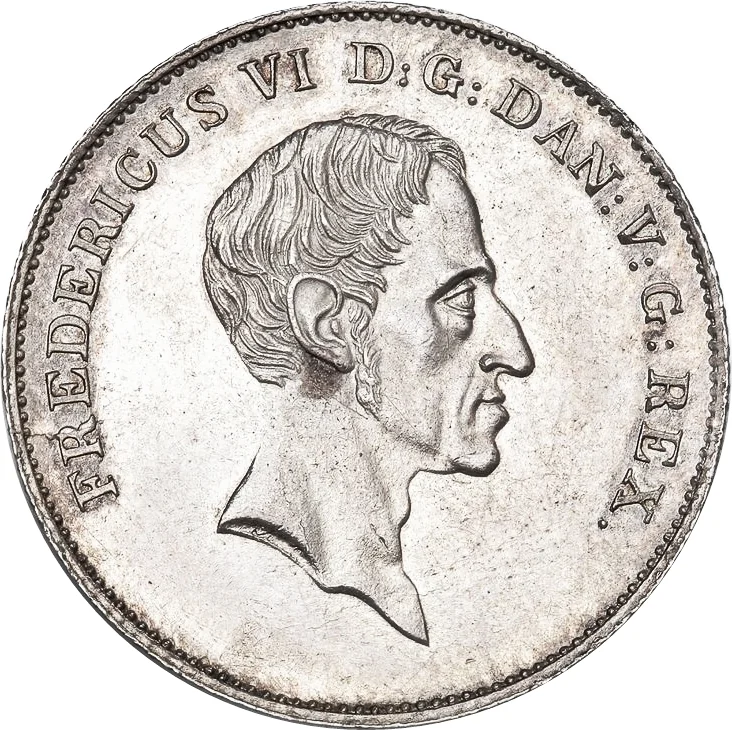
6 rigsdaler courant – Denmark
Add to wishlist
Denmark
Context
Years: 1833–1839
Issuer: Denmark
Ruler: Frederick VI
Currency:
(1813—1854)
Subdivision: 6 rigsdaler courant = 1 Rigsbankdaler
Demonetized: Yes
Material
References
KM: #
Numista: #83070
Value
Bullion value: $32.06
Obverse
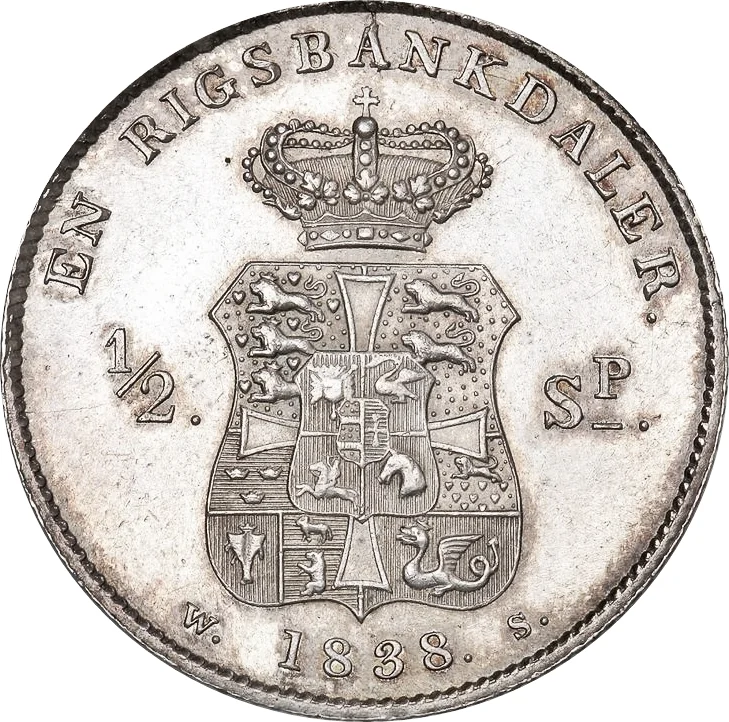
Reverse
Description:
Crowned grater shield with Denmark's arms. Value in letters above, fraction at sides. Date below, mintmaster initials at sides.
Inscription:
EN RIGSBANKDALER.
½. SP.
W. 1838. S.
½. SP.
W. 1838. S.
Script: Latin
Edge
Mints
| Name | Mark |
|---|---|
| Altona, Schleswig-Holstein | — |
| Royal Danish Mint | — |
Mintings
| Year | Mint Mark | Mintage | Quality | Collection |
|---|---|---|---|---|
| 1833 | — | — | ||
| 1834 | — | — | ||
| 1834 | KM | — | ||
| 1835 | — | — | ||
| 1836 | — | — | ||
| 1838 | — | — | ||
| 1839 | — | — |
Historical background
In 1833, Denmark operated under a complex and strained monetary system, a legacy of the state bankruptcy declared in 1813. The previous rigsdaler specie, backed by silver, had been abolished, and the new currency, the rigsbankdaler, was introduced as a fiat currency with no intrinsic metallic value. This transition was a direct result of the immense national debt accrued during the Napoleonic Wars, which had crippled the Danish economy. By the 1830s, public confidence in the paper currency remained low, and it circulated alongside a confusing array of older coins and foreign silver, creating a fragmented and inefficient economy.
The core issue was the lack of a stable, uniform silver standard. While the government aimed to establish the rigsbankdaler as the sole unit of account, in practice, large transactions and international trade were often conducted using silver kurant rigsdaler or foreign coinage. This duality led to constant exchange rate fluctuations between the paper money and silver, hindering commerce and long-term investment. The situation was particularly burdensome for the rural population and for merchants, who faced uncertainty and exchange losses.
Consequently, the early 1830s were a period of intense debate and gradual transition toward monetary reform. There was a broad consensus among economists and government officials that a return to a secure silver standard was essential for economic recovery and growth. The year 1833 itself fell within this preparatory phase, setting the stage for the pivotal currency reform that would come in 1838, which finally re-established a stable, unified silver standard for the Danish rigsdaler, laying the foundation for modern Denmark's financial system.
The core issue was the lack of a stable, uniform silver standard. While the government aimed to establish the rigsbankdaler as the sole unit of account, in practice, large transactions and international trade were often conducted using silver kurant rigsdaler or foreign coinage. This duality led to constant exchange rate fluctuations between the paper money and silver, hindering commerce and long-term investment. The situation was particularly burdensome for the rural population and for merchants, who faced uncertainty and exchange losses.
Consequently, the early 1830s were a period of intense debate and gradual transition toward monetary reform. There was a broad consensus among economists and government officials that a return to a secure silver standard was essential for economic recovery and growth. The year 1833 itself fell within this preparatory phase, setting the stage for the pivotal currency reform that would come in 1838, which finally re-established a stable, unified silver standard for the Danish rigsdaler, laying the foundation for modern Denmark's financial system.
💎 Extremely Rare