

5 Francs CFA – Western African States
Context
Years: 1965–2024
Issuer: Western African States
Issuing organization: Central Bank of Western African States
Currency:
(since 1958)
Total mintage: 583,026,000
Material
References
KM: #Click to copy to clipboard2a
Numista: #828
Value
Exchange value: 5 XOF
Obverse
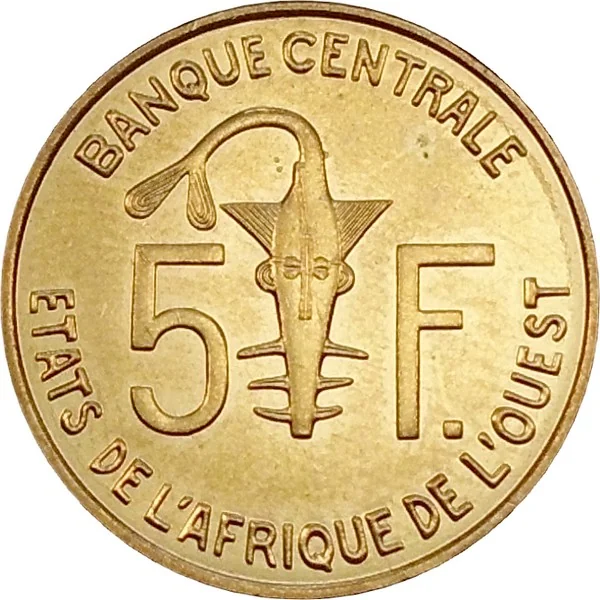
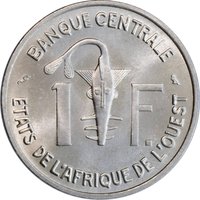
Description:
BCEAO emblem and value
Inscription:
BANQUE CENTRALE
5 F.
ETATS DE L'AFRIQUE DE L'OUEST
5 F.
ETATS DE L'AFRIQUE DE L'OUEST
Translation:
CENTRAL BANK
5 F.
WEST AFRICAN STATES
5 F.
WEST AFRICAN STATES
Script: Latin
Language: French
Engravers: Gabriel Bernard, Lucien Bazor
Reverse
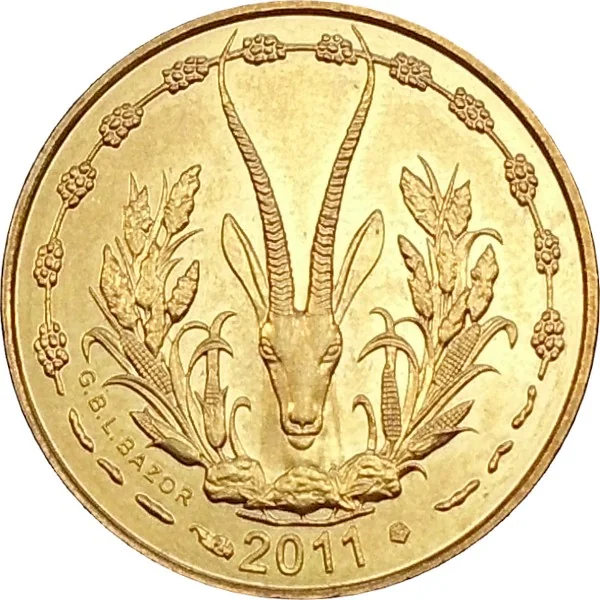
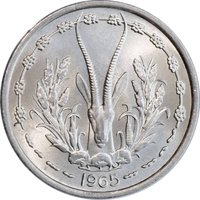
Description:
Swift antelope
Inscription:
G.B.L.BAZOR
2011
2011
Script: Latin
Engravers: Gabriel Bernard, Lucien Bazor
Edge
Plain
Mints
| Name | Mark |
|---|---|
| Monnaie de Paris | — |
Mintings
| Year | Mint Mark | Mintage | Quality | Collection |
|---|---|---|---|---|
| 1965 | — | 12,510,000 | ||
| 1967 | — | 6,510,000 | ||
| 1968 | — | 6,000,000 | ||
| 1969 | — | 8,000,000 | ||
| 1970 | — | 10,005,000 | ||
| 1971 | — | 10,005,000 | ||
| 1972 | — | 5,010,000 | ||
| 1973 | — | 6,000,000 | ||
| 1974 | — | 13,326,000 | ||
| 1975 | — | 16,890,000 | ||
| 1976 | — | 20,010,000 | ||
| 1977 | — | 22,000,000 | ||
| 1978 | — | 39,800,000 | ||
| 1979 | — | 11,000,000 | ||
| 1980 | — | 18,000,000 | ||
| 1981 | — | 18,000,000 | ||
| 1982 | — | 25,000,000 | ||
| 1984 | — | 31,620,000 | ||
| 1985 | — | 16,000,000 | ||
| 1986 | — | 8,000,000 | ||
| 1987 | — | 26,500,000 | ||
| 1989 | — | 44,500,000 | ||
| 1990 | — | 20,000,000 | ||
| 1991 | — | 19,000,000 | ||
| 1992 | — | 9,000,000 | ||
| 1993 | — | 6,500,000 | ||
| 1994 | — | 8,500,000 | ||
| 1995 | — | 11,500,000 | ||
| 1996 | — | 21,500,000 | ||
| 1997 | — | 18,060,000 | ||
| 1999 | — | 54,930,000 | ||
| 2000 | — | 2,550,000 | ||
| 2001 | — | 8,000,000 | ||
| 2002 | — | 20,000,000 | ||
| 2003 | — | 6,000,000 | ||
| 2004 | — | 2,800,000 | ||
| 2005 | — | — | ||
| 2006 | — | — | ||
| 2007 | — | — | ||
| 2008 | — | — | ||
| 2009 | — | — | ||
| 2010 | — | — | ||
| 2011 | — | — | ||
| 2012 | — | — | ||
| 2013 | — | — | ||
| 2014 | — | — | ||
| 2015 | — | — | ||
| 2016 | — | — | ||
| 2017 | — | — | ||
| 2018 | — | — | ||
| 2019 | — | — | ||
| 2020 | — | — | ||
| 2021 | — | — | ||
| 2022 | — | — | ||
| 2023 | — | — | ||
| 2024 | — | — |
Historical background
In 1965, the currency landscape of West Africa was predominantly shaped by the legacy of French colonial rule and the early challenges of post-independence nation-building. The region was divided between the CFA franc zone, used by most former French colonies, and the independent currencies of former British territories. The CFA franc, pegged to the French franc and guaranteed by France, provided monetary stability and facilitated trade with the former metropole for countries like Senegal, Ivory Coast, and Niger. However, it also symbolized continued economic dependence and limited sovereign control over monetary policy for these newly independent states.
Meanwhile, former British colonies such as Ghana and Nigeria had established their own central banks and national currencies—the Ghanaian pound (later cedi) and the Nigerian pound. These nations pursued more independent monetary policies, but faced significant economic headwinds. Ghana, under Kwame Nkrumah, was grappling with foreign debt and inflation, pressures that would eventually lead to a major devaluation. Nigeria, though oil-rich, was navigating the complexities of a federal structure and the political tensions that would soon erupt into civil war, impacting its currency's stability.
Thus, the mid-1960s represented a critical juncture where the fundamental monetary paths of the region were set. The CFA zone prioritized stability and external convertibility through its French link, while the non-franc states embraced greater autonomy at the cost of vulnerability to internal and external shocks. This divergence created two distinct monetary spheres in West Africa, a framework that would influence economic development and regional cooperation for decades to come.
Meanwhile, former British colonies such as Ghana and Nigeria had established their own central banks and national currencies—the Ghanaian pound (later cedi) and the Nigerian pound. These nations pursued more independent monetary policies, but faced significant economic headwinds. Ghana, under Kwame Nkrumah, was grappling with foreign debt and inflation, pressures that would eventually lead to a major devaluation. Nigeria, though oil-rich, was navigating the complexities of a federal structure and the political tensions that would soon erupt into civil war, impacting its currency's stability.
Thus, the mid-1960s represented a critical juncture where the fundamental monetary paths of the region were set. The CFA zone prioritized stability and external convertibility through its French link, while the non-franc states embraced greater autonomy at the cost of vulnerability to internal and external shocks. This divergence created two distinct monetary spheres in West Africa, a framework that would influence economic development and regional cooperation for decades to come.
🌱 Very Common