

10 francs cfa – Western African States
Add to wishlist
Context
Years: 1966–1981
Issuer: Western African States
Issuing organization: Central Bank of Western African States
Currency:
(since 1958)
Total mintage: 161,520,000
Material
References
KM: #
Numista: #3401
Value
Exchange value: 10 XOF
Obverse
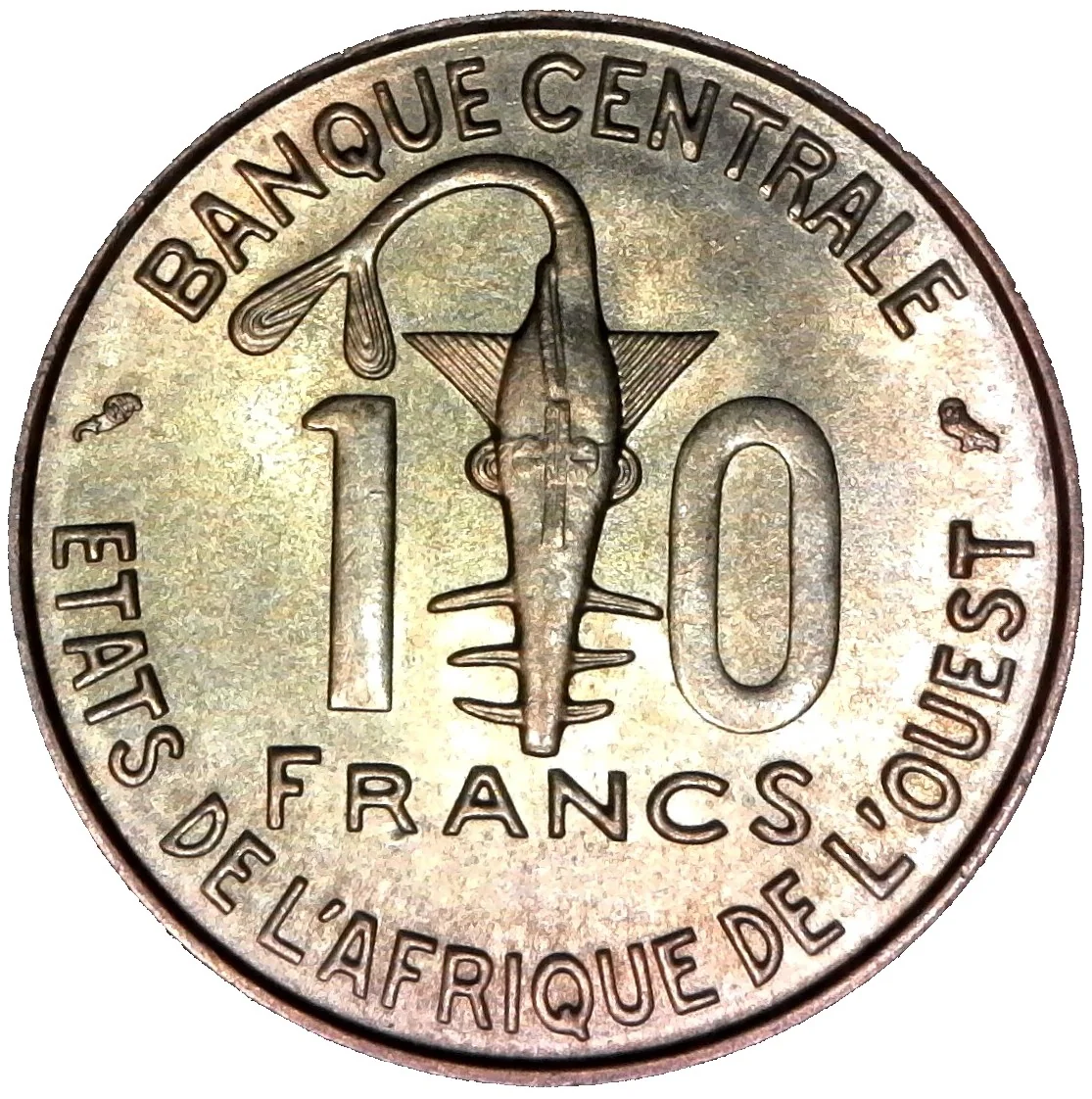
Description:
BCEAO emblem and value
Inscription:
BANQUE CENTRALE
10
FRANCS
ETATS DE L'AFRIQUE DE L'OUEST
10
FRANCS
ETATS DE L'AFRIQUE DE L'OUEST
Translation:
CENTRAL BANK
10
FRANCS
WEST AFRICAN STATES
10
FRANCS
WEST AFRICAN STATES
Script: Latin
Language: French
Engravers: Gabriel Bernard, Lucien Bazor
Reverse
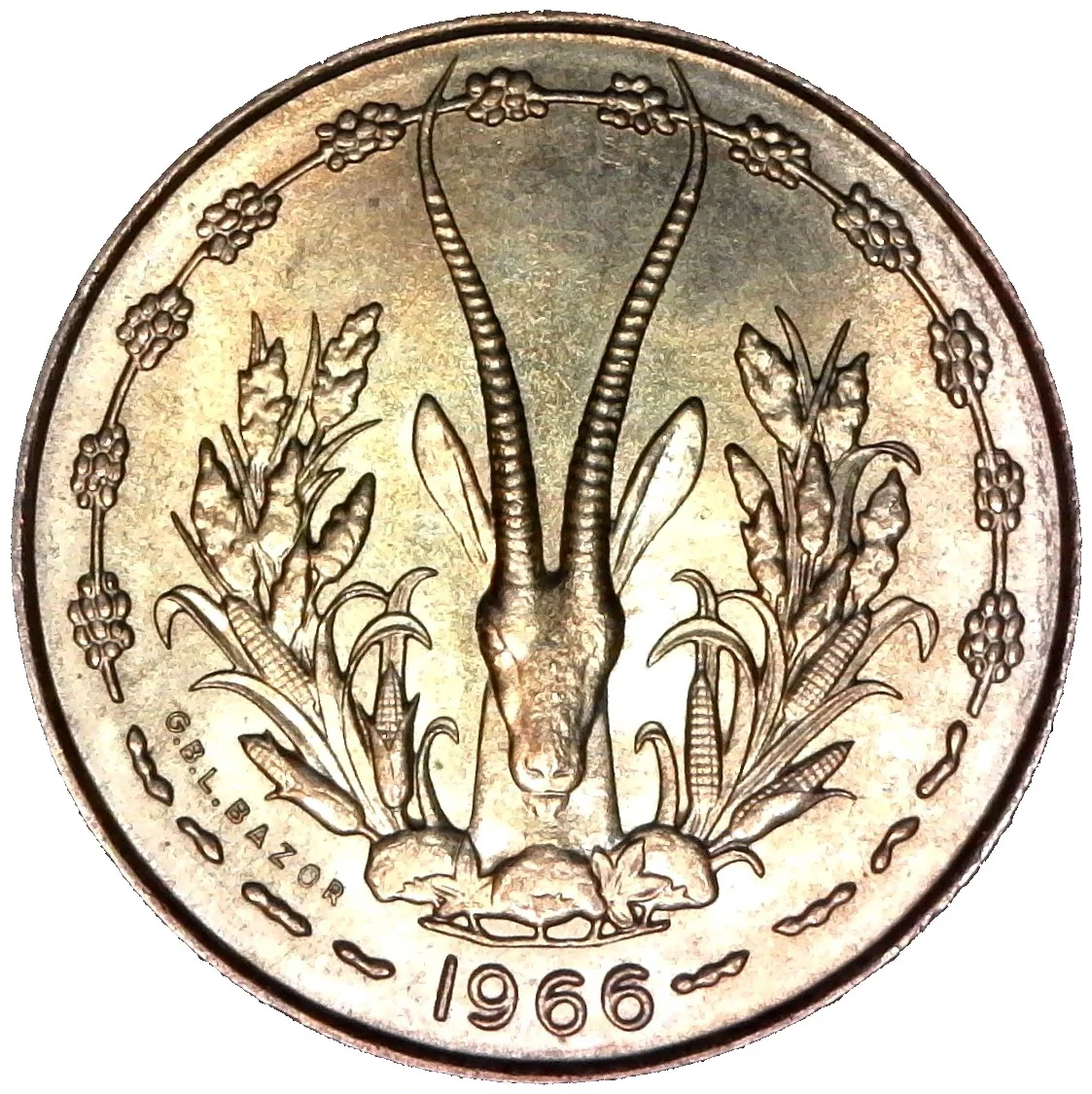
Description:
Graceful over the date.
Inscription:
G.B.L. BAZOR
1966
1966
Script: Latin
Engravers: Gabriel Bernard, Lucien Bazor
Edge
Plain
Mints
| Name | Mark |
|---|---|
| Monnaie de Paris | — |
Mintings
| Year | Mint Mark | Mintage | Quality | Collection |
|---|---|---|---|---|
| 1966 | — | 6,000,000 | ||
| 1967 | — | 3,500,000 | ||
| 1968 | — | 6,000,000 | ||
| 1969 | — | 7,000,000 | ||
| 1970 | — | 7,000,000 | ||
| 1971 | — | 8,000,000 | ||
| 1973 | — | 8,500,000 | ||
| 1974 | — | 10,000,000 | ||
| 1975 | — | 17,000,000 | ||
| 1976 | — | 18,000,000 | ||
| 1977 | — | 11,000,000 | ||
| 1978 | — | 20,620,000 | ||
| 1979 | — | 11,000,000 | ||
| 1980 | — | 15,900,000 | ||
| 1981 | — | 12,000,000 |
Historical background
In 1966, the currency landscape of West Africa was defined by the continued dominance of the CFA franc, a colonial-era currency managed by France. The region was divided into two monetary zones: the West African CFA franc (XOF), used by the seven members of the West African Monetary Union (UMOA) – Ivory Coast, Dahomey (now Benin), Upper Volta (now Burkina Faso), Niger, Senegal, Mauritania, and Togo – and the Central African CFA franc (XAF), used by states in the Equatorial region. Both currencies were pegged to the French franc at a fixed parity (1 French franc = 50 CFA francs) and were fully convertible, with their foreign reserves pooled in the French Treasury, guaranteeing their stability but also cementing French monetary influence.
This system provided notable macroeconomic stability for the newly independent states, insulating them from the currency volatility that plagued some of their neighbours. However, it was a source of growing political and economic debate. Critics, both within and outside the region, argued that the arrangement limited national sovereignty over monetary policy and tied the economies too closely to France, potentially hindering independent economic development. The fixed parity and free convertibility were seen by some as benefiting a Francophile elite and import-oriented businesses rather than fostering broad-based industrialisation.
Meanwhile, non-francophone West Africa presented a contrasting picture. Nigeria, the region's economic giant, had introduced its own Nigerian pound in 1959, managed by the Central Bank of Nigeria, asserting full monetary autonomy. Ghana, under Kwame Nkrumah, had also issued its own Ghanaian pound (later the cedi in 1965), though its economy was facing significant challenges. Liberia used the US dollar, and Sierra Leone the Sierra Leonean pound. Thus, 1966 captured a moment of monetary divergence: a core of francophone states operating within a guaranteed but externally managed framework, while the larger anglophone economies pursued independent, and in some cases struggling, national currency paths.
This system provided notable macroeconomic stability for the newly independent states, insulating them from the currency volatility that plagued some of their neighbours. However, it was a source of growing political and economic debate. Critics, both within and outside the region, argued that the arrangement limited national sovereignty over monetary policy and tied the economies too closely to France, potentially hindering independent economic development. The fixed parity and free convertibility were seen by some as benefiting a Francophile elite and import-oriented businesses rather than fostering broad-based industrialisation.
Meanwhile, non-francophone West Africa presented a contrasting picture. Nigeria, the region's economic giant, had introduced its own Nigerian pound in 1959, managed by the Central Bank of Nigeria, asserting full monetary autonomy. Ghana, under Kwame Nkrumah, had also issued its own Ghanaian pound (later the cedi in 1965), though its economy was facing significant challenges. Liberia used the US dollar, and Sierra Leone the Sierra Leonean pound. Thus, 1966 captured a moment of monetary divergence: a core of francophone states operating within a guaranteed but externally managed framework, while the larger anglophone economies pursued independent, and in some cases struggling, national currency paths.
🌱 Very Common