

20 zlotys – Poland
Add to wishlist
Non-circulating coins
Commemoration: Polish Painters of the 19th and 20th Centuries – Jozef Chelmonski
Series: Polish Painters
Poland
Context
Material
Weight: 28.28 g
Silver Weight:: 26.16 g
Shape: Rectangular
Composition: 92.5% Silver
Magnetic: No
Alignment: Medal alignment
flip
References
Y: #
Numista: #82541
Value
Exchange value: 20 PLN
Bullion value: $65.66
Inflation-adjusted value: 30.87 PLN
Obverse
Description:
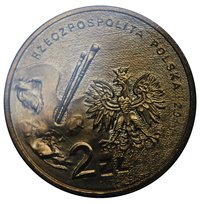
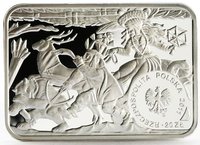
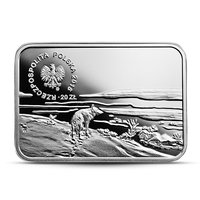
Fragment of Józef Chełmoński's *Night in the Ukraine* (1877). Upper right: Poland's national eagle emblem. Below: mint mark. Surrounding inscription: 20 ZŁ • RZECZPOSPOLITA POLSKA 2014.
Inscription:
RZECZPOSPOLITA POLSKA 2014
20 ZŁ
mw
20 ZŁ
mw
Translation:
REPUBLIC OF POLAND 2014
20 ZŁOTYCH
MW
20 ZŁOTYCH
MW
Script: Latin
Language: Polish
Designer: Ewa Olszewska-Borys
Reverse
Description:
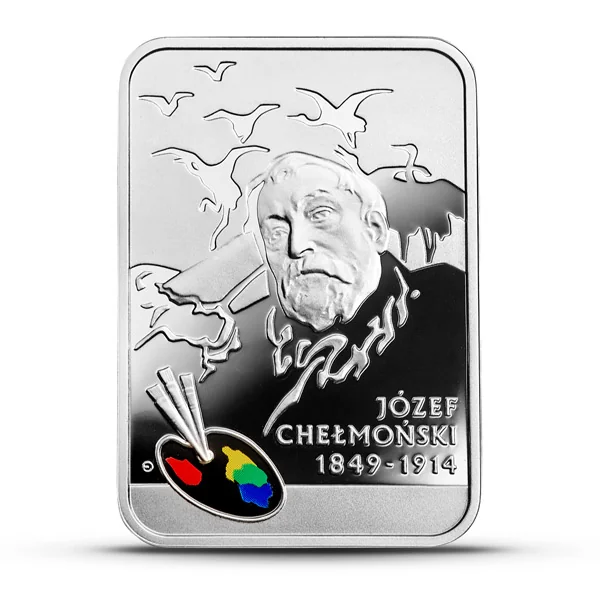
Fragment of Chełmoński's "Departing Cranes" (1870) with his portrait. Includes a fragment of his "Night in the Ukraine" (1877). Features the Polish eagle, 20 ZŁ, "RZECZPOSPOLITA POLSKA," and the year 2014.
Inscription:
JÓZEF CHEŁMOŃSKI
1849–1914
1849–1914
Translation:
JÓZEF CHEŁMOŃSKI
1849–1914
1849–1914
Script: Latin
Language: Polish
Designer: Ewa Olszewska-Borys
Edge
Plain
Mints
| Name | Mark |
|---|---|
| Mint of Poland | (MW) |
Mintings
| Year | Mint Mark | Mintage | Quality | Collection |
|---|---|---|---|---|
| 2014 | MW | 30,000 | Proof |
Historical background
In 2014, Poland's currency situation was characterized by a period of significant volatility for the Polish złoty (PLN), driven primarily by external geopolitical shocks. The year began with relative stability, but the escalation of the Russia-Ukraine conflict in early 2014 sent shockwaves through Central and Eastern European financial markets. As a neighboring country, Poland was perceived by investors as being exposed to regional instability, leading to capital outflows and sustained pressure on the złoty. The currency weakened notably against both the euro and the US dollar, with market sentiment overshadowing Poland's solid domestic economic fundamentals, which included steady growth and contained inflation.
The National Bank of Poland (NBP) faced a complex policy dilemma. While the weakening złoty boosted export competitiveness, it also raised the risk of imported inflation. The central bank's primary tool, the reference interest rate, was already at a historic low of 2.50% following a series of cuts in 2012-2013 to stimulate growth. Throughout 2014, the NBP held rates steady, opting for verbal interventions and occasional foreign exchange market operations to smooth excessive volatility rather than aggressively defending a specific exchange rate level. Governor Marek Belka emphasized that the bank would not "defend the złoty at all costs," signaling a focus on broader monetary stability.
By the end of 2014, the situation had partially stabilized, though the złoty remained weaker than at the start of the year. The immediate market panic subsided as the direct economic impact of the Ukraine crisis on Poland proved less severe than initially feared, and the European Central Bank's moves toward quantitative easing improved sentiment toward European assets. However, the year underscored the Polish currency's sensitivity to regional geopolitical risks and set the stage for subsequent challenges, including deflationary pressures that would lead the NBP to cut interest rates further in 2015.
The National Bank of Poland (NBP) faced a complex policy dilemma. While the weakening złoty boosted export competitiveness, it also raised the risk of imported inflation. The central bank's primary tool, the reference interest rate, was already at a historic low of 2.50% following a series of cuts in 2012-2013 to stimulate growth. Throughout 2014, the NBP held rates steady, opting for verbal interventions and occasional foreign exchange market operations to smooth excessive volatility rather than aggressively defending a specific exchange rate level. Governor Marek Belka emphasized that the bank would not "defend the złoty at all costs," signaling a focus on broader monetary stability.
By the end of 2014, the situation had partially stabilized, though the złoty remained weaker than at the start of the year. The immediate market panic subsided as the direct economic impact of the Ukraine crisis on Poland proved less severe than initially feared, and the European Central Bank's moves toward quantitative easing improved sentiment toward European assets. However, the year underscored the Polish currency's sensitivity to regional geopolitical risks and set the stage for subsequent challenges, including deflationary pressures that would lead the NBP to cut interest rates further in 2015.
Series: Polish Painters

💎 Extremely Rare