

5 shilingi – Tanzania
Add to wishlist
Circulating commemorative coins
Commemoration: FAO
Tanzania
Obverse
Description:
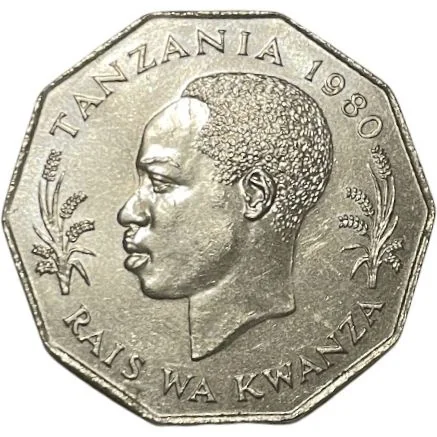
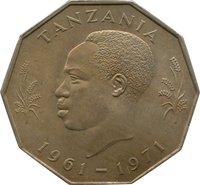
President Nyerere's head.
Inscription:
TANZANIA 1980
RAIS WA KWANZA
RAIS WA KWANZA
Translation:
FIRST PRESIDENT
Script: Latin
Language: Swahili
Engraver: Christopher Ironside
Reverse
Description:
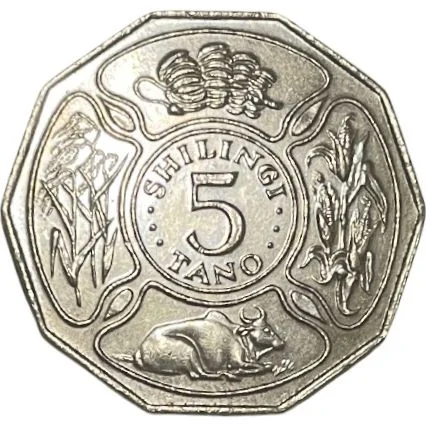
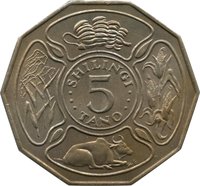
Cereals, Bananas, Maize, Cow
(Agriculture, Horticulture, Dairy Development)
(Agriculture, Horticulture, Dairy Development)
Inscription:
SHILINGI
5
TANO
5
TANO
Translation:
SHILLING
5
FIVE
5
FIVE
Script: Latin
Language: Swahili
Engraver: Christopher Ironside
Edge
Five smooth and five reeded sides
Categories
| Animal> Cow |
| Person> Politician |
| Plant> Fruit |
| Organization> FAO |
Mints
| Name | Mark |
|---|---|
| Royal Mint | — |
Mintings
| Year | Mint Mark | Mintage | Quality | Collection |
|---|---|---|---|---|
| 1972 | — | 8,000,000 | ||
| 1973 | — | 5,000,000 | ||
| 1980 | — | 5,000,000 |
Historical background
In 1972, Tanzania's currency situation was defined by the ongoing implementation of President Julius Nyerere's socialist Ujamaa policy, which sought economic self-reliance and a break from colonial structures. The Tanzanian shilling, introduced in 1966 to replace the East African shilling, was the symbol of this monetary sovereignty. However, the economy faced significant pressures, including the costly nationalization of key industries and banks, a heavy reliance on volatile agricultural exports (notably sisal and cotton), and the financial burden of supporting liberation movements in southern Africa. These factors strained foreign exchange reserves and created underlying inflationary pressures.
The currency was managed within a fixed exchange rate system, pegged to the US dollar and later to the Special Drawing Right (SDR) of the International Monetary Fund. This peg provided stability but became increasingly difficult to maintain as the trade deficit widened. The government maintained strict exchange controls to conserve scarce foreign currency, directing it towards priority imports like machinery and oil, while restricting access for consumer goods. This created a gap between the official exchange rate and the black-market rate, where shillings traded at a significant discount, reflecting the currency's overvaluation and the scarcity of hard currency.
Overall, 1972 represented a period of controlled but mounting strain on the Tanzanian shilling. While the currency itself was stable in name and pegged value, the economic policies of Ujamaa, combined with external shocks, were eroding its fundamental strength. The situation foreshadowed the more severe economic challenges of the late 1970s, which would eventually lead to a major economic crisis and structural adjustment programs, forcing a devaluation and a gradual move away from strict socialist policies.
The currency was managed within a fixed exchange rate system, pegged to the US dollar and later to the Special Drawing Right (SDR) of the International Monetary Fund. This peg provided stability but became increasingly difficult to maintain as the trade deficit widened. The government maintained strict exchange controls to conserve scarce foreign currency, directing it towards priority imports like machinery and oil, while restricting access for consumer goods. This created a gap between the official exchange rate and the black-market rate, where shillings traded at a significant discount, reflecting the currency's overvaluation and the scarcity of hard currency.
Overall, 1972 represented a period of controlled but mounting strain on the Tanzanian shilling. While the currency itself was stable in name and pegged value, the economic policies of Ujamaa, combined with external shocks, were eroding its fundamental strength. The situation foreshadowed the more severe economic challenges of the late 1970s, which would eventually lead to a major economic crisis and structural adjustment programs, forcing a devaluation and a gradual move away from strict socialist policies.
🌱 Very Common