

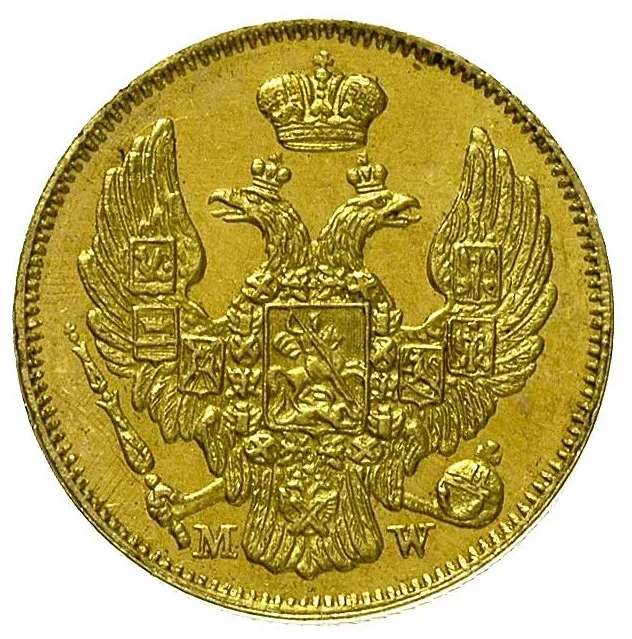
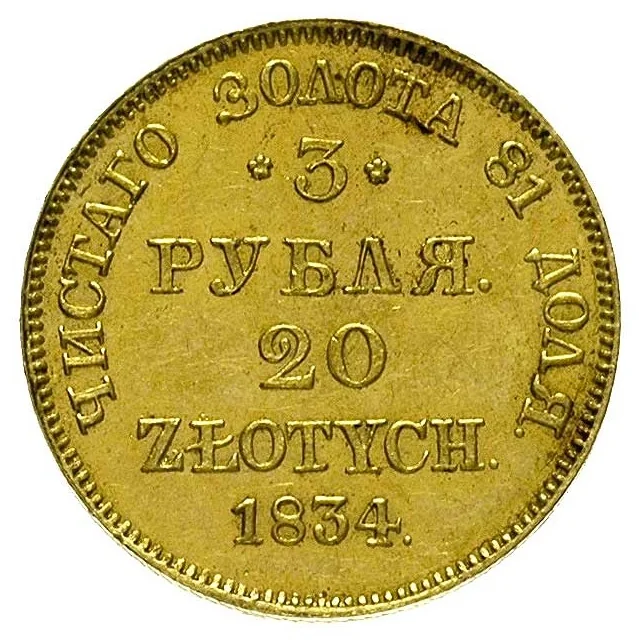
20 zlotys – Congress Kingdom of Poland
Add to wishlist
Poland
Context
Years: 1834–1840
Country: Poland
Issuer: Congress Kingdom of Poland
Ruler: Nicholas I
Currency:
(1815—1841)
Demonetized: Yes
Total mintage: 1,472
Material
References
Numista: #82049
Value
Bullion value: $555.35
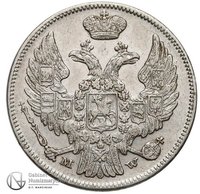
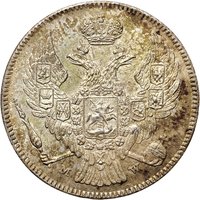
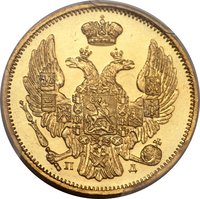
Obverse
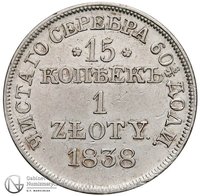
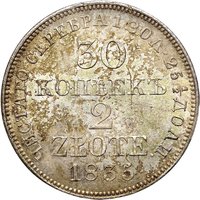
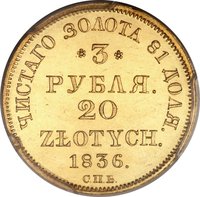
Reverse
Edge
Slant reeded
Mints
| Name | Mark |
|---|---|
| Mint of Poland | — |
Mintings
| Year | Mint Mark | Mintage | Quality | Collection |
|---|---|---|---|---|
| 1834 | MW | 243 | ||
| 1835 | MW | 350 | ||
| 1836 | MW | 307 | ||
| 1837 | MW | 423 | ||
| 1838 | MW | 66 | ||
| 1839 | MW | 57 | ||
| 1840 | MW | 26 |
Historical background
The currency situation in the Congress Kingdom of Poland in 1834 was defined by a period of forced monetary integration and the aftermath of the failed November Uprising (1830-1831). Following the crushing of the rebellion, Tsar Nicholas I initiated a policy of Russification aimed at dismantling the Kingdom's autonomy. A key component of this policy was the abolition of the Polish monetary system. In 1832, the State Bank of Poland was closed, and the production of Polish złoty coins at the Warsaw Mint was halted, although existing coins remained in circulation for a transitional period.
By 1834, the formal transition was nearing completion. The imperial manifesto of December 1831 (Old Style) had decreed the replacement of the Polish currency with the Russian ruble. The exchange rate was fixed at 1 Russian silver ruble for 6.67 Polish złotys (or 1 złoty = 15 Russian kopeks). This rate was unfavorable to the Polish economy, effectively acting as a financial penalty for the rebellion and facilitating the flow of capital from the Kingdom to the imperial center. While Russian banknotes and coins became the official legal tender, the physical replacement of currency in daily circulation was a gradual process, with Polish coins still being used alongside Russian ones throughout the mid-1830s.
Thus, 1834 represents a point of consolidation within this coercive financial integration. The Kingdom's economy was being forcibly tied more directly to the Russian imperial system, losing a key symbol of its separate financial identity. This monetary unification served both practical and political ends: it simplified trade and administration within the empire while starkly demonstrating the Kingdom's diminished status as a mere province under tighter St. Petersburg control.
By 1834, the formal transition was nearing completion. The imperial manifesto of December 1831 (Old Style) had decreed the replacement of the Polish currency with the Russian ruble. The exchange rate was fixed at 1 Russian silver ruble for 6.67 Polish złotys (or 1 złoty = 15 Russian kopeks). This rate was unfavorable to the Polish economy, effectively acting as a financial penalty for the rebellion and facilitating the flow of capital from the Kingdom to the imperial center. While Russian banknotes and coins became the official legal tender, the physical replacement of currency in daily circulation was a gradual process, with Polish coins still being used alongside Russian ones throughout the mid-1830s.
Thus, 1834 represents a point of consolidation within this coercive financial integration. The Kingdom's economy was being forcibly tied more directly to the Russian imperial system, losing a key symbol of its separate financial identity. This monetary unification served both practical and political ends: it simplified trade and administration within the empire while starkly demonstrating the Kingdom's diminished status as a mere province under tighter St. Petersburg control.
✨ Legendary