

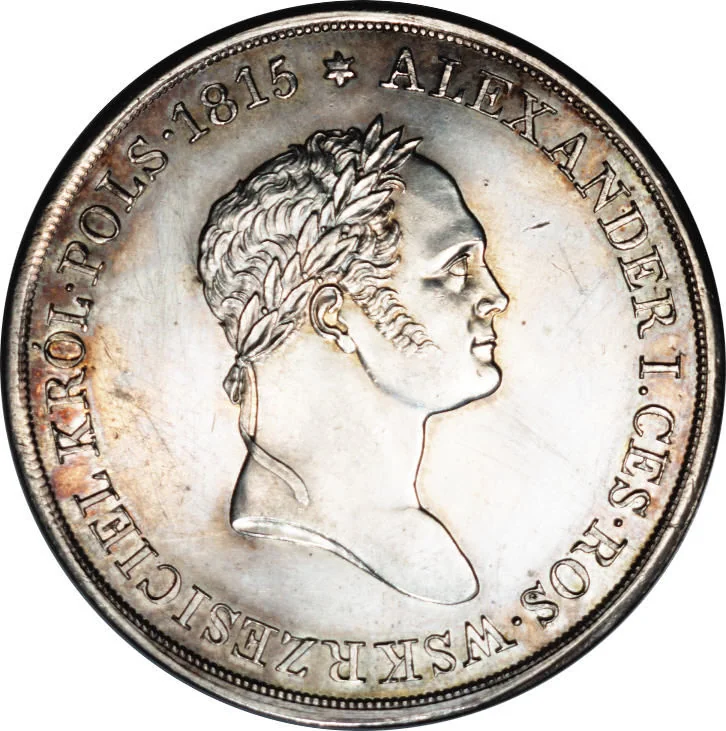
10 Zlotys – Congress Kingdom of Poland
Poland
Context
Year: 1827
Country: Poland 
Issuer: Congress Kingdom of Poland
Ruler: Nicholas I
Currency:
(1815—1841)
Demonetized: Yes
Total mintage: 123
Material
References
Numista: #82048
Value
Bullion value: $85.28
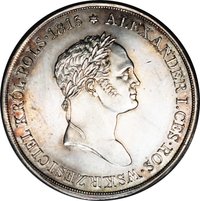
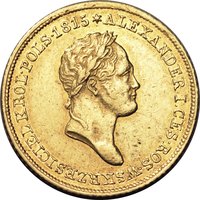
Obverse
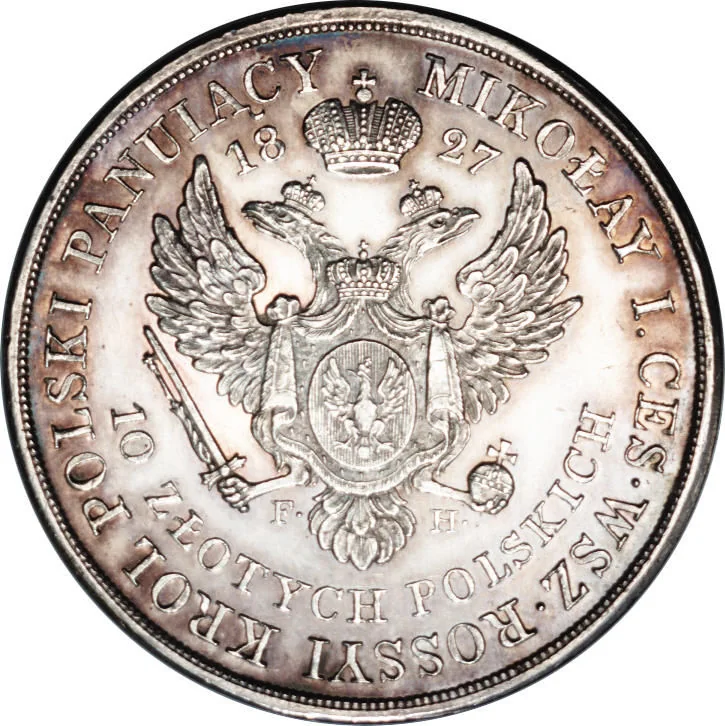
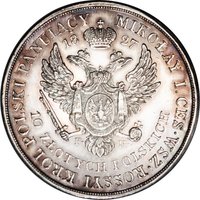
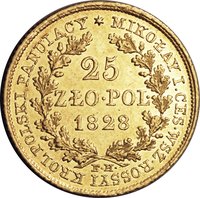
Reverse
Description:
Double-headed eagle with crown, encircled by text.
Inscription:
MIKOŁAY I. CES·WSZ·ROSSYI KROL POLSKI PANUIACY
18 27
F. H.
1O ZŁOTYCH POLSKICH
18 27
F. H.
1O ZŁOTYCH POLSKICH
Translation:
NICHOLAS I. EMPEROR AND AUTOCRAT OF ALL RUSSIA, KING OF POLAND, REIGNING
18 27
F. H.
10 POLISH ZŁOTY
18 27
F. H.
10 POLISH ZŁOTY
Script: Latin
Edge
Plain
Mintings
| Year | Mint Mark | Mintage | Quality | Collection |
|---|---|---|---|---|
| 1827 | FH | — | ||
| 1827 | IB | 123 |
Historical background
In 1827, the currency situation in the Congress Kingdom of Poland was characterized by a complex and deteriorating dual-system, a legacy of its autonomous status within the Russian Empire. The Kingdom maintained its own monetary unit, the Polish złoty, which was theoretically distinct from the Russian ruble. However, the 1815 monetary convention had fixed an exchange rate of 1 złoty to 0.15 silver rubles (or 6⅔ złoty to 1 ruble), formally tying the Polish currency to the Russian system. This fixed parity was intended to facilitate trade and integrate the Kingdom's economy with the Empire, but it created significant vulnerabilities.
The core problem was a growing divergence between the two currencies' intrinsic values. While the Russian silver ruble was a full-bodied, stable coin, the Polish złoty existed primarily as depreciating paper money issued by the Bank of Poland. A flood of these banknotes, driven by state deficits and ambitious industrial investments like the Old Polish Industrial District, led to inflation and a severe loss of public confidence. Consequently, the paper złoty traded at a significant discount to its nominal silver value, creating a disruptive gap between the official fixed rate and the market reality.
This unstable monetary environment placed a heavy burden on the economy, discouraging foreign investment and creating uncertainty for merchants. The situation was a microcosm of the Kingdom's broader political tensions, highlighting the contradictions between its formal autonomy and its economic subordination to St. Petersburg. By 1827, the currency instability was a clear symptom of the Kingdom's fiscal distress, contributing to the growing discontent that would culminate in the November Uprising of 1830, after which the remaining monetary autonomy would be abolished.
The core problem was a growing divergence between the two currencies' intrinsic values. While the Russian silver ruble was a full-bodied, stable coin, the Polish złoty existed primarily as depreciating paper money issued by the Bank of Poland. A flood of these banknotes, driven by state deficits and ambitious industrial investments like the Old Polish Industrial District, led to inflation and a severe loss of public confidence. Consequently, the paper złoty traded at a significant discount to its nominal silver value, creating a disruptive gap between the official fixed rate and the market reality.
This unstable monetary environment placed a heavy burden on the economy, discouraging foreign investment and creating uncertainty for merchants. The situation was a microcosm of the Kingdom's broader political tensions, highlighting the contradictions between its formal autonomy and its economic subordination to St. Petersburg. By 1827, the currency instability was a clear symptom of the Kingdom's fiscal distress, contributing to the growing discontent that would culminate in the November Uprising of 1830, after which the remaining monetary autonomy would be abolished.
✨ Legendary