

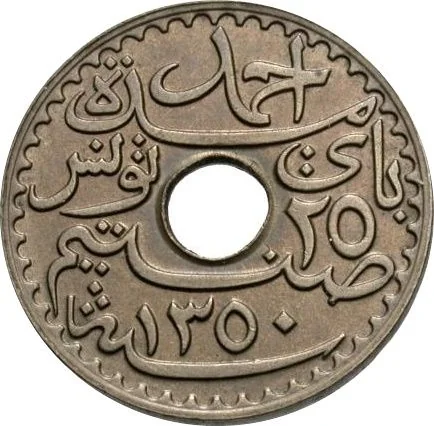
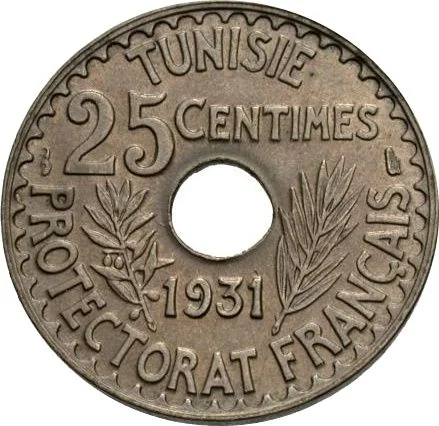
25 Centimes – Tunisia
Tunisia
Context

Material
Diameter: 24 mm
Weight: 5 g
Thickness: 1.8 mm
Shape: Round with a round hole
Composition: Aluminium-nickel-bronze
Technique: Milled
Alignment: Coin alignment
flip
References
KM: #Click to copy to clipboard260
Numista: #8189
Value
Exchange value: 0.25 TNF
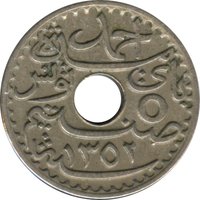
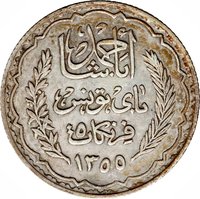
Obverse
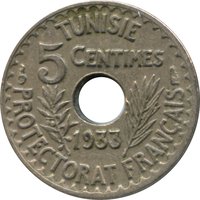
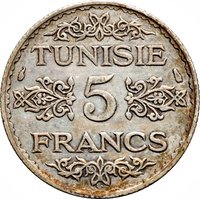
Reverse
Edge
Plain
Mints
| Name | Mark |
|---|---|
| Monnaie de Paris | — |
Mintings
| Year | Mint Mark | Mintage | Quality | Collection |
|---|---|---|---|---|
| 1931 | — | 300,000 | ||
| 1933 | — | 400,000 | ||
| 1938 | — | 480,000 |
Historical background
In 1931, Tunisia's currency situation was defined by its status as a French protectorate, established in 1881. The country operated within the Franc Zone, with the French franc serving as the official legal tender. However, the Tunisian franc, introduced in 1891, was the physical currency in circulation. It was pegged at par with the French franc, meaning the two were interchangeable and Tunisia's monetary policy was entirely directed by the French authorities in Paris. This arrangement ensured monetary stability and facilitated trade with France, but it also meant Tunisia had no independent control over its money supply, interest rates, or exchange rates, tying its economic fate directly to that of the metropole.
The year 1931 was a point of significant strain within this system due to the onset of the Great Depression. As global trade collapsed and commodity prices plummeted, Tunisia's export-oriented economy, heavily reliant on agricultural products like olive oil and phosphates, suffered severely. The fixed peg to the French franc, while providing stability, also meant Tunisia imported France's deflationary pressures, exacerbating the local economic downturn. There was no ability to devalue the currency to make exports more competitive, and the tight monetary policy required to maintain the peg further constrained economic activity and deepened the crisis for Tunisian farmers and businesses.
Consequently, the currency regime of 1931 reflected the core dynamics of colonial economics: integration and subordination. While the peg provided administrative simplicity and guaranteed stability during normal times, it proved rigid and detrimental during a global shock, highlighting Tunisia's vulnerability. The situation underscored how monetary policy was wielded as an instrument of imperial control, prioritizing the stability of the Franc Zone and the interests of French settlers and creditors over the need for a flexible response to protect the local Tunisian economy from the ravages of the worldwide depression.
The year 1931 was a point of significant strain within this system due to the onset of the Great Depression. As global trade collapsed and commodity prices plummeted, Tunisia's export-oriented economy, heavily reliant on agricultural products like olive oil and phosphates, suffered severely. The fixed peg to the French franc, while providing stability, also meant Tunisia imported France's deflationary pressures, exacerbating the local economic downturn. There was no ability to devalue the currency to make exports more competitive, and the tight monetary policy required to maintain the peg further constrained economic activity and deepened the crisis for Tunisian farmers and businesses.
Consequently, the currency regime of 1931 reflected the core dynamics of colonial economics: integration and subordination. While the peg provided administrative simplicity and guaranteed stability during normal times, it proved rigid and detrimental during a global shock, highlighting Tunisia's vulnerability. The situation underscored how monetary policy was wielded as an instrument of imperial control, prioritizing the stability of the Franc Zone and the interests of French settlers and creditors over the need for a flexible response to protect the local Tunisian economy from the ravages of the worldwide depression.
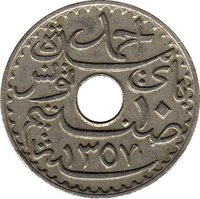
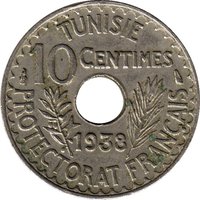
Series: 1931 Tunisia circulation coins
🌱 Common