

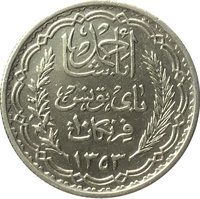
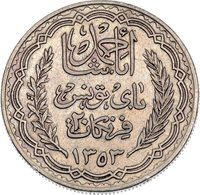
Obverse
Description:
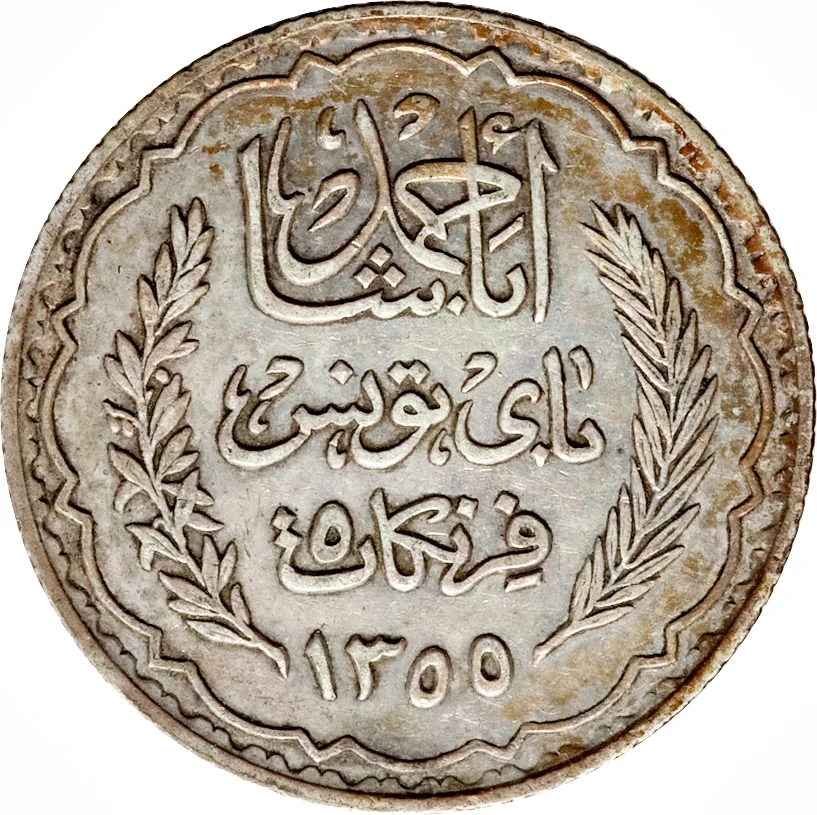
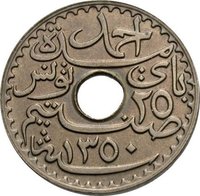
Arabic ruler with value and Hijri date.
Inscription:
أحمد
باشا
باي تونس
٥
فرنكات
١٣٥٥
باشا
باي تونس
٥
فرنكات
١٣٥٥
Translation:
Ahmad
Pasha
Bey of Tunis
5
Francs
1355
Pasha
Bey of Tunis
5
Francs
1355
Script: Arabic
Language: Arabic
Engraver: Lucien Georges Bazor
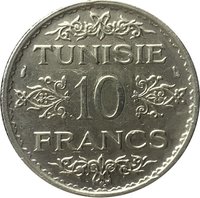
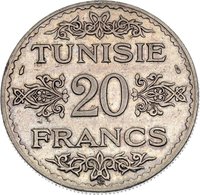
Reverse
Description:
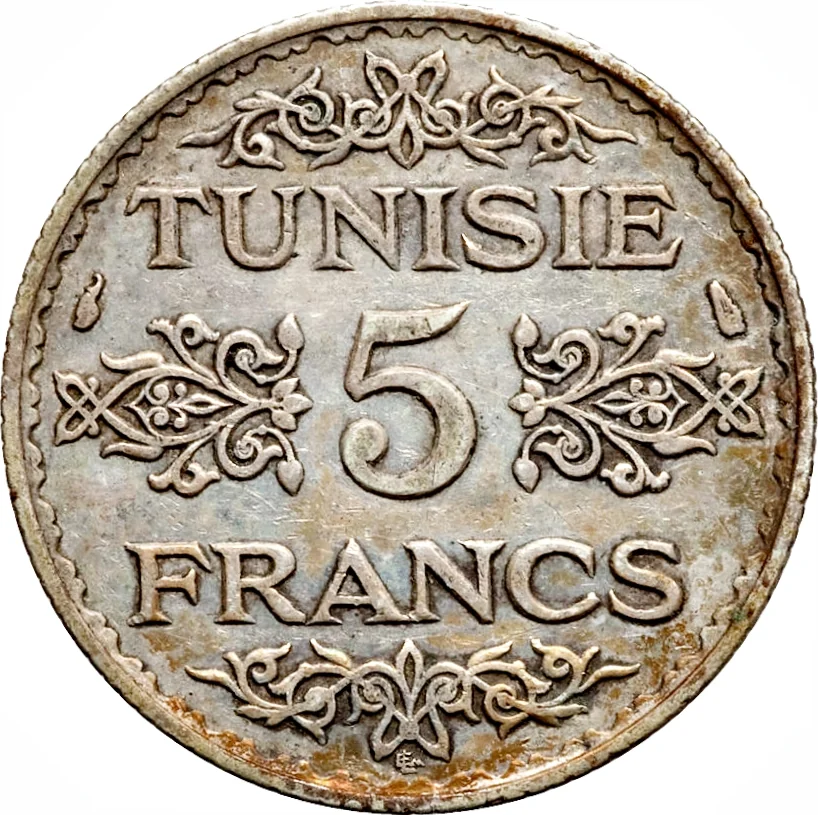
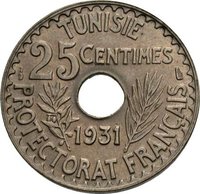
Tunisia's French influence and worth.
Inscription:
TUNISIE
5
FRANCS
5
FRANCS
Translation:
TUNISIA
5
FRANCS
5
FRANCS
Script: Latin
Language: French
Engraver: Lucien Georges Bazor
Edge
Reeded
Mints
| Name | Mark |
|---|---|
| Monnaie de Paris | — |
Mintings
| Year | Mint Mark | Mintage | Quality | Collection |
|---|---|---|---|---|
| 1935 | — | 2,000,000 | ||
| 1936 | — | 2,000,000 |
Historical background
In 1935, Tunisia's currency situation was defined by its status as a French protectorate, established in 1881. The monetary system was fully integrated into the French franc zone, with the French franc serving as the official legal tender. The Banque de l'Algérie, which also had the privilege of issuing banknotes for Tunisia, operated as the central banking authority, ensuring that the Tunisian economy was pegged to and dependent on the monetary policy and stability of metropolitan France.
This arrangement created a dual-track economy. While the franc was dominant in modern sectors, commerce, and government, the piastre—a legacy unit of account from the pre-protectorate era—persisted in everyday vernacular and some local transactions. One piastre was conventionally valued at 5 centimes (0.05 francs), providing a familiar reference point for the local population. Furthermore, alongside the official banknotes, older Ottoman and local coins still circulated in rural markets, reflecting the lingering traditional economic practices beneath the formal French system.
The year 1935 fell within the global economic turmoil of the Great Depression, which impacted Tunisia through its French connection. The deflationary policies in France and the devaluation of the franc in the mid-1930s directly affected the protectorate, influencing prices, trade, and agricultural exports like wheat and olives. Consequently, while the currency system was formally stable and unified, the broader economic pressures of the era contributed to social strains and growing nationalist sentiments that questioned the costs of colonial economic integration.
This arrangement created a dual-track economy. While the franc was dominant in modern sectors, commerce, and government, the piastre—a legacy unit of account from the pre-protectorate era—persisted in everyday vernacular and some local transactions. One piastre was conventionally valued at 5 centimes (0.05 francs), providing a familiar reference point for the local population. Furthermore, alongside the official banknotes, older Ottoman and local coins still circulated in rural markets, reflecting the lingering traditional economic practices beneath the formal French system.
The year 1935 fell within the global economic turmoil of the Great Depression, which impacted Tunisia through its French connection. The deflationary policies in France and the devaluation of the franc in the mid-1930s directly affected the protectorate, influencing prices, trade, and agricultural exports like wheat and olives. Consequently, while the currency system was formally stable and unified, the broader economic pressures of the era contributed to social strains and growing nationalist sentiments that questioned the costs of colonial economic integration.
🌱 Common