

Obverse
Description:
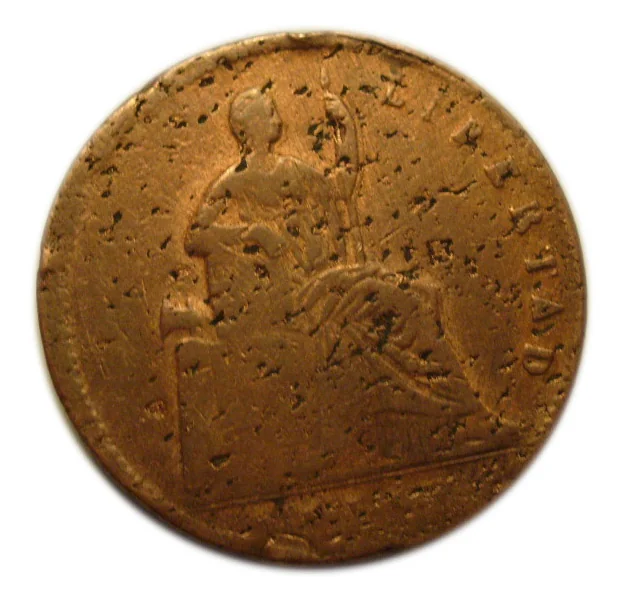
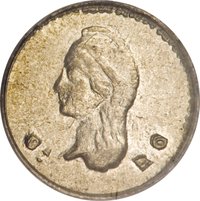
Seated Liberty holding a lance. Size varies 29-30mm; weight varies accordingly.
Inscription:
LIBERTAD
L. ROVIRA. F.
L. ROVIRA. F.
Translation:
LIBERTY
L. ROVIRA. F.
L. ROVIRA. F.
Script: Latin
Engraver: L. Roviera F.
Reverse
Description:
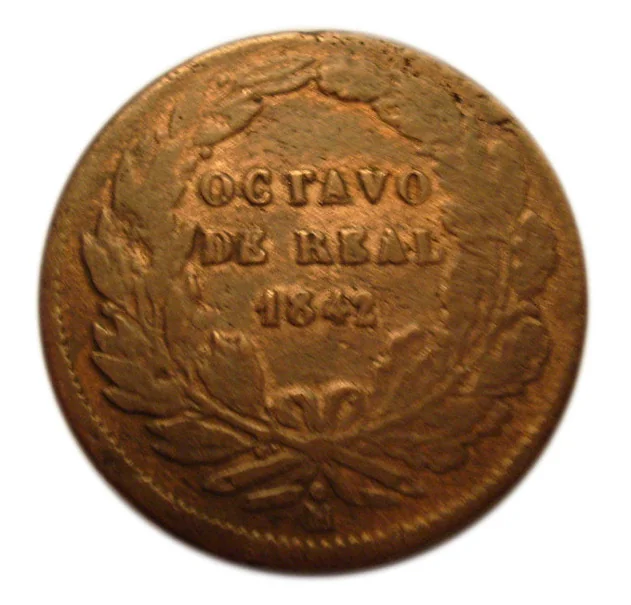
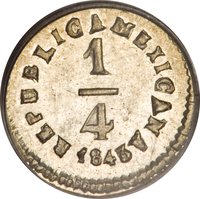
Value and date in wreath; mintmark below.
Inscription:
OCTAVO
DE REAL
1842
Mo
DE REAL
1842
Mo
Script: Latin
Edge
1841 and 1842: Lettered1850 and 1861: Plain
Legend:
REPUBLICA MEXICANA
Translation:
Mexican Republic
Language: Latin
Mintings
| Year | Mint Mark | Mintage | Quality | Collection |
|---|---|---|---|---|
| 1841 | Mo | — | ||
| 1842 | Mo | — | ||
| 1850 | Mo | — | ||
| 1861 | Mo | — |
Historical background
In 1841, Mexico's currency system was in a state of profound crisis and confusion, a direct consequence of the political and economic turmoil that followed independence. The fledgling nation, having endured the devastating War of Independence and a series of internal coups and conflicts, faced a bankrupt treasury and a collapse in silver production, the traditional backbone of the economy. To finance government operations, successive administrations, most notably that of Anastasio Bustamante in the early 1830s, had resorted to printing massive quantities of paper money, known as billetes or moneda de necesidad (necessity money). These bills were not backed by silver or gold, leading to rapid depreciation and a severe loss of public confidence.
The monetary landscape became a chaotic patchwork of competing mediums of exchange. While the official silver peso (often cut or clipped) remained the preferred standard, it was scarce in circulation. In its place, a plethora of devalued paper bills from various government issues circulated alongside tokens issued by states, municipalities, and even private businesses like mines and haciendas. This fragmentation meant that the value of money could vary drastically from one region to another, crippling domestic trade. The situation was exacerbated by the government's own refusal to accept its paper currency for tax payments, further undermining its validity and fueling inflation.
This monetary anarchy reached a critical point in 1841, coinciding with the rebellion that brought Antonio López de Santa Anna back to power. The widespread rejection of paper money and the scarcity of coinage effectively paralyzed commerce and government finance. Recognizing the untenable situation, one of the first major acts of Santa Anna's new regime in 1842 was to decree the demonetization and cancellation of the discredited government paper money, acknowledging the complete collapse of the system. Thus, the currency situation of 1841 represents the nadir of Mexico's early financial instability, setting the stage for a painful and protracted struggle to re-establish a unified and trustworthy monetary system.
The monetary landscape became a chaotic patchwork of competing mediums of exchange. While the official silver peso (often cut or clipped) remained the preferred standard, it was scarce in circulation. In its place, a plethora of devalued paper bills from various government issues circulated alongside tokens issued by states, municipalities, and even private businesses like mines and haciendas. This fragmentation meant that the value of money could vary drastically from one region to another, crippling domestic trade. The situation was exacerbated by the government's own refusal to accept its paper currency for tax payments, further undermining its validity and fueling inflation.
This monetary anarchy reached a critical point in 1841, coinciding with the rebellion that brought Antonio López de Santa Anna back to power. The widespread rejection of paper money and the scarcity of coinage effectively paralyzed commerce and government finance. Recognizing the untenable situation, one of the first major acts of Santa Anna's new regime in 1842 was to decree the demonetization and cancellation of the discredited government paper money, acknowledging the complete collapse of the system. Thus, the currency situation of 1841 represents the nadir of Mexico's early financial instability, setting the stage for a painful and protracted struggle to re-establish a unified and trustworthy monetary system.
🌟 Limited