

2 euro (Independence) – Slovenia
Add to wishlist
Circulating commemorative coins
Commemoration: 25th Anniversary of Independence
Slovenia
Obverse
Description:
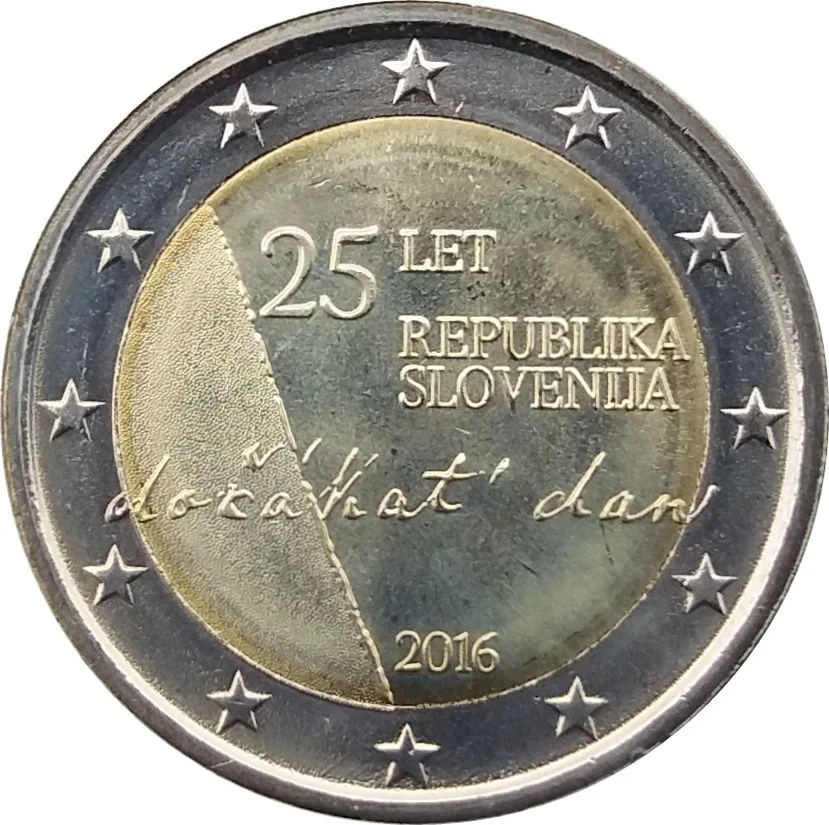
A line slants across the left inner circle. To its right are '25 LET' above 'REPUBLIKA SLOVENIJA', with Prešeren's handwritten 'dočákat’ dan' from the hymn Zdravljica below. The year '2016' is at the bottom. The outer ring features the 12 stars of the EU.
Inscription:
25 LET
REPUBLIKA SLOVENIJA
dočákat dan
2016
REPUBLIKA SLOVENIJA
dočákat dan
2016
Translation:
25th anniversary
REPUBLIC OF SLOVENIA
to witness the day
2016
REPUBLIC OF SLOVENIA
to witness the day
2016
Script: Latin
Language: Slovenian
Engraver: Jernej Kejžar
Reverse
Edge
Categories
| Event> Independence |
| Map |
Mints
| Name | Mark |
|---|---|
| Rome | — |
Mintings
| Year | Mint Mark | Mintage | Quality | Collection |
|---|---|---|---|---|
| 2016 | — | 984,500 | ||
| 2016 | — | 5,000 | Proof | |
| 2016 | — | 10,500 | BU |
Historical background
In 2016, Slovenia was a stable member of the Eurozone, having adopted the euro as its official currency in 2007. The country's currency situation was therefore defined by its participation in the European single currency and the monetary policy set by the European Central Bank (ECB). This provided macroeconomic stability, eliminated exchange rate risk with its main trading partners, and facilitated trade and investment flows. Domestically, there was no significant political movement or public debate about leaving the euro, as the currency was widely seen as a cornerstone of Slovenia's economic security and European identity.
The primary financial focus in 2016 was not on currency but on the ongoing cleanup of the banking sector following a deep crisis in 2013. The government had completed a major recapitalization of state-owned banks and was working to reduce high levels of non-performing loans. This effort was crucial for strengthening the financial system and ensuring the smooth transmission of ECB monetary policy within the Slovenian economy. The country's economic performance was positive, with GDP growth of 3.1% for the year, outpacing the Eurozone average and supported by strong exports and a rebound in investment.
However, Slovenia was not insulated from broader Eurozone challenges. The lingering effects of the European debt crisis, the ECB's continuation of its expansive quantitative easing program, and the persistent low-interest-rate environment all shaped the financial landscape. Furthermore, the aftermath of the 2015 Greek crisis and the Brexit referendum in June 2016 served as reminders of potential existential risks to the Eurozone project, indirectly influencing economic sentiment. Nevertheless, for Slovenia specifically, the euro functioned as intended in 2016—providing a stable monetary framework while national authorities focused on domestic fiscal and structural reforms.
The primary financial focus in 2016 was not on currency but on the ongoing cleanup of the banking sector following a deep crisis in 2013. The government had completed a major recapitalization of state-owned banks and was working to reduce high levels of non-performing loans. This effort was crucial for strengthening the financial system and ensuring the smooth transmission of ECB monetary policy within the Slovenian economy. The country's economic performance was positive, with GDP growth of 3.1% for the year, outpacing the Eurozone average and supported by strong exports and a rebound in investment.
However, Slovenia was not insulated from broader Eurozone challenges. The lingering effects of the European debt crisis, the ECB's continuation of its expansive quantitative easing program, and the persistent low-interest-rate environment all shaped the financial landscape. Furthermore, the aftermath of the 2015 Greek crisis and the Brexit referendum in June 2016 served as reminders of potential existential risks to the Eurozone project, indirectly influencing economic sentiment. Nevertheless, for Slovenia specifically, the euro functioned as intended in 2016—providing a stable monetary framework while national authorities focused on domestic fiscal and structural reforms.
Series: Slovenia 2 euro commemoratives
🌱 Very Common