

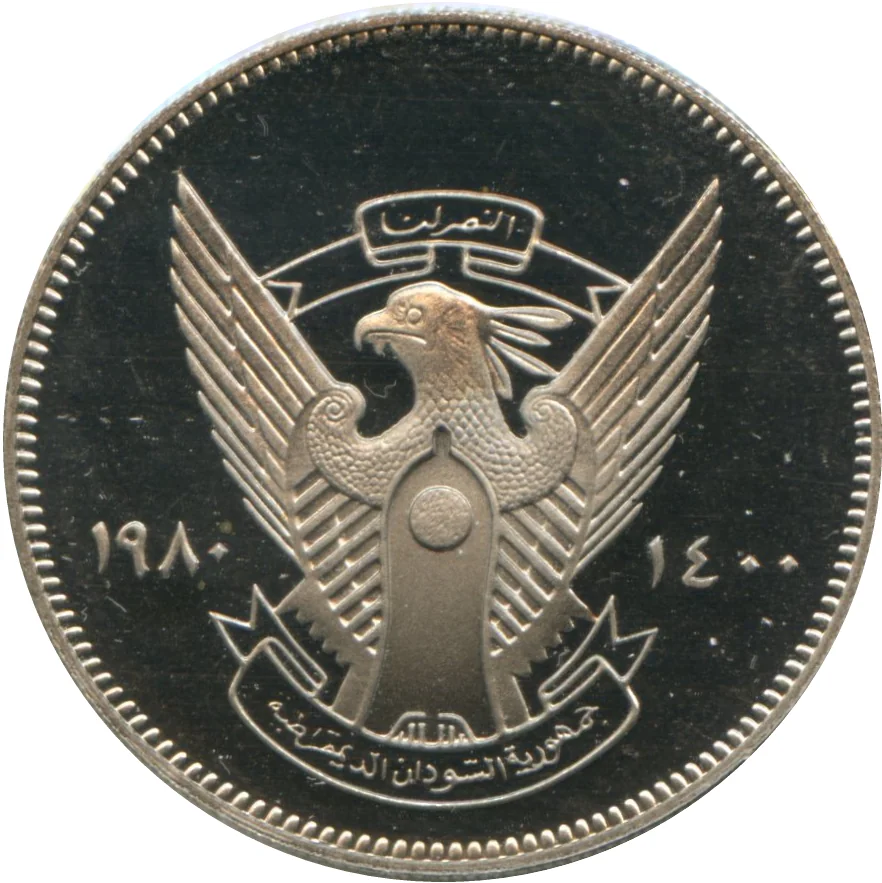
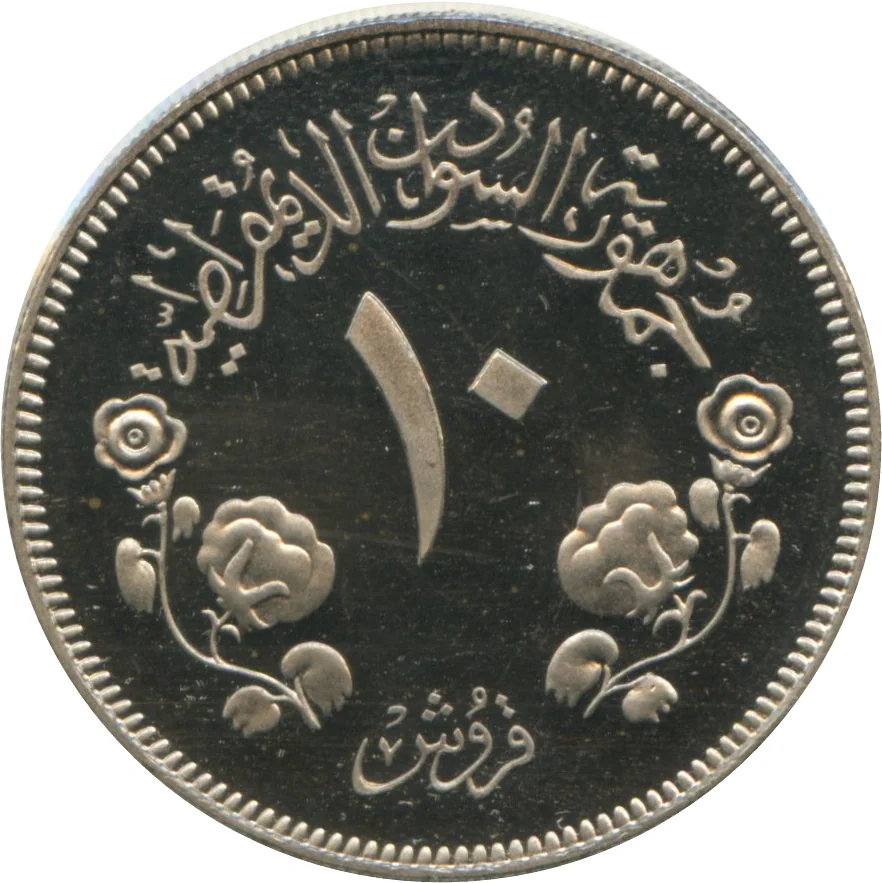
10 piastres – Sudan
Add to wishlist
Sudan
Context
Years: 1975–1980
Issuer: Sudan
Period:
(1969—1985)
Currency:
(1956—1992)
Demonetization: 8 June 1992
Total mintage: 3,000,000
Material
Diameter: 28 mm
Weight: 9.9 g
Shape: Round
Composition: Copper-nickel
Technique: Milled
Alignment: Medal alignment
flip
References
KM: #
Numista: #8089
Value
Exchange value: 0.10 SDP
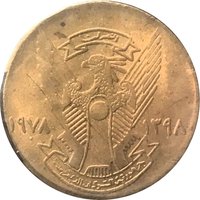
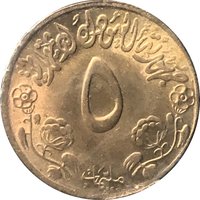
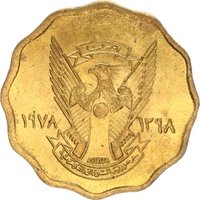
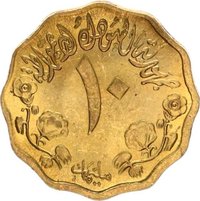
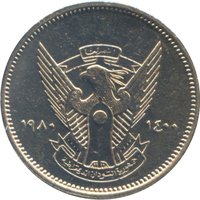
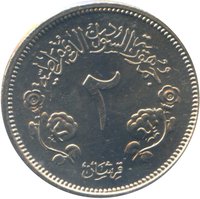
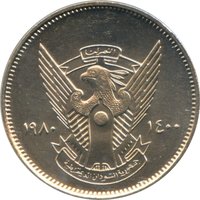
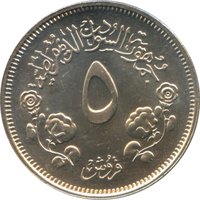
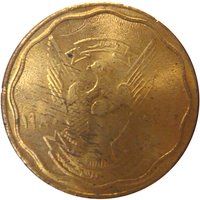
Obverse
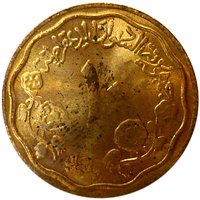
Reverse
Edge
MilledNOTE: edge varieties exist for KM#59.2
Mints
| Name | Mark |
|---|---|
| Royal Mint | — |
Mintings
| Year | Mint Mark | Mintage | Quality | Collection |
|---|---|---|---|---|
| 1975 | — | 1,000,000 | ||
| 1977 | — | 1,000,000 | ||
| 1980 | — | 1,000,000 | ||
| 1980 | — | — | Proof |
Historical background
In 1975, Sudan's currency situation was characterized by relative stability but underlying economic strains that foreshadowed future crises. The Sudanese pound (SDG), introduced in 1956 to replace the Egyptian pound, was the national currency and was pegged to the U.S. dollar under the Bretton Woods system of fixed exchange rates. This peg, managed by the Bank of Sudan, provided a period of monetary stability and predictability for foreign trade, which was crucial for an economy heavily dependent on agricultural exports, particularly cotton.
However, this stability was increasingly artificial and propped up by unsustainable policies. The government of President Gaafar Nimeiry, while initially benefiting from an economic boom, was pursuing expansive public spending and ambitious development projects. A significant devaluation had already occurred in 1972, and by 1975, inflationary pressures were building due to global oil price shocks and rising import costs. The fixed exchange rate began to overvalue the Sudanese pound, hurting export competitiveness and leading to a growing imbalance in the country's external accounts.
Consequently, 1975 represented a calm before the storm. The structural weaknesses of an economy reliant on a single cash crop, combined with fiscal expansion and external shocks, were putting severe pressure on the currency peg. While a major crisis was not yet fully manifest, the conditions were set for the severe balance of payments problems and the series of drastic devaluations that would define the late 1970s and lead to Sudan's eventual economic restructuring agreements with the International Monetary Fund.
However, this stability was increasingly artificial and propped up by unsustainable policies. The government of President Gaafar Nimeiry, while initially benefiting from an economic boom, was pursuing expansive public spending and ambitious development projects. A significant devaluation had already occurred in 1972, and by 1975, inflationary pressures were building due to global oil price shocks and rising import costs. The fixed exchange rate began to overvalue the Sudanese pound, hurting export competitiveness and leading to a growing imbalance in the country's external accounts.
Consequently, 1975 represented a calm before the storm. The structural weaknesses of an economy reliant on a single cash crop, combined with fiscal expansion and external shocks, were putting severe pressure on the currency peg. While a major crisis was not yet fully manifest, the conditions were set for the severe balance of payments problems and the series of drastic devaluations that would define the late 1970s and lead to Sudan's eventual economic restructuring agreements with the International Monetary Fund.
Series: 1975 Sudan circulation coins
🌱 Common