

2 hayriye – Ottoman Empire
Add to wishlist
Turkey
Context
Year: 1827
Islamic (Hijri) Year:: 1243
Country: Turkey
Issuer: Ottoman Empire
Ruler: Mahmud II
Currency:
(1688—1844)
Demonetized: Yes
Material
References
KM: #
Numista: #79931
Value
Bullion value: $471.61
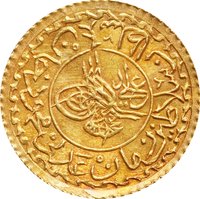
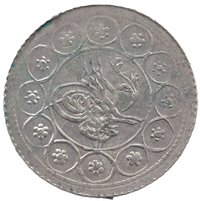
Obverse
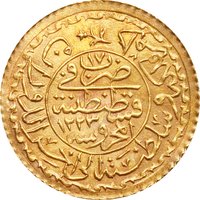
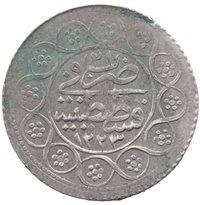
Reverse
Description:
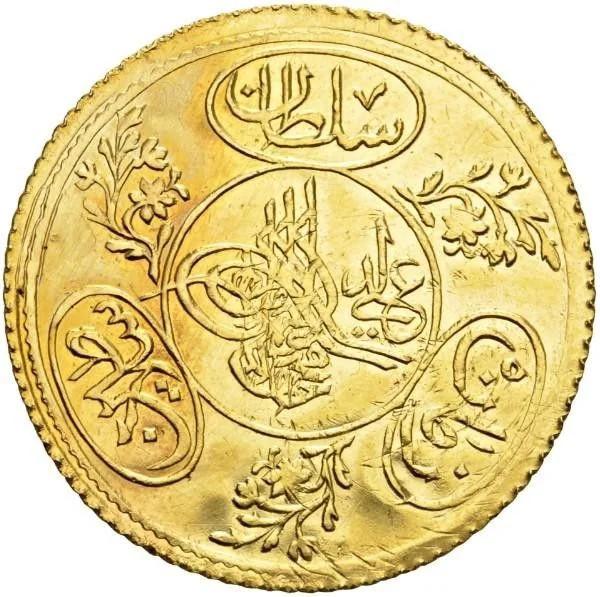
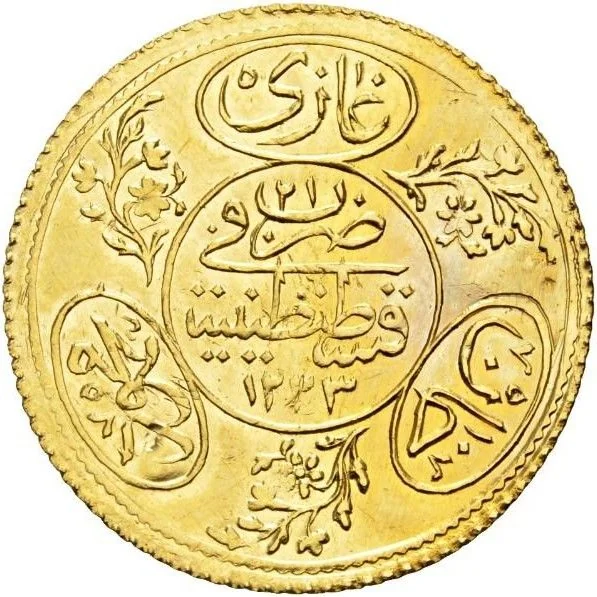
Central circle with mint and year, three inscribed ovals, and surrounding floral sprigs.
Inscription:
غازى | محمود | خان
٢١
ضرب
في
قسطنطينية
١٢٢٣
٢١
ضرب
في
قسطنطينية
١٢٢٣
Translation:
Ghazi | Mahmud | Khan
21
Struck
in
Constantinople
1223
21
Struck
in
Constantinople
1223
Script: Arabic
Languages: Arabic, Ottoman Turkish
Edge
Mints
| Name | Mark |
|---|---|
| Constantinople | — |
Mintings
| Year | Mint Mark | Mintage | Quality | Collection |
|---|---|---|---|---|
| 1827 | — | — |
Historical background
In 1827, the Ottoman Empire's currency system was in a state of profound crisis, characterized by severe depreciation and loss of confidence. The primary unit, the kuruş (piastre), was a silver-based coin, but decades of financial strain from military defeats, internal rebellions, and the rising costs of a modernizing state had forced the Porte to repeatedly debase the coinage. By the 1820s, the silver content of the kuruş had been drastically reduced, leading to a wide gap between its official and market value. This was compounded by the widespread circulation of a vast array of foreign coins—especially the Austrian thaler and Spanish real—which were often preferred for their reliable silver content, further undermining the Ottoman monetary authority.
The situation was acutely worsened by the ongoing Greek War of Independence (1821-1829), which was reaching a critical juncture in 1827. The costly campaign drained the imperial treasury, forcing the state to resort to short-term, high-interest loans from Galata bankers and to issue even more debased currency to pay troops and fund operations. This cycle of deficit financing led to rampant inflation, particularly in urban centers like Istanbul. The infamous Battle of Navarino in October 1827, where the combined British, French, and Russian fleet destroyed the Ottoman-Egyptian navy, was not just a military catastrophe but also a financial one, guaranteeing further expenditure and loss of revenue.
Consequently, the monetary landscape was one of chaotic duality. While the state accounted its finances in the nominal kuruş, everyday commercial transactions were increasingly conducted using a fluctuating mix of debased domestic coins and foreign specie, valued by weight and purity. This period laid bare the structural weaknesses of the traditional Ottoman fiscal system and highlighted the urgent need for reform. The crisis of 1827 thus set the stage for the more centralized monetary reforms that would follow in the subsequent decades under Sultan Abdülmecid I, culminating in the introduction of the first Ottoman gold lira in 1844.
The situation was acutely worsened by the ongoing Greek War of Independence (1821-1829), which was reaching a critical juncture in 1827. The costly campaign drained the imperial treasury, forcing the state to resort to short-term, high-interest loans from Galata bankers and to issue even more debased currency to pay troops and fund operations. This cycle of deficit financing led to rampant inflation, particularly in urban centers like Istanbul. The infamous Battle of Navarino in October 1827, where the combined British, French, and Russian fleet destroyed the Ottoman-Egyptian navy, was not just a military catastrophe but also a financial one, guaranteeing further expenditure and loss of revenue.
Consequently, the monetary landscape was one of chaotic duality. While the state accounted its finances in the nominal kuruş, everyday commercial transactions were increasingly conducted using a fluctuating mix of debased domestic coins and foreign specie, valued by weight and purity. This period laid bare the structural weaknesses of the traditional Ottoman fiscal system and highlighted the urgent need for reform. The crisis of 1827 thus set the stage for the more centralized monetary reforms that would follow in the subsequent decades under Sultan Abdülmecid I, culminating in the introduction of the first Ottoman gold lira in 1844.
💎 Extremely Rare