

10 Pesetas – Spain
Spain
Context
Years: 1983–1985
Issuer: Spain 
Ruler: Juan Carlos I
Currency:
(1868—2001)
Demonetization: 28 February 2002
Total mintage: 260,706,000
Material
References
KM: #Click to copy to clipboard827
Numista: #794
Value
Exchange value: 10 ESP
Inflation-adjusted value: 47.64 ESP
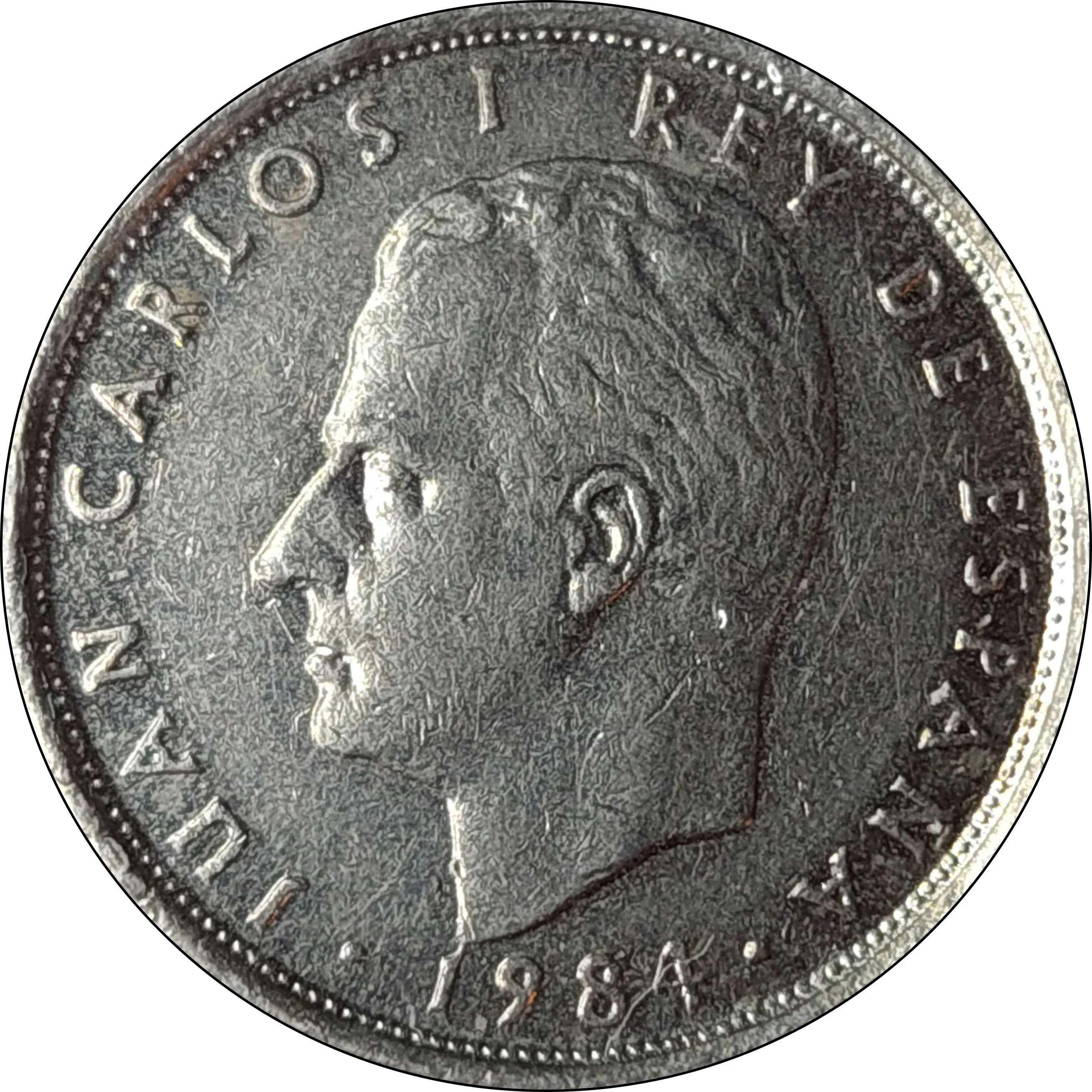
Obverse
Description:
King Juan Carlos I facing left.
Inscription:
JUAN CARLOS I REY DE ESPAÑA
· 1984 ·
· 1984 ·
Translation:
Juan Carlos I King of Spain
· 1984 ·
· 1984 ·
Script: Latin
Language: Spanish
Engraver: Manuel Martinez Tornero
Reverse
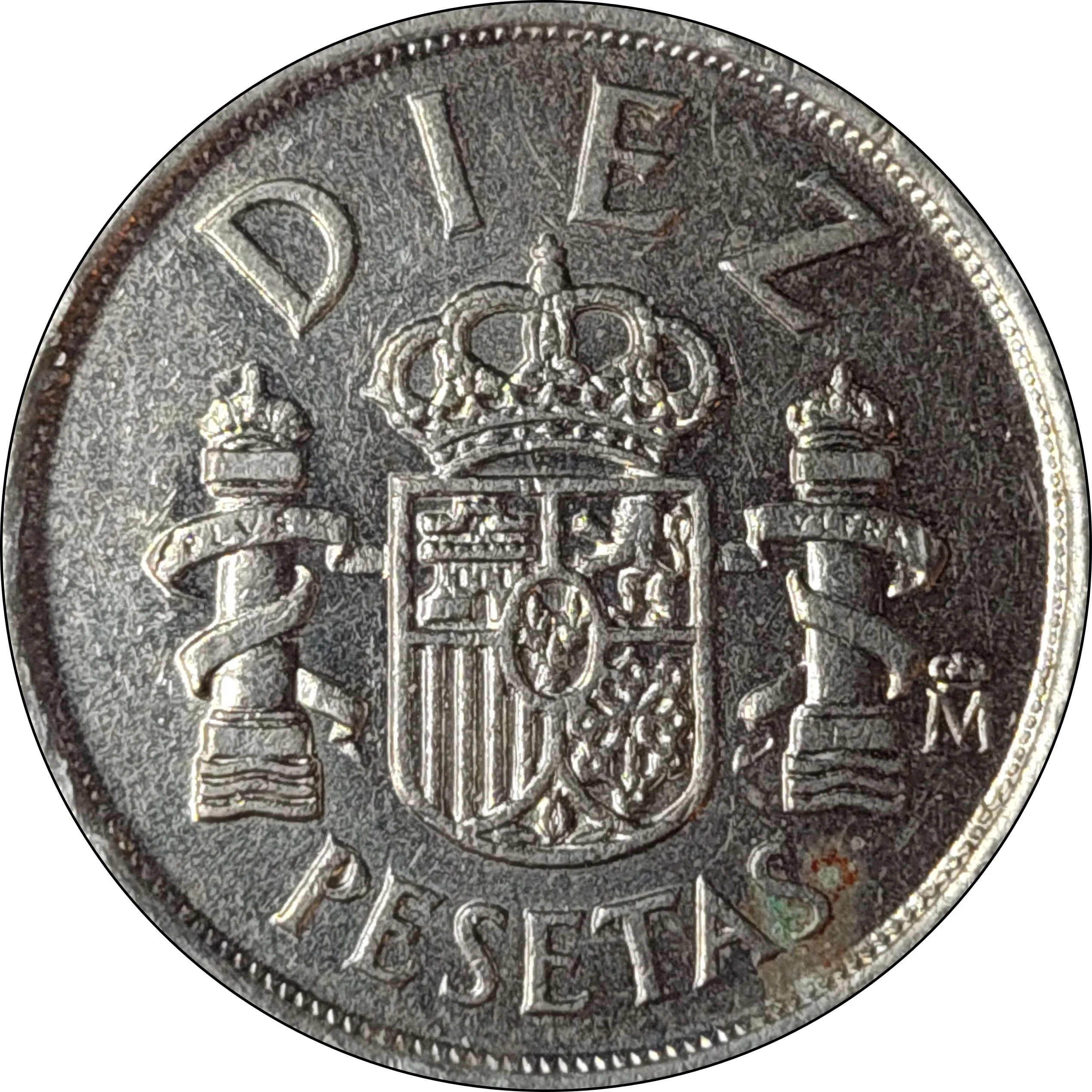
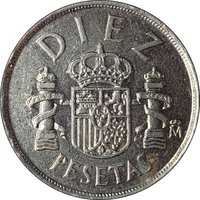
Description:
Spanish coat of arms featuring the Pillars of Hercules.
Inscription:
DIEZ
PLUS ULTRA
M
PESETAS
PLUS ULTRA
M
PESETAS
Translation:
TEN
FURTHER BEYOND
M
PESETAS
FURTHER BEYOND
M
PESETAS
Script: Latin
Engraver: Manuel Martinez Tornero
Edge
Reeded
Categories
| Mythology |
| Symbols> Coat of Arms |
Mints
| Name | Mark |
|---|---|
| Royal Mint of Madrid | (M) |
Mintings
| Year | Mint Mark | Mintage | Quality | Collection |
|---|---|---|---|---|
| 1983 | M | 149,000,000 | ||
| 1984 | M | 66,000,000 | ||
| 1985 | M | 45,706,000 |
Historical background
In 1983, Spain was navigating a critical and turbulent period of economic transition, still grappling with the profound aftershocks of the 1970s oil crises and the political transition to democracy following Franco's death. The economy was characterized by high inflation (over 12%), stubbornly high unemployment (approaching 17%), and a significant public deficit. The Spanish peseta, the national currency, was under considerable pressure, having undergone a series of devaluations. A major devaluation in December 1982, just as the new Socialist government of Felipe González took office, was a stark admission that the peseta was overvalued and that Spain's industrial competitiveness was severely lacking.
The government's primary economic objective was to stabilize the currency and curb inflation to align with European partners, a prerequisite for its strategic goal of joining the European Economic Community (EEC). This led to a period of strict austerity and a "policy of competitive disinflation," which combined tight monetary policy, wage restraint, and further managed devaluations of the peseta to boost exports. The peseta was part of the European Monetary System's (EMS) exchange rate mechanism, but within its wider fluctuation band, allowing for controlled adjustments. These devaluations in 1982 and 1983 were painful but deliberate tools to correct external imbalances without fully sacrificing monetary stability.
Thus, the currency situation in 1983 was one of managed weakness and strategic realignment. The peseta's value was not left to free markets but was carefully steered by the Bank of Spain and the government as a central instrument for economic restructuring. This painful medicine was seen as essential to modernize the economy, reduce the trade deficit, and ultimately achieve convergence with Europe—a goal that would culminate in Spain's EEC accession in 1986 and the eventual replacement of the peseta with the euro decades later.
The government's primary economic objective was to stabilize the currency and curb inflation to align with European partners, a prerequisite for its strategic goal of joining the European Economic Community (EEC). This led to a period of strict austerity and a "policy of competitive disinflation," which combined tight monetary policy, wage restraint, and further managed devaluations of the peseta to boost exports. The peseta was part of the European Monetary System's (EMS) exchange rate mechanism, but within its wider fluctuation band, allowing for controlled adjustments. These devaluations in 1982 and 1983 were painful but deliberate tools to correct external imbalances without fully sacrificing monetary stability.
Thus, the currency situation in 1983 was one of managed weakness and strategic realignment. The peseta's value was not left to free markets but was carefully steered by the Bank of Spain and the government as a central instrument for economic restructuring. This painful medicine was seen as essential to modernize the economy, reduce the trade deficit, and ultimately achieve convergence with Europe—a goal that would culminate in Spain's EEC accession in 1986 and the eventual replacement of the peseta with the euro decades later.
🌱 Very Common