

100 Pesetas – Spain
Spain
Context
Years: 1982–1990
Issuer: Spain 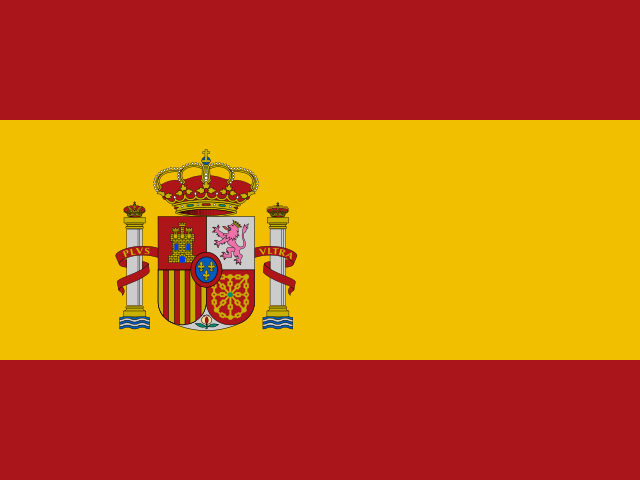
Ruler: Juan Carlos I
Currency:
(1868—2001)
Demonetization: 28 February 2002
Total mintage: 891,840,000
Material
References
KM: #Click to copy to clipboard826
Numista: #1258
Value
Exchange value: 100 ESP
Inflation-adjusted value: 545.09 ESP
Obverse
Description:
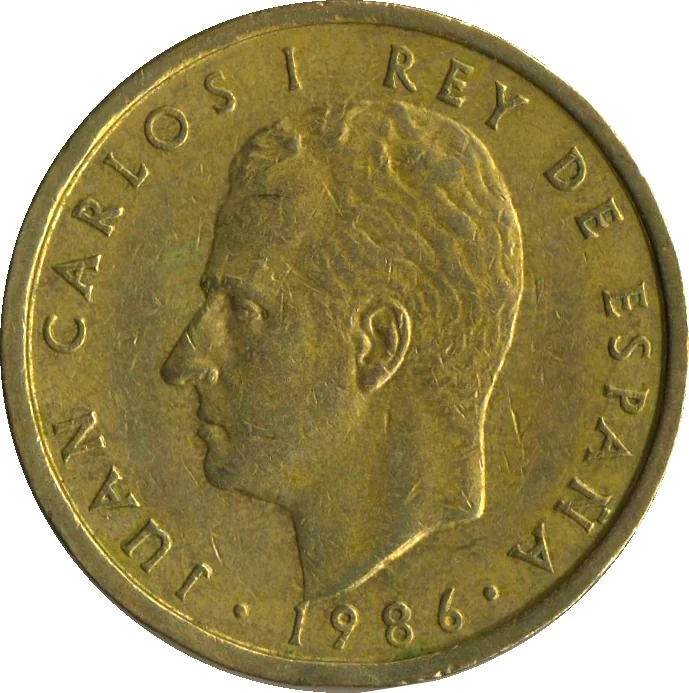
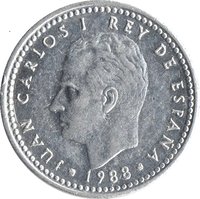
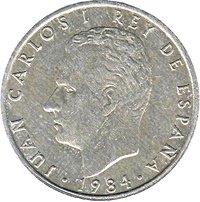
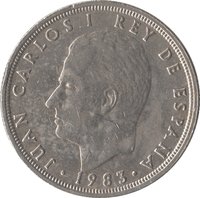
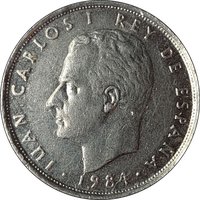
King Juan Carlos I facing left.
Inscription:
JUAN CARLOS I REY DE ESPAÑA
· 1986 ·
· 1986 ·
Translation:
JUAN CARLOS I KING OF SPAIN
· 1986 ·
· 1986 ·
Script: Latin
Language: Spanish
Engraver: Manuel Martinez Tornero
Reverse
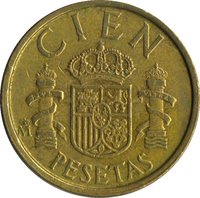
Description:
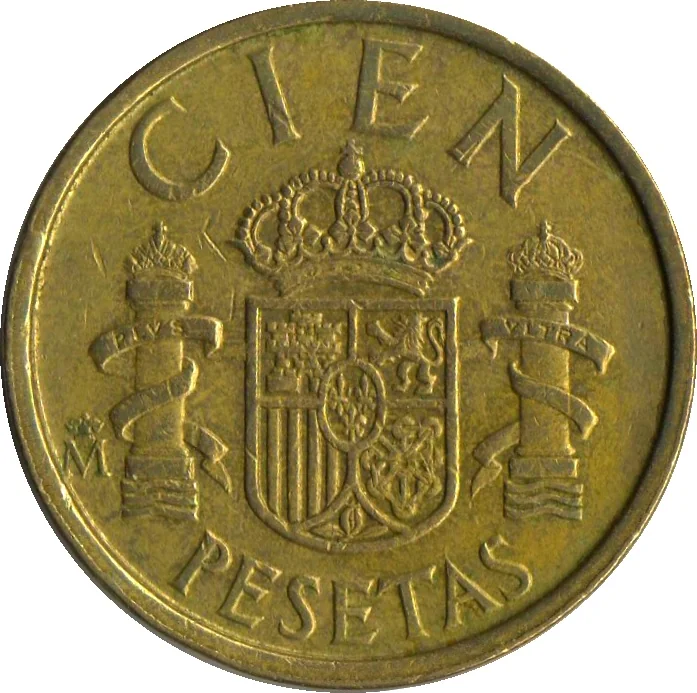
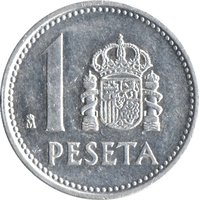
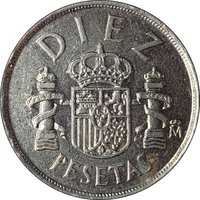
Spanish coat of arms featuring the Pillars of Hercules.
Inscription:
CIEN PESETAS
PLVS VLTRA
M
PLVS VLTRA
M
Translation:
One Hundred Pesetas
Further Beyond
Further Beyond
Script: Latin
Engraver: Manuel Martinez Tornero
Edge
Categories
| Mythology |
| Symbols> Coat of Arms |
Mints
| Name | Mark |
|---|---|
| Royal Mint of Madrid | (M) |
Mintings
| Year | Mint Mark | Mintage | Quality | Collection |
|---|---|---|---|---|
| 1982 | M | — | Proof | |
| 1982 | M | 117,600,000 | ||
| 1983 | M | 182,000,000 | ||
| 1984 | M | 208,000,000 | ||
| 1985 | M | 118,000,000 | ||
| 1986 | M | 160,000,000 | ||
| 1988 | M | — | ||
| 1989 | M | 80,877,000 | ||
| 1990 | M | 25,363,000 |
Historical background
In 1982, Spain was navigating a complex and challenging currency situation, deeply intertwined with its political transition and economic modernization. The country was still emerging from the autarkic policies of the Franco era and had recently embarked on a path of democratic and economic integration with Europe. The peseta, the national currency, was weak and prone to devaluation, suffering from high inflation (around 14% in 1982), a significant trade deficit, and capital flight due to political uncertainty. This instability was a legacy of the 1970s oil crises and the structural weaknesses of the Spanish economy, creating a persistent lack of confidence in the peseta on international markets.
The government's response, under Prime Minister Leopoldo Calvo-Sotelo of the Union of the Democratic Centre (UCD), was to pursue a policy of competitive devaluations. The peseta was devalued three times between 1977 and 1982, with a significant 8% devaluation in December 1982, just as the Spanish Socialist Workers' Party (PSOE) was coming to power. These devaluations aimed to boost exports by making Spanish goods cheaper abroad, but they also risked importing further inflation by increasing the cost of critical imports like oil. Monetary policy was largely subordinated to these exchange rate goals and the need to finance public deficits.
Crucially, this period was defined by Spain's strategic orientation toward European integration. The desire to eventually join the European Economic Community (EEC) necessitated greater monetary stability and economic convergence. In 1982, Spain was still outside the European Monetary System (EMS), but the debate was intensifying. The incoming PSOE government, led by Felipe González, would make EEC membership a top priority, understanding that anchoring the volatile peseta to a European discipline was essential for modernizing the economy and taming inflation, setting the stage for Spain's eventual entry into the EMS in 1989.
The government's response, under Prime Minister Leopoldo Calvo-Sotelo of the Union of the Democratic Centre (UCD), was to pursue a policy of competitive devaluations. The peseta was devalued three times between 1977 and 1982, with a significant 8% devaluation in December 1982, just as the Spanish Socialist Workers' Party (PSOE) was coming to power. These devaluations aimed to boost exports by making Spanish goods cheaper abroad, but they also risked importing further inflation by increasing the cost of critical imports like oil. Monetary policy was largely subordinated to these exchange rate goals and the need to finance public deficits.
Crucially, this period was defined by Spain's strategic orientation toward European integration. The desire to eventually join the European Economic Community (EEC) necessitated greater monetary stability and economic convergence. In 1982, Spain was still outside the European Monetary System (EMS), but the debate was intensifying. The incoming PSOE government, led by Felipe González, would make EEC membership a top priority, understanding that anchoring the volatile peseta to a European discipline was essential for modernizing the economy and taming inflation, setting the stage for Spain's eventual entry into the EMS in 1989.
Series: 1982 Spain circulation coins
🌱 Very Common