

200 pesetas – Spain
Add to wishlist
Spain
Context
Years: 1986–1988
Issuer: Spain
Ruler: Juan Carlos I
Currency:
(1868—2001)
Demonetization: 1 January 1997
Total mintage: 147,484,000
Material
References
KM: #
Numista: #2285
Value
Exchange value: 200 ESP
Inflation-adjusted value: 701.57 ESP
Obverse
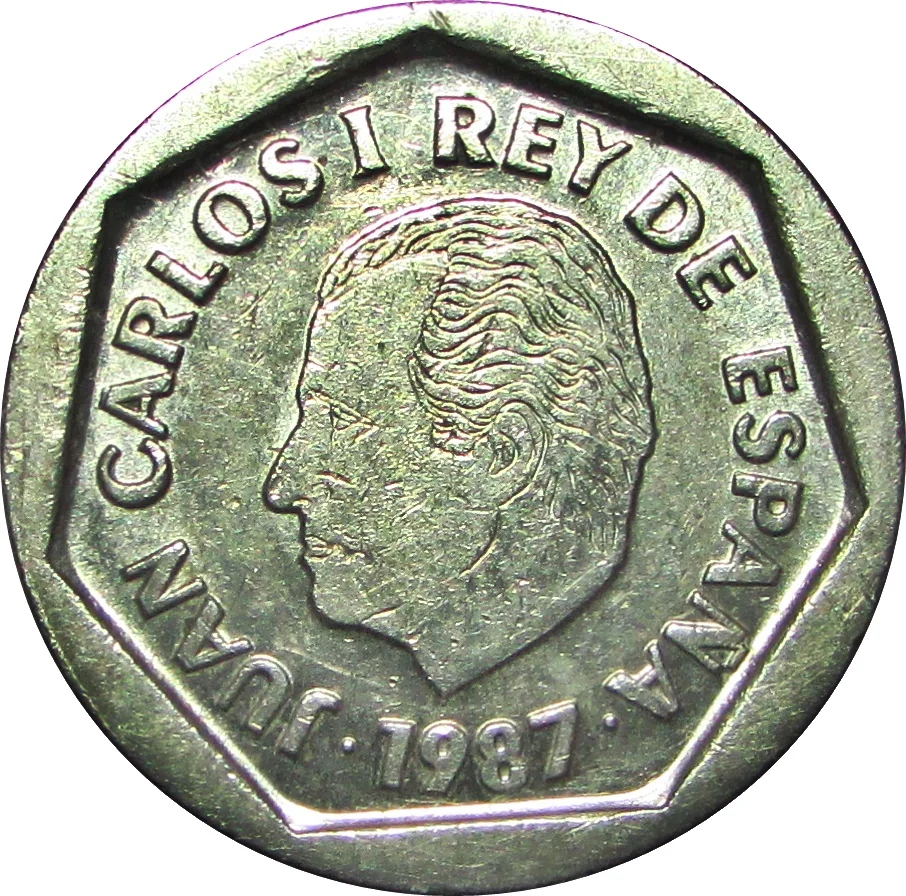
Description:
King Juan Carlos I facing left.
Inscription:
JUAN CARLOS I REY DE ESPAÑA
· 1987 ·
· 1987 ·
Translation:
Juan Carlos I King of Spain
· 1987 ·
· 1987 ·
Script: Latin
Language: Spanish
Engraver: Francisco Martínez Tornero
Reverse
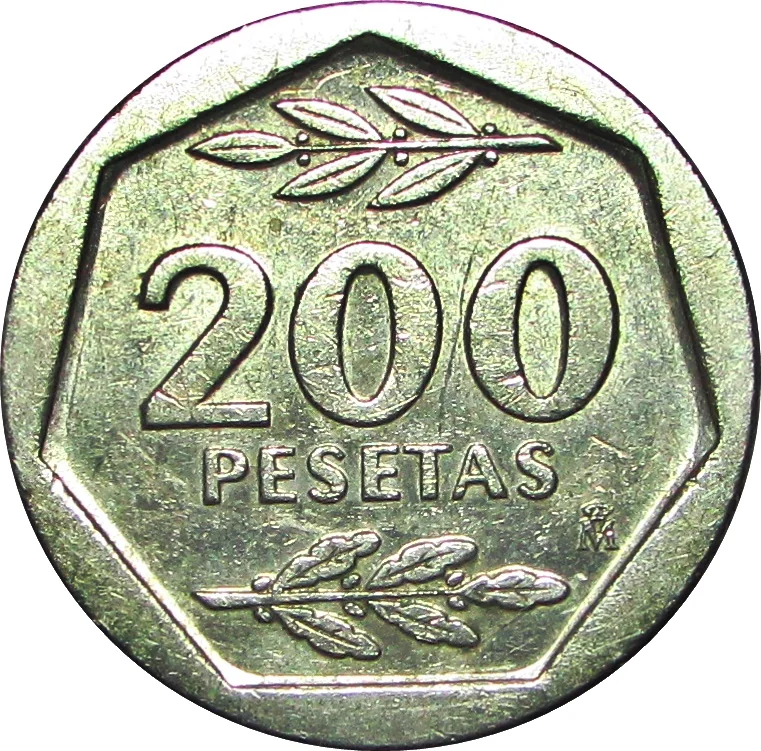
Description:
Olive branch above, oak below.
Inscription:
200 PESETAS
M
M
Script: Latin
Engraver: Francisco Martínez Tornero
Edge
Segmented reeding
Mints
| Name | Mark |
|---|---|
| Royal Mint of Madrid | (M) |
Mintings
| Year | Mint Mark | Mintage | Quality | Collection |
|---|---|---|---|---|
| 1986 | M | 43,576,000 | ||
| 1987 | M | 66,718,000 | ||
| 1988 | M | 37,190,000 |
Historical background
In 1986, Spain's currency situation was defined by its dual transition: into a modern European democracy and towards deeper integration with the European Economic Community (EEC), which it had joined on January 1st of that year. The national currency was the peseta, which operated under a managed float within the European Monetary System's (EMS) Exchange Rate Mechanism (ERM). However, Spain did not immediately join the ERM upon EEC accession; it would formally enter in June 1989. Prior to that, the Bank of Spain managed the peseta against a basket of currencies, with a particular focus on maintaining stability against the powerful German Deutsche Mark, the anchor of the EMS, to signal monetary discipline and commitment to European convergence.
Economically, the mid-1980s were a period of robust growth for Spain, fueled by structural reforms, foreign investment inflows, and optimism surrounding EEC membership. This created upward pressure on the peseta. However, the currency also faced underlying vulnerabilities, including a persistently high inflation rate that exceeded the EEC average. This inflation differential threatened Spain's competitiveness and created a constant tension for monetary authorities, who had to balance the goals of price stability, economic growth, and preparing for future fixed exchange rate regimes within Europe.
Therefore, the currency situation in 1986 was one of preparation and cautious management. The overarching strategy, led by the government of Felipe González, was to use the discipline of future European monetary integration as an external anchor to modernize the Spanish economy and curb inflation. Policies were increasingly geared towards meeting the convergence criteria that would later be formalized in the Maastricht Treaty. The peseta's value and stability became a key barometer of Spain's successful Europeanization, setting the stage for its eventual entry into the ERM and, ultimately, the adoption of the euro in 1999.
Economically, the mid-1980s were a period of robust growth for Spain, fueled by structural reforms, foreign investment inflows, and optimism surrounding EEC membership. This created upward pressure on the peseta. However, the currency also faced underlying vulnerabilities, including a persistently high inflation rate that exceeded the EEC average. This inflation differential threatened Spain's competitiveness and created a constant tension for monetary authorities, who had to balance the goals of price stability, economic growth, and preparing for future fixed exchange rate regimes within Europe.
Therefore, the currency situation in 1986 was one of preparation and cautious management. The overarching strategy, led by the government of Felipe González, was to use the discipline of future European monetary integration as an external anchor to modernize the Spanish economy and curb inflation. Policies were increasingly geared towards meeting the convergence criteria that would later be formalized in the Maastricht Treaty. The peseta's value and stability became a key barometer of Spain's successful Europeanization, setting the stage for its eventual entry into the ERM and, ultimately, the adoption of the euro in 1999.
🌱 Very Common