

Obverse
Description:
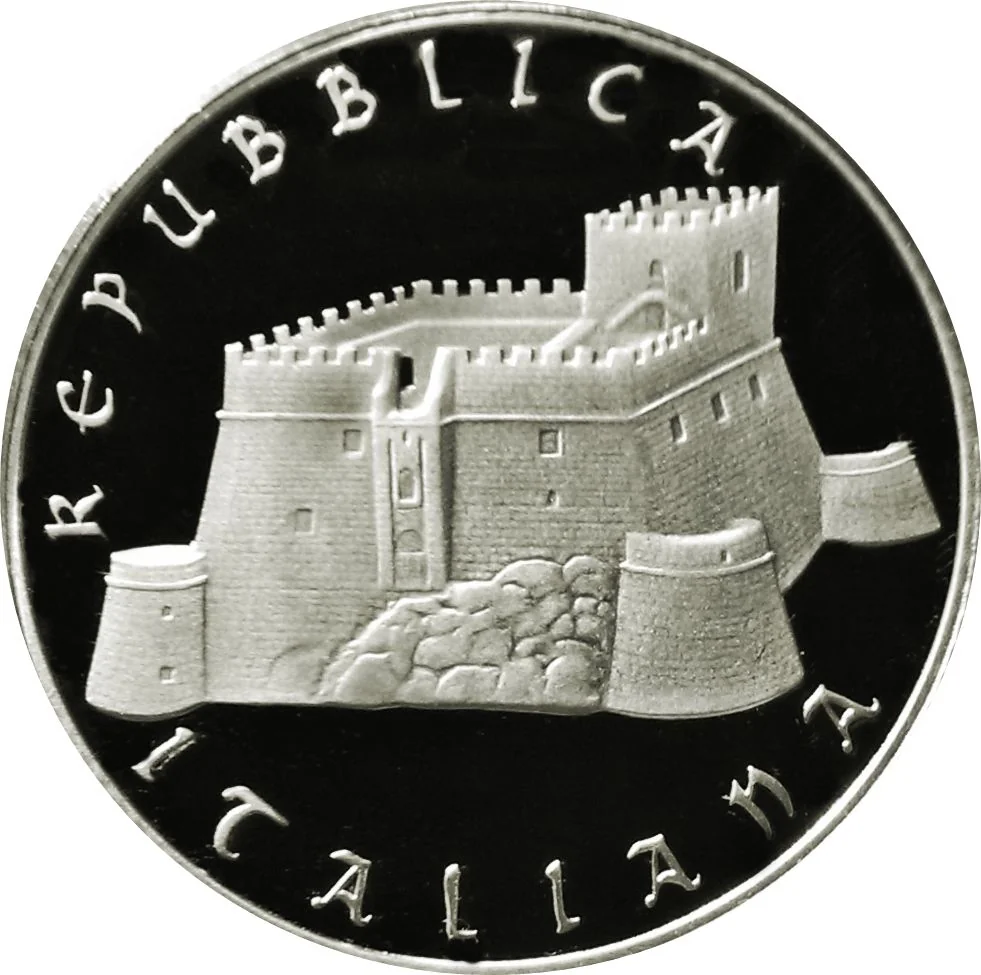
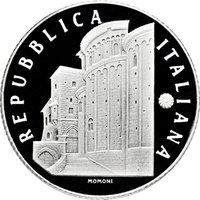
Monforte Castle overlooking Campobasso from a central hill.
Inscription:
REPUBBLICA
ITALIANA
ITALIANA
Translation:
Italian Republic
Language: Italian
Engraver: Claudia Momoni
Reverse
Description:
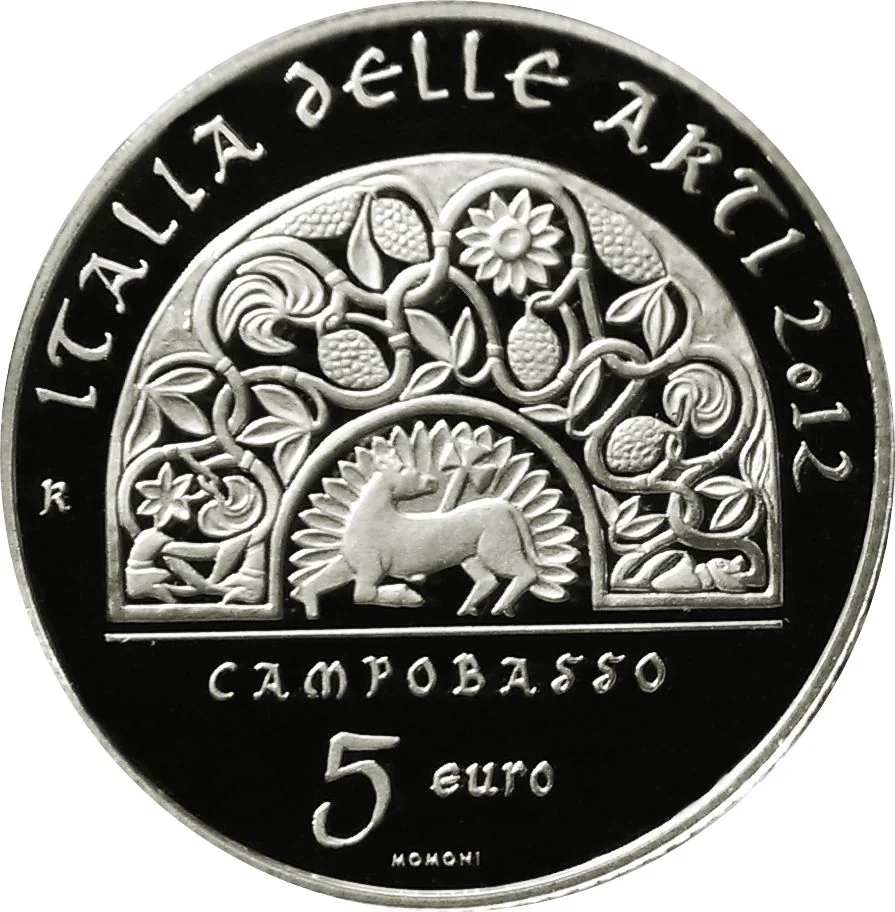
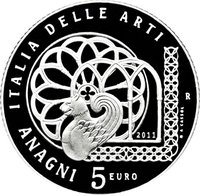
Lunette of St. George Church (Campobasso's ancient church) decorated with grapevines and foliage, featuring a central mystical lamb. Below are the artist's name and the value.
Inscription:
ITALIA DELLE ARTI 2012
R
CAMPOBASSO
5 EURO
MOMONI
R
CAMPOBASSO
5 EURO
MOMONI
Translation:
Italy of the Arts 2012
R
Campobasso
5 Euro
MOMONI
R
Campobasso
5 Euro
MOMONI
Language: Italian
Engraver: Claudia Momoni
Edge
Reeded
Categories
| Art> Sculpture |
| Building> Castle or fortification |
Mints
| Name | Mark |
|---|---|
| Rome | R |
Mintings
| Year | Mint Mark | Mintage | Quality | Collection |
|---|---|---|---|---|
| 2012 | R | 4,000 | Proof |
Historical background
In 2012, Italy found itself at the epicenter of the Eurozone debt crisis, a period of severe financial strain that threatened the stability of the single currency. The country was burdened by a massive public debt exceeding 120% of its GDP, stagnant economic growth, and high borrowing costs. Investors, losing confidence in Italy's ability to manage its finances, demanded increasingly high yields to hold Italian government bonds, pushing the 10-year BTP yield above 7%—a level widely seen as unsustainable. This created a dangerous feedback loop where fears of default raised borrowing costs, which in turn worsened the debt outlook, pushing Italy toward a potential need for a sovereign bailout that the European rescue funds were ill-equipped to handle.
The situation was a direct threat to the euro itself, as Italy's economy was deemed "too big to fail but too big to save." The crisis was fundamentally a crisis of confidence in both Italian economic governance and the European Central Bank's (ECB) role as a lender of last resort. Domestically, technocrat Prime Minister Mario Monti, appointed in late 2011, implemented harsh austerity measures and structural reforms to restore fiscal credibility. However, these austerity policies also deepened a recession, exacerbating social unrest and political fragmentation within the country.
The turning point came in the summer of 2012 when ECB President Mario Draghi delivered his historic "whatever it takes" speech, pledging to do everything necessary to preserve the euro. This commitment culminated in the announcement of the Outright Monetary Transactions (OMT) program, a conditional bond-buying backstop. While no Italian bonds were ever purchased under OMT, the mere announcement dramatically reduced Italian borrowing costs by alleviating existential fears about the euro's breakup. Thus, 2012 ended with the immediate pressure subsiding, but with Italy's underlying structural economic weaknesses—low growth, high debt, and political instability—largely unresolved.
The situation was a direct threat to the euro itself, as Italy's economy was deemed "too big to fail but too big to save." The crisis was fundamentally a crisis of confidence in both Italian economic governance and the European Central Bank's (ECB) role as a lender of last resort. Domestically, technocrat Prime Minister Mario Monti, appointed in late 2011, implemented harsh austerity measures and structural reforms to restore fiscal credibility. However, these austerity policies also deepened a recession, exacerbating social unrest and political fragmentation within the country.
The turning point came in the summer of 2012 when ECB President Mario Draghi delivered his historic "whatever it takes" speech, pledging to do everything necessary to preserve the euro. This commitment culminated in the announcement of the Outright Monetary Transactions (OMT) program, a conditional bond-buying backstop. While no Italian bonds were ever purchased under OMT, the mere announcement dramatically reduced Italian borrowing costs by alleviating existential fears about the euro's breakup. Thus, 2012 ended with the immediate pressure subsiding, but with Italy's underlying structural economic weaknesses—low growth, high debt, and political instability—largely unresolved.
Series: Italy of Arts
💎 Extremely Rare