

Obverse
Description:
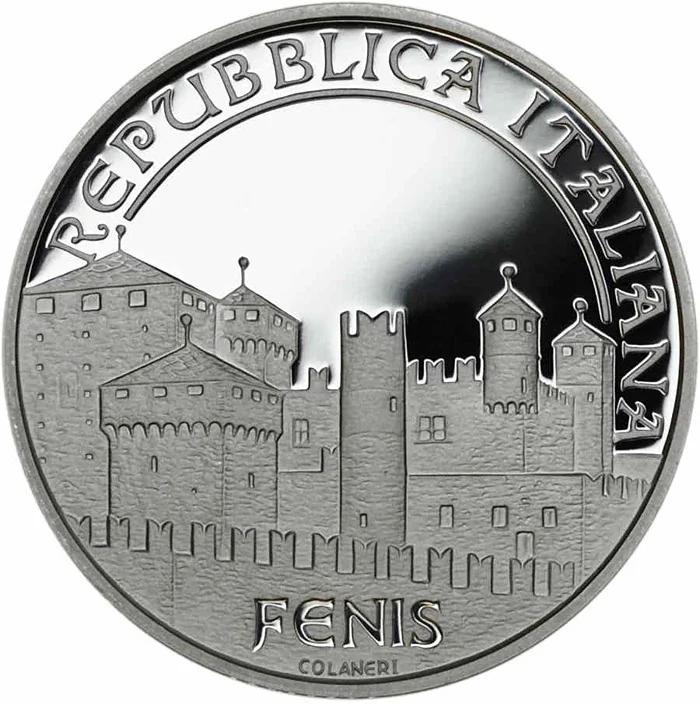
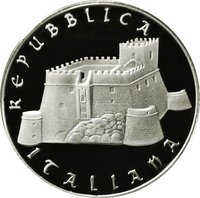
Exterior view of Fénis Castle; engraver's name along the lower border.
Inscription:
REPUBBLICA ITALIANA
FENIS
COLANERI
FENIS
COLANERI
Translation:
Italian Republic
The End
Colaneri
The End
Colaneri
Script: Latin
Engraver: Maria Carmela Colaneri
Reverse
Description:
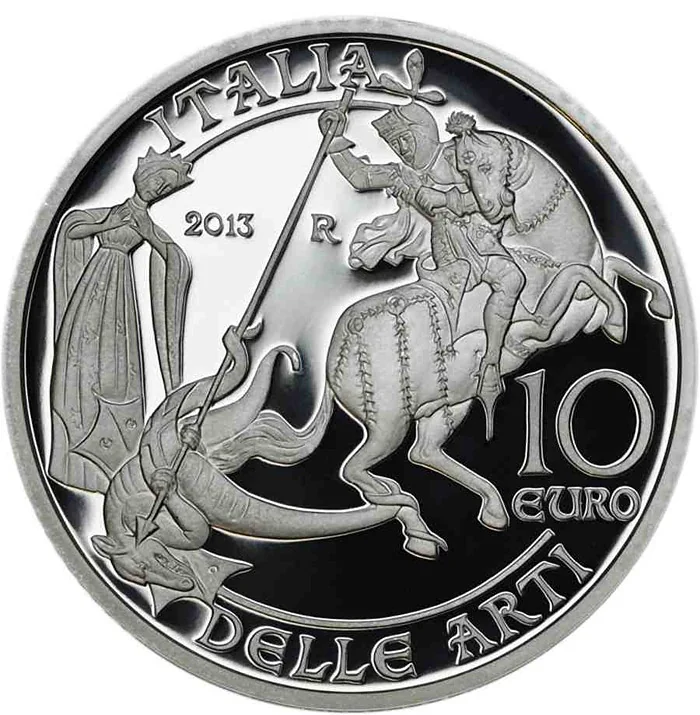
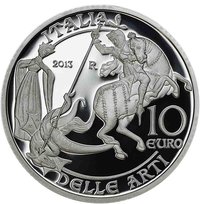
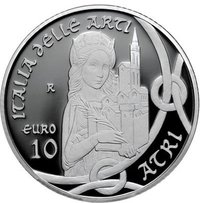
Fresco of Saint George slaying the dragon, from the inner courtyard staircase of Fénis Castle. Central date and mintmark; value at bottom right.
Inscription:
ITALIA
2013 R
10
EURO
DELLE ARTI
2013 R
10
EURO
DELLE ARTI
Translation:
Italy
2013 R
10
Euro
of the Arts
2013 R
10
Euro
of the Arts
Script: Latin
Language: Italian
Engraver: Maria Carmela Colaneri
Edge
Discontinuous coarse milled
Categories
| Mythology> Fantastic animal |
| Animal> Horse |
| Building> Castle or fortification |
Mints
| Name | Mark |
|---|---|
| Rome | R |
Mintings
| Year | Mint Mark | Mintage | Quality | Collection |
|---|---|---|---|---|
| 2013 | R | 3,900 | Proof |
Historical background
In 2013, Italy remained deeply entrenched in the Eurozone sovereign debt crisis, which had erupted in full force in 2011. The country was operating under the euro, having adopted the single currency in 1999, which meant it had relinquished control over its monetary policy and currency valuation to the European Central Bank (ECB). This lack of monetary sovereignty was a double-edged sword: it provided stability and prevented a speculative currency collapse, but it also stripped Italy of the traditional tools to devalue its way out of economic trouble. Consequently, the government was forced to implement harsh austerity measures and structural reforms under intense pressure from European institutions and financial markets to reduce its massive public debt, which exceeded 130% of GDP.
The year was politically charged, beginning with a hung parliament after the February elections, which resulted in a fragile grand coalition government led by Enrico Letta by April. Financial markets and European partners closely watched Rome, concerned about the risk of political instability derailing fiscal consolidation. While the immediate threat of Italy being forced out of the euro (a "Italeave") had receded after the ECB's "whatever it takes" pledge in mid-2012, underlying vulnerabilities remained severe. The economy was in its longest postwar recession, with unemployment, particularly youth unemployment, reaching critical levels, fueling social discontent and raising questions about the long-term sustainability of the euro regime for Italy's stagnant economy.
Discussions around the currency situation therefore extended beyond the euro itself to include intense debate about Italy's future within the monetary union. Some economists and political factions began openly questioning the benefits of the euro, arguing that a return to a devalued national lira could restore competitiveness. However, this was considered a catastrophic scenario by the political mainstream and financial establishment, due to the risk of triggering a banking collapse and a sovereign default. Thus, 2013 was a year of fragile equilibrium within the euro, where the currency was both the perceived source of Italy's rigidities and the only anchor preventing a deeper financial crisis.
The year was politically charged, beginning with a hung parliament after the February elections, which resulted in a fragile grand coalition government led by Enrico Letta by April. Financial markets and European partners closely watched Rome, concerned about the risk of political instability derailing fiscal consolidation. While the immediate threat of Italy being forced out of the euro (a "Italeave") had receded after the ECB's "whatever it takes" pledge in mid-2012, underlying vulnerabilities remained severe. The economy was in its longest postwar recession, with unemployment, particularly youth unemployment, reaching critical levels, fueling social discontent and raising questions about the long-term sustainability of the euro regime for Italy's stagnant economy.
Discussions around the currency situation therefore extended beyond the euro itself to include intense debate about Italy's future within the monetary union. Some economists and political factions began openly questioning the benefits of the euro, arguing that a return to a devalued national lira could restore competitiveness. However, this was considered a catastrophic scenario by the political mainstream and financial establishment, due to the risk of triggering a banking collapse and a sovereign default. Thus, 2013 was a year of fragile equilibrium within the euro, where the currency was both the perceived source of Italy's rigidities and the only anchor preventing a deeper financial crisis.
Series: Italy of Arts
💎 Extremely Rare