

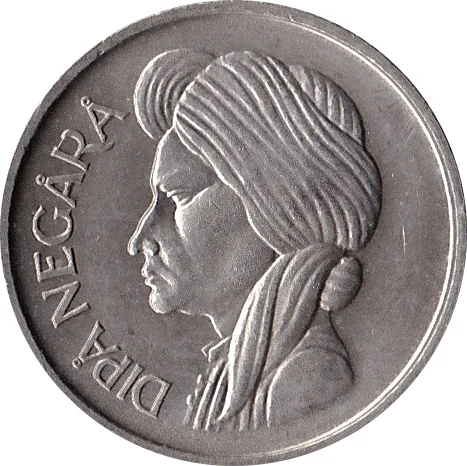
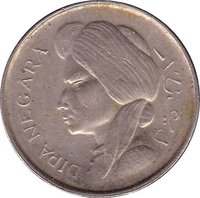
Obverse
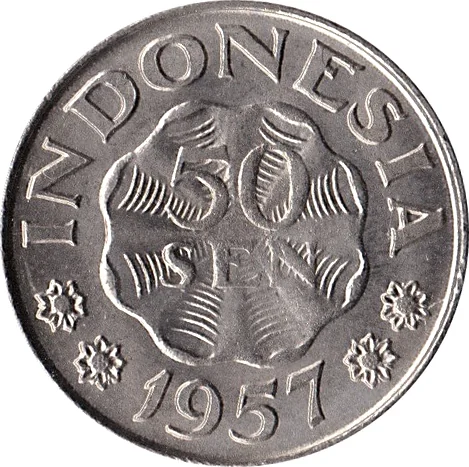
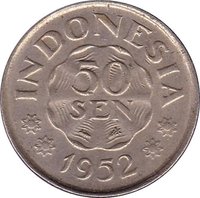
Reverse
Description:
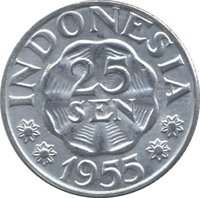
Denomination within scallops, ornaments flank date.
Inscription:
INDONESIA
50
SEN
1957
50
SEN
1957
Script: Latin
Edge
Reeded
Mints
| Name | Mark |
|---|---|
| Kings Norton Metal Company | — |
| Staatliche Münze Baden-Württemberg | — |
Mintings
| Year | Mint Mark | Mintage | Quality | Collection |
|---|---|---|---|---|
| 1954 | — | 1,290,000 | ||
| 1955 | — | 26,000,000 | ||
| 1957 | — | 26,267,313 |
Historical background
In 1954, Indonesia's currency situation was characterized by the complex legacy of the revolution and the early challenges of economic unification. Following independence in 1949, the nation grappled with multiple circulating currencies: the Indonesian rupiah (ORI), which had been introduced during the revolution, coexisted with Dutch-era notes and a variety of emergency "scrip" issued by regional authorities. This monetary fragmentation hindered national integration and economic stability, as the central government in Jakarta struggled to establish the rupiah as the sole, trusted legal tender across the vast archipelago.
Economically, the period was one of post-colonial strain and cautious stabilization. High inflation, a large budget deficit, and a reliance on a limited range of commodity exports (notably rubber and tin) created persistent pressure on the rupiah's value. The government, under Prime Minister Ali Sastroamidjojo, pursued policies focused on economic nationalism and import substitution, but these were often at odds with the need for fiscal discipline. While not in a state of hyperinflation, the currency remained weak, and foreign exchange reserves were critically low, limiting the capacity for essential imports and development projects.
Internationally, Indonesia's currency was non-convertible, and its value was managed through a system of strict exchange controls and multiple, complex rates set by the government. This created a thriving black market for foreign currency, particularly the US dollar, where the rupiah traded at a significant discount. The situation in 1954 thus reflected a young nation attempting to assert monetary sovereignty while navigating the turbulent waters of post-independence economic reconstruction, with the rupiah's stability being a central concern for both the government's legitimacy and the country's future development.
Economically, the period was one of post-colonial strain and cautious stabilization. High inflation, a large budget deficit, and a reliance on a limited range of commodity exports (notably rubber and tin) created persistent pressure on the rupiah's value. The government, under Prime Minister Ali Sastroamidjojo, pursued policies focused on economic nationalism and import substitution, but these were often at odds with the need for fiscal discipline. While not in a state of hyperinflation, the currency remained weak, and foreign exchange reserves were critically low, limiting the capacity for essential imports and development projects.
Internationally, Indonesia's currency was non-convertible, and its value was managed through a system of strict exchange controls and multiple, complex rates set by the government. This created a thriving black market for foreign currency, particularly the US dollar, where the rupiah traded at a significant discount. The situation in 1954 thus reflected a young nation attempting to assert monetary sovereignty while navigating the turbulent waters of post-independence economic reconstruction, with the rupiah's stability being a central concern for both the government's legitimacy and the country's future development.
🌱 Very Common