

50 sen – Indonesia
Add to wishlist
Indonesia
Context
Material
Diameter: 20 mm
Weight: 3.25 g
Thickness: 1.64 mm
Shape: Round
Composition: Copper-nickel
Technique: Milled
Alignment: Coin alignment
flip
References
KM: #
Numista: #6568
Obverse
Description:
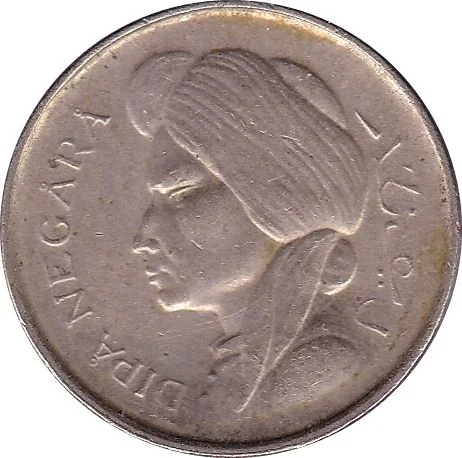
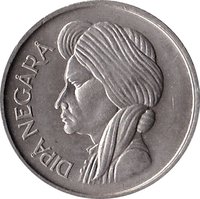
Portrait of Pangeran Diponegoro facing left, with Latin and Arabic Jawi inscriptions.
Inscription:
DIPÅ NEGÅRÅ
ديفنڬار
ديفنڬار
Translation:
Lord of the City
Designer: Ludwig Oswald Wenckebach
Reverse
Description:
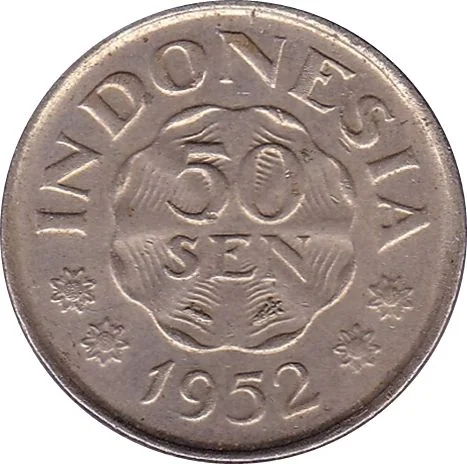
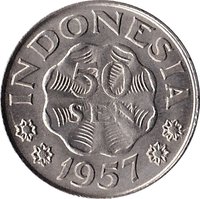
Blossoms and scallops frame "Value."
Inscription:
INDONESIA
50
SEN
1952
50
SEN
1952
Script: Latin
Designer: Ludwig Oswald Wenckebach
Edge
Milled
Mints
| Name | Mark |
|---|---|
| Royal Dutch Mint | — |
Mintings
| Year | Mint Mark | Mintage | Quality | Collection |
|---|---|---|---|---|
| 1952 | — | 100,000,000 |
Historical background
In 1952, Indonesia's currency situation was a critical challenge for the young republic, grappling with the economic legacy of revolution and the transition from colonial rule. The nation operated with the Indonesian rupiah, which had been introduced in 1949 to replace the Dutch East Indies gulden, but its stability was severely undermined. The government, led by President Sukarno, faced massive budget deficits primarily funded by printing new money, leading to rampant inflation. This hyperinflation eroded public confidence, caused severe hardship, and distorted the entire economy, making long-term planning and recovery from wartime destruction nearly impossible.
The core of the crisis was structural. The government's revenue base was weak, relying heavily on exports of a few commodities like rubber and tin, whose prices were volatile on the global market. Simultaneously, it bore the enormous costs of consolidating the state, including maintaining a large military and a burgeoning civil service. With an underdeveloped taxation system and limited foreign exchange reserves, the Bank Indonesia (established in 1953) lacked the tools to effectively conduct monetary policy. The currency's instability was both a cause and a symptom of a fragile economic foundation struggling to support national aspirations.
This precarious financial environment became a central issue in Indonesia's early political turmoil. The inflation crisis fueled public discontent and was a key factor in the political tensions that culminated in the October 17, 1952, incident, where military factions demonstrated against parliament. The currency instability underscored the difficulties of post-colonial state-building, forcing the government to seek external solutions. It set the stage for subsequent, often contentious, economic policies and negotiations for foreign aid and investment in the years that followed.
The core of the crisis was structural. The government's revenue base was weak, relying heavily on exports of a few commodities like rubber and tin, whose prices were volatile on the global market. Simultaneously, it bore the enormous costs of consolidating the state, including maintaining a large military and a burgeoning civil service. With an underdeveloped taxation system and limited foreign exchange reserves, the Bank Indonesia (established in 1953) lacked the tools to effectively conduct monetary policy. The currency's instability was both a cause and a symptom of a fragile economic foundation struggling to support national aspirations.
This precarious financial environment became a central issue in Indonesia's early political turmoil. The inflation crisis fueled public discontent and was a key factor in the political tensions that culminated in the October 17, 1952, incident, where military factions demonstrated against parliament. The currency instability underscored the difficulties of post-colonial state-building, forcing the government to seek external solutions. It set the stage for subsequent, often contentious, economic policies and negotiations for foreign aid and investment in the years that followed.

🌱 Common