

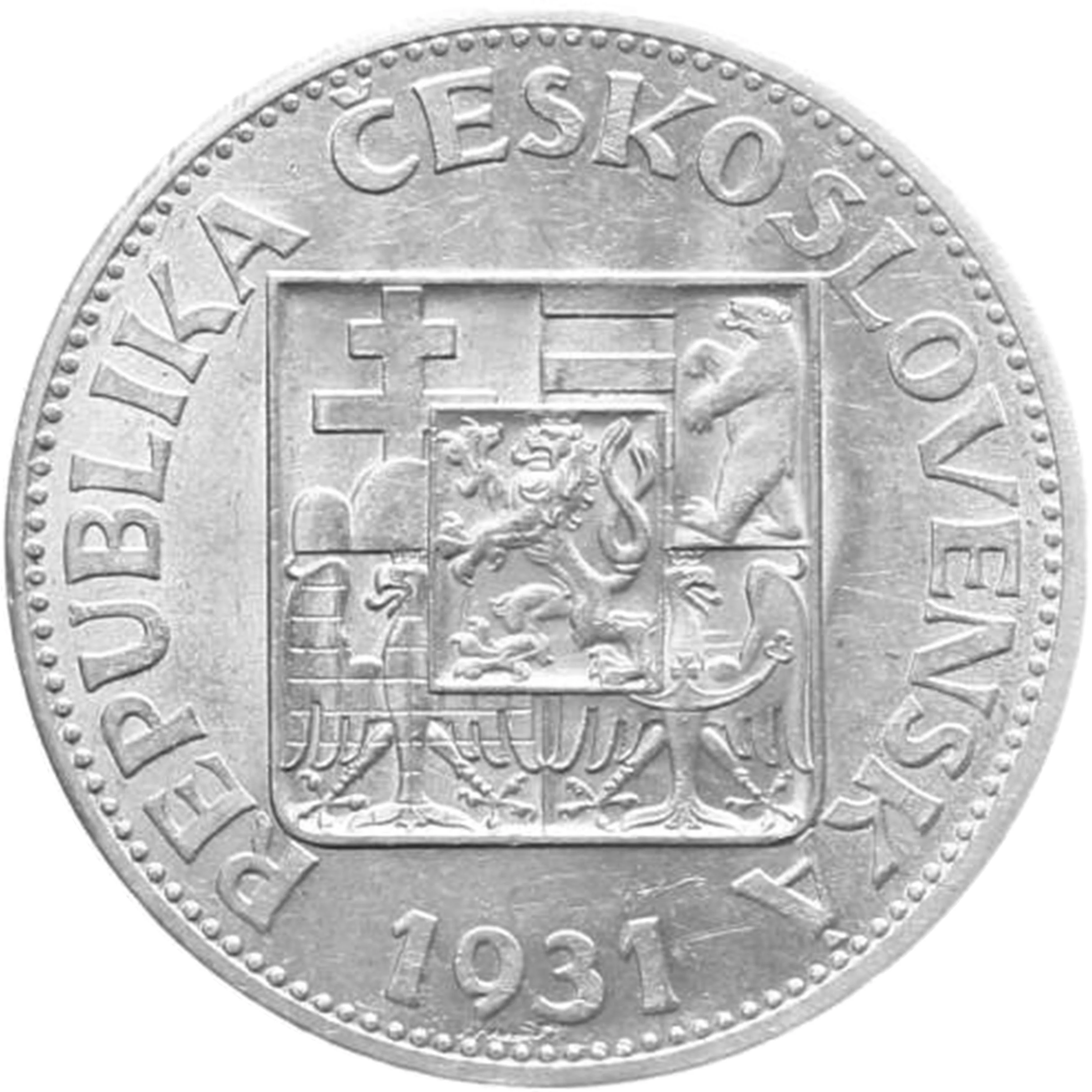

10 Korun / Korún – Czechoslovakia
Context
Years: 1930–1933
Issuer: Czechoslovakia 
Period:
(1918—1938)
Currency:
(1919—1939)
Demonetization: 31 March 1940
Total mintage: 24,000,500
Material
References
KM: #Click to copy to clipboard15
Numista: #7797
Value
Bullion value: $19.97
Obverse
Description:
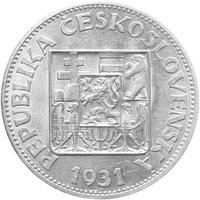
State emblem above date.
Inscription:
REPUBLIKA ČESKOSLOVENSKÁ
1931
1931
Translation:
REPUBLIC OF CZECHOSLOVAKIA
1931
1931
Script: Latin
Engraver: Jaroslav Horejc
Reverse
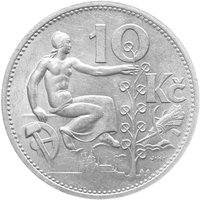
Description:
Lime tree owner, high value.
Inscription:
10 Kč
J.H
J.H
Translation:
Ten Czech Crowns
J.H
J.H
Script: Latin
Language: Czech
Engraver: Jaroslav Horejc
Edge
Milled
Mints
| Name | Mark |
|---|---|
| Kremnica | — |
Mintings
| Year | Mint Mark | Mintage | Quality | Collection |
|---|---|---|---|---|
| 1930 | — | 4,949,000 | ||
| 1931 | — | 6,689,000 | ||
| 1932 | — | 11,447,500 | ||
| 1933 | — | 915,000 |
Historical background
In 1930, Czechoslovakia's currency, the koruna (Kč), stood as a notable pillar of stability in Central Europe, a direct legacy of the rigorous financial policies implemented after the state's founding in 1918. Following the dissolution of the Austro-Hungarian Empire, the new government, led by Minister of Finance Alois Rašín, deliberately carved out a separate and strong monetary identity. This involved physically stamping and later replacing the old Austro-Hungarian banknotes, and pursuing a deflationary policy to establish a gold-backed currency with high value. By 1929, the Czechoslovak koruna was officially placed on the gold standard, earning it a reputation as the "hard currency" of the region, which bolstered international confidence and attracted foreign investment.
The domestic economic reality, however, was complex. The strong koruna benefited the financial sector and those with savings, but it made Czechoslovak exports, particularly from its dominant industrial and agricultural sectors, more expensive on the world market. This created persistent pressure on trade balances and contributed to economic disparities between the more developed Czech lands and the less industrialized Slovakia. While the country was largely spared the hyperinflation that devastated neighboring Germany and Austria in the early 1920s, its export-oriented industries were vulnerable to shifts in global demand.
This vulnerability would be severely tested as the 1930s progressed. The year 1930 itself marked a precarious turning point, as the stability painstakingly built during the 1920s began to confront the external shock of the Great Depression. The global collapse in trade and prices soon placed immense strain on the Czechoslovak economy. The fixed, high-value koruna became a burden, and the government was forced to defend its gold parity through strict austerity measures, leading to significant social and political tensions that would culminate in the eventual abandonment of the gold standard later in the decade.
The domestic economic reality, however, was complex. The strong koruna benefited the financial sector and those with savings, but it made Czechoslovak exports, particularly from its dominant industrial and agricultural sectors, more expensive on the world market. This created persistent pressure on trade balances and contributed to economic disparities between the more developed Czech lands and the less industrialized Slovakia. While the country was largely spared the hyperinflation that devastated neighboring Germany and Austria in the early 1920s, its export-oriented industries were vulnerable to shifts in global demand.
This vulnerability would be severely tested as the 1930s progressed. The year 1930 itself marked a precarious turning point, as the stability painstakingly built during the 1920s began to confront the external shock of the Great Depression. The global collapse in trade and prices soon placed immense strain on the Czechoslovak economy. The fixed, high-value koruna became a burden, and the government was forced to defend its gold parity through strict austerity measures, leading to significant social and political tensions that would culminate in the eventual abandonment of the gold standard later in the decade.
🌱 Common