


25 Haléřů / Halierov – Czechoslovakia
Context
Years: 1932–1933
Issuer: Czechoslovakia 
Period:
(1918—1938)
Currency:
(1919—1939)
Demonetization: 30 September 1941
Total mintage: 22,711,000
Material
Diameter: 21 mm
Weight: 4 g
Thickness: 1.5 mm
Shape: Round
Composition: Copper-nickel
Technique: Milled
Alignment: Medal alignment
flip
References
KM: #Click to copy to clipboard16
Numista: #6880
Obverse
Description:
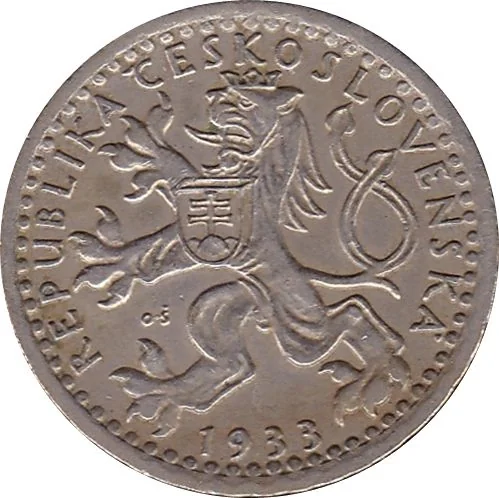
Czech lion, Slovak shield.
Inscription:
REPUBLIKA ČESKOSLOVENSKÁ
O·Š
1933
O·Š
1933
Translation:
REPUBLIC OF CZECHOSLOVAKIA
O·Š
1933
O·Š
1933
Script: Latin
Engraver: Otakar Španiel
Reverse
Description:
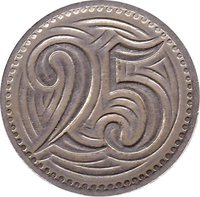
Beaded circle enclosing stylized text.
Inscription:
25
Translation:
In the 25th year of King George.
Script: Latin
Language: Latin
Engraver: Otakar Španiel
Edge
Coarsely reeded
Categories
| Symbols> Coat of Arms |
Mints
| Name | Mark |
|---|---|
| Kremnica | — |
Mintings
| Year | Mint Mark | Mintage | Quality | Collection |
|---|---|---|---|---|
| 1932 | — | — | ||
| 1933 | — | 22,711,000 |
Historical background
In 1932, Czechoslovakia found itself in a relatively stable but strained currency position amidst the global Great Depression. The country's financial system was anchored by the Czechoslovak koruna (Kčs), which had been successfully introduced in 1919 following the empire's dissolution. Under the prudent leadership of the National Bank and its first governor, Vilém Pospíšil, the koruna had achieved a hard-won stability, famously being placed on the gold standard in 1929. This discipline provided a shield against the hyperinflation that devastated neighboring Germany and Austria, but it came at a significant economic cost.
The primary challenge in 1932 was the severe deflationary pressure caused by maintaining the gold peg during a worldwide collapse in demand and prices. While the currency itself was strong and trusted internationally, the Czechoslovak economy suffered deeply. Industrial output, particularly in the dominant export sectors of textiles, glass, and armaments in the Czech lands, fell sharply. Agricultural prices in the Slovak and Ruthenian regions plummeted, leading to widespread rural distress. The government's commitment to a strong koruna limited its ability to use monetary policy to stimulate the economy, forcing it to rely on strict austerity measures and high interest rates to defend the currency's parity.
Consequently, the currency situation was a paradox of external strength and internal hardship. The koruna's stability preserved foreign credit and prevented a banking collapse, but it exacerbated domestic unemployment and social tensions. This period highlighted the difficult trade-offs of the gold standard during a global crisis, setting the stage for future debates about devaluation, which would eventually occur in 1934 as pressures became unsustainable. The policy preserved financial integrity but at the cost of deepening the economic downturn within the nation's borders.
The primary challenge in 1932 was the severe deflationary pressure caused by maintaining the gold peg during a worldwide collapse in demand and prices. While the currency itself was strong and trusted internationally, the Czechoslovak economy suffered deeply. Industrial output, particularly in the dominant export sectors of textiles, glass, and armaments in the Czech lands, fell sharply. Agricultural prices in the Slovak and Ruthenian regions plummeted, leading to widespread rural distress. The government's commitment to a strong koruna limited its ability to use monetary policy to stimulate the economy, forcing it to rely on strict austerity measures and high interest rates to defend the currency's parity.
Consequently, the currency situation was a paradox of external strength and internal hardship. The koruna's stability preserved foreign credit and prevented a banking collapse, but it exacerbated domestic unemployment and social tensions. This period highlighted the difficult trade-offs of the gold standard during a global crisis, setting the stage for future debates about devaluation, which would eventually occur in 1934 as pressures became unsustainable. The policy preserved financial integrity but at the cost of deepening the economic downturn within the nation's borders.
🌱 Very Common