

1 Baht – Thailand
Circulating commemorative coins
Commemoration: 1970 Asian Games, Bangkok
Thailand
Context
Year: 1970
Thai Year: 2513
Issuer: Thailand 
Ruler: Bhumibol Adulyadej
Currency:
(since 1897)
Demonetized: Yes
Total mintage: 9,000,000
Material
Diameter: 26.9 mm
Weight: 7.4 g
Thickness: 1.8 mm
Shape: Round
Composition: Copper-nickel
Technique: Milled
Alignment: Coin alignment
flip
References
Y: #Click to copy to clipboard91
Numista: #7739
Value
Exchange value: 1 THB = $0.03
Obverse
Reverse
Description:
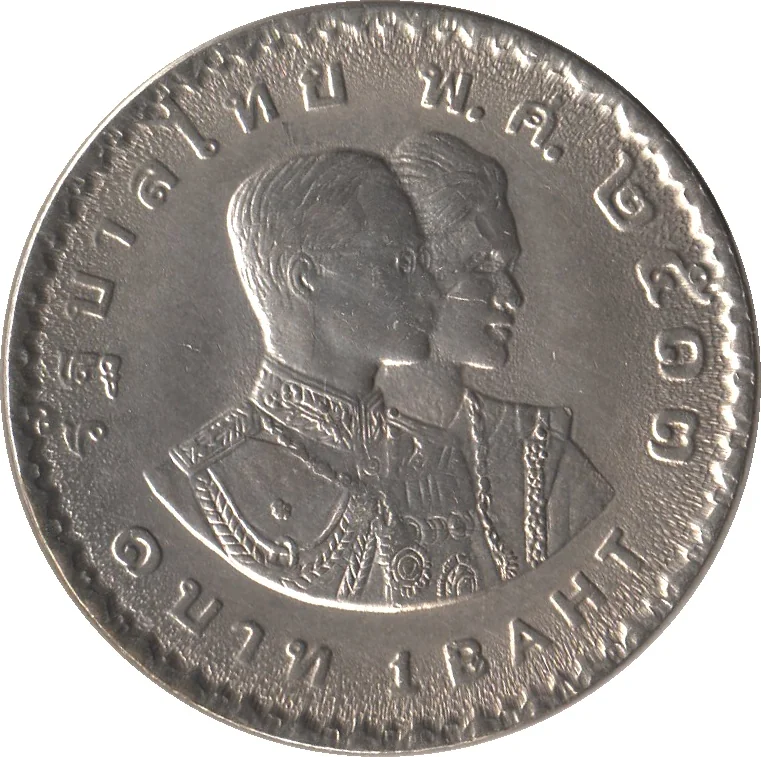
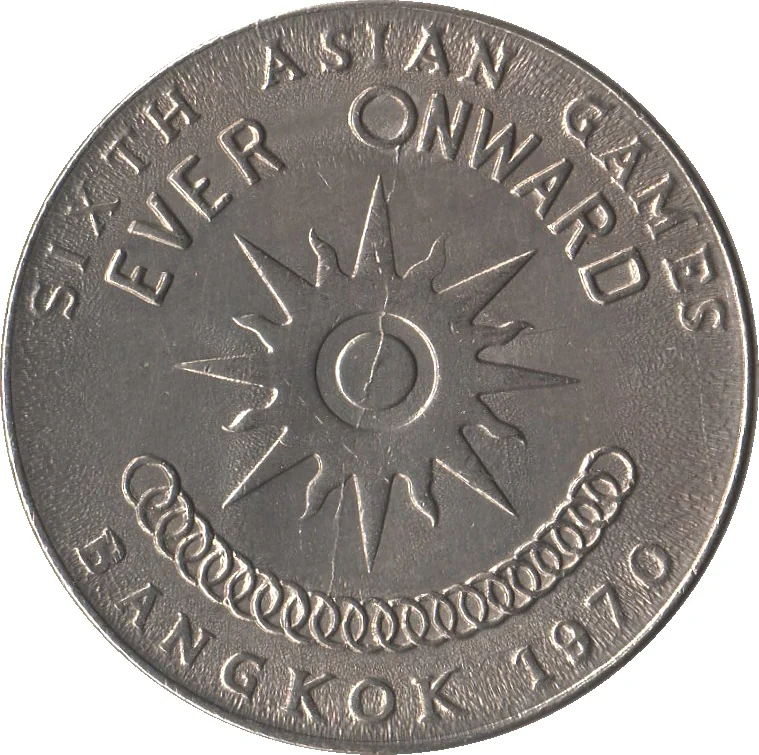
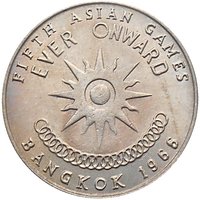
Asian Games symbol: a sun with 16 rays, motto above, 20 conjoined circles below, surrounded by inscriptions.
Inscription:
SIXTH ASIAN GAMES
EVER ONWARD
BANGKOK 1970
EVER ONWARD
BANGKOK 1970
Script: Latin
Edge
Reeded
Categories
| Sport> Asian Games |
| Symbol> Sun |
Mintings
| Year | Mint Mark | Mintage | Quality | Collection |
|---|---|---|---|---|
| 1970 | — | 9,000,000 |
Historical background
In 1970, Thailand's currency system was defined by the baht, which operated under a fixed exchange rate regime pegged to the U.S. dollar at approximately 20.8 baht per dollar. This peg, managed by the Bank of Thailand, provided crucial stability for an economy that was still largely agricultural but was in the early stages of a significant industrialization and export-oriented push. The fixed rate facilitated international trade and investment, which were central to the government's development plans under the US-aligned military leadership of Field Marshal Thanom Kittikachorn.
The period was one of relative monetary stability, supported by conservative fiscal policies and substantial foreign exchange reserves accumulated from key exports like rice, rubber, and tin, as well as from growing tourism revenues. Importantly, Thailand benefited economically from its strategic role during the Vietnam War, receiving significant U.S. military spending and aid, which further bolstered its balance of payments and reinforced the baht's peg. This external inflow helped offset trade deficits and provided the central bank with the reserves needed to confidently maintain the fixed parity.
However, this stability existed within a broader context of regional uncertainty and underlying pressures. The gold standard for international transactions had ended in 1968, and the global Bretton Woods system of fixed rates was showing severe strains, which would culminate in its collapse in 1971. While the Thai baht itself was not under immediate speculative attack in 1970, the impending international monetary crisis foreshadowed future challenges. The rigidity of the peg would eventually become a constraint, but for that year, it served as a cornerstone for Thailand's growing, yet still developing, post-war economy.
The period was one of relative monetary stability, supported by conservative fiscal policies and substantial foreign exchange reserves accumulated from key exports like rice, rubber, and tin, as well as from growing tourism revenues. Importantly, Thailand benefited economically from its strategic role during the Vietnam War, receiving significant U.S. military spending and aid, which further bolstered its balance of payments and reinforced the baht's peg. This external inflow helped offset trade deficits and provided the central bank with the reserves needed to confidently maintain the fixed parity.
However, this stability existed within a broader context of regional uncertainty and underlying pressures. The gold standard for international transactions had ended in 1968, and the global Bretton Woods system of fixed rates was showing severe strains, which would culminate in its collapse in 1971. While the Thai baht itself was not under immediate speculative attack in 1970, the impending international monetary crisis foreshadowed future challenges. The rigidity of the peg would eventually become a constraint, but for that year, it served as a cornerstone for Thailand's growing, yet still developing, post-war economy.
🌱 Common