

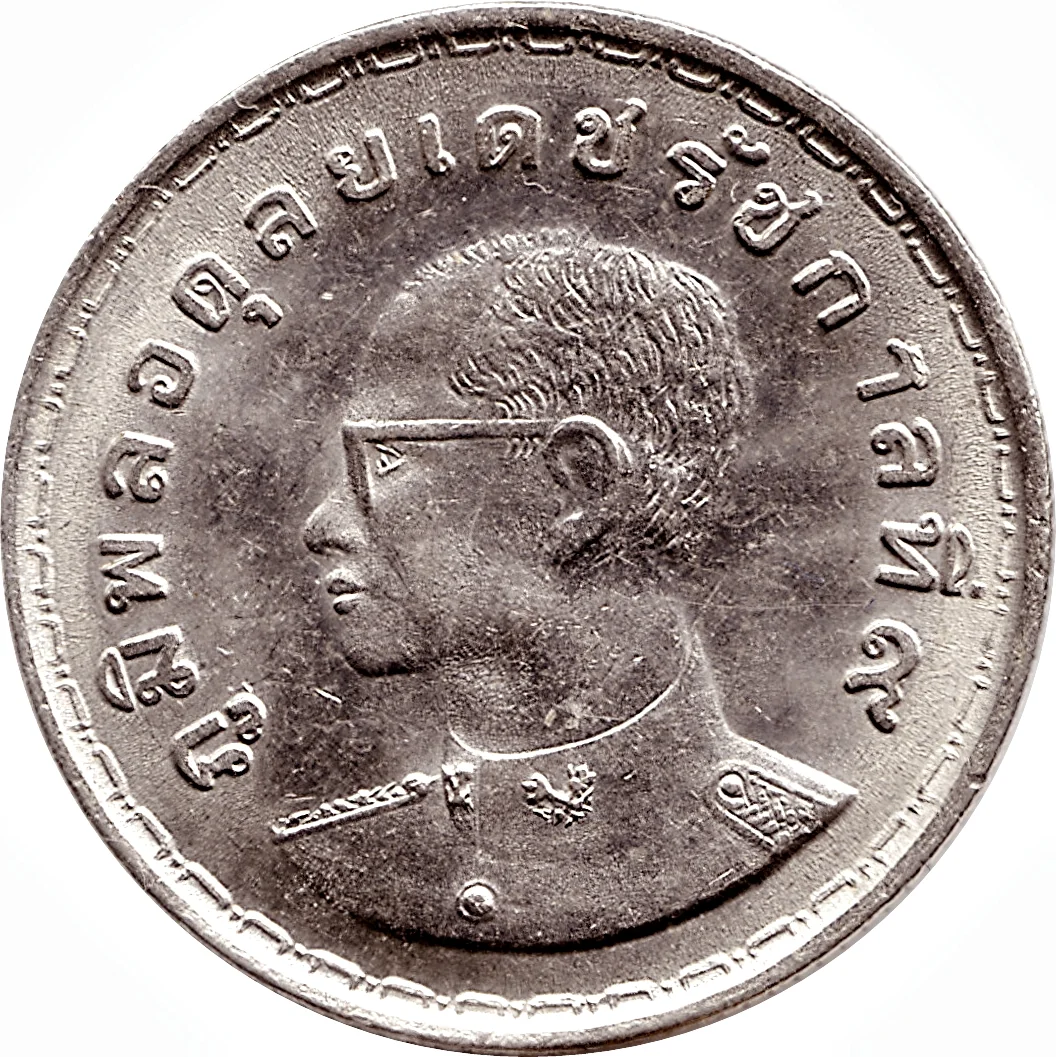
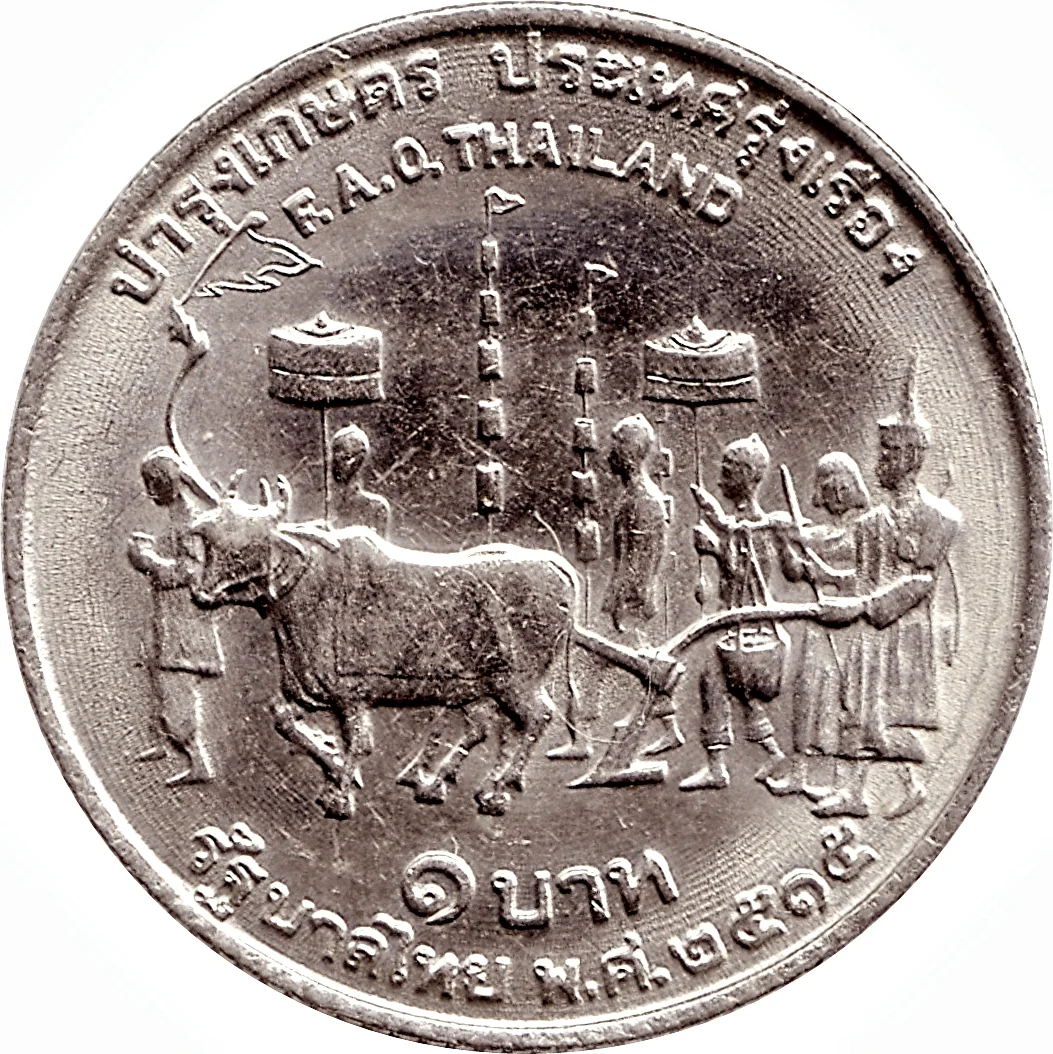
1 Baht – Thailand
Circulating commemorative coins
Commemoration: F.A.O.
Thailand
Context
Year: 1972
Thai Year: 2515
Issuer: Thailand 
Ruler: Bhumibol Adulyadej
Currency:
(since 1897)
Demonetized: Yes
Total mintage: 9,000,000
Material
Diameter: 26.9 mm
Weight: 7.5 g
Thickness: 1.7 mm
Shape: Round
Composition: Copper-nickel
Technique: Milled
Alignment: Medal alignment
flip
References
Y: #Click to copy to clipboard96
Numista: #6698
Value
Exchange value: 1 THB = $0.03
Obverse
Reverse
Edge
Reeded
Categories
| Animal> Cow |
| Organization> FAO |
Mintings
| Year | Mint Mark | Mintage | Quality | Collection |
|---|---|---|---|---|
| 1972 | — | 9,000,000 |
Historical background
In 1972, Thailand's currency situation was characterized by a fixed exchange rate system managed by the Bank of Thailand, with the baht pegged to the U.S. dollar at a rate of approximately 20.8 baht per dollar. This peg was part of the broader Bretton Woods international monetary order, which provided stability for trade and investment. The Thai economy was in a period of growth and modernization, fueled by agricultural exports, the beginnings of tourism, and increased American military spending related to the Vietnam War, which provided substantial foreign exchange reserves.
However, this stability existed within a context of mounting global pressures. The international Bretton Woods system was collapsing; the U.S. had suspended the dollar's convertibility to gold in 1971, leading to global monetary uncertainty. While Thailand maintained its dollar peg, it faced inflationary pressures imported from abroad and had to carefully manage its capital controls to defend the fixed rate. The country's monetary policy was largely subordinated to the goal of maintaining the exchange rate, limiting its tools for addressing domestic economic conditions.
Consequently, the currency regime of 1972 was on the cusp of significant change. The pressures from the breakdown of Bretton Woods and shifting global dynamics would soon force a reevaluation. Within a few years, Thailand would transition to a more flexible system, moving to a peg against a basket of currencies in 1978. Thus, 1972 represents the final years of a long-standing, rigid dollar peg, operating in a calm before the storm of mid-1970s oil shocks and global monetary realignment.
However, this stability existed within a context of mounting global pressures. The international Bretton Woods system was collapsing; the U.S. had suspended the dollar's convertibility to gold in 1971, leading to global monetary uncertainty. While Thailand maintained its dollar peg, it faced inflationary pressures imported from abroad and had to carefully manage its capital controls to defend the fixed rate. The country's monetary policy was largely subordinated to the goal of maintaining the exchange rate, limiting its tools for addressing domestic economic conditions.
Consequently, the currency regime of 1972 was on the cusp of significant change. The pressures from the breakdown of Bretton Woods and shifting global dynamics would soon force a reevaluation. Within a few years, Thailand would transition to a more flexible system, moving to a peg against a basket of currencies in 1978. Thus, 1972 represents the final years of a long-standing, rigid dollar peg, operating in a calm before the storm of mid-1970s oil shocks and global monetary realignment.
🌱 Common