

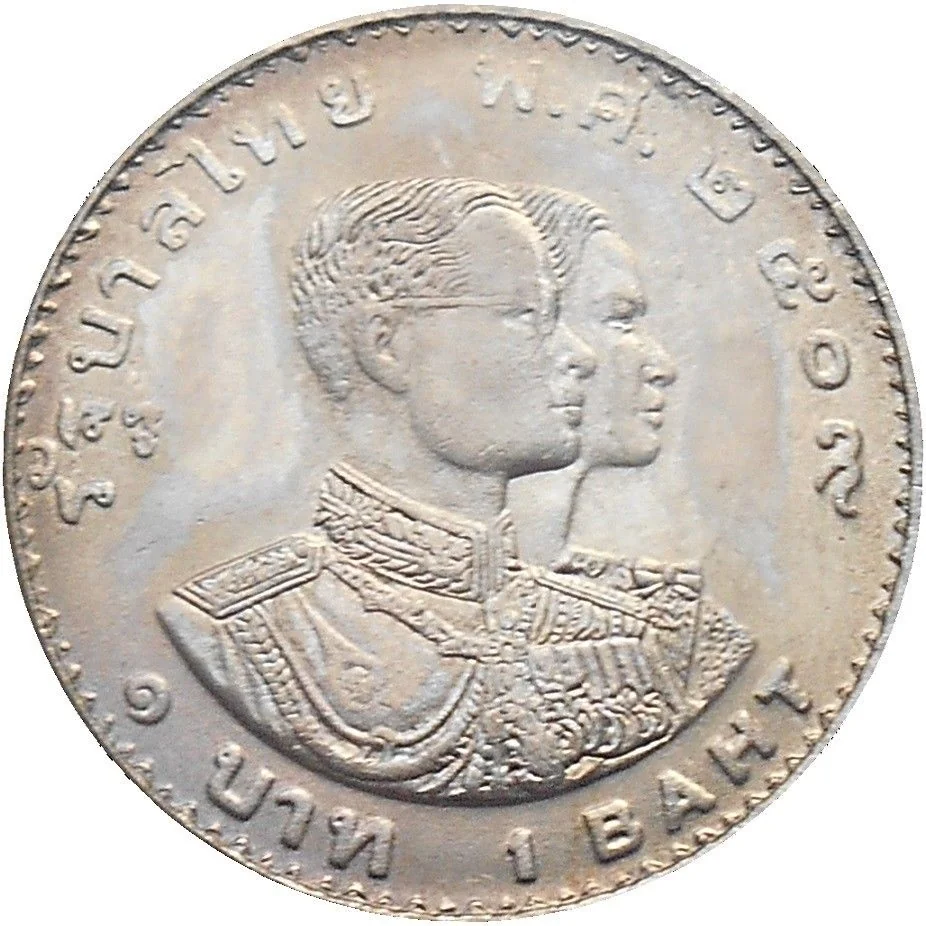
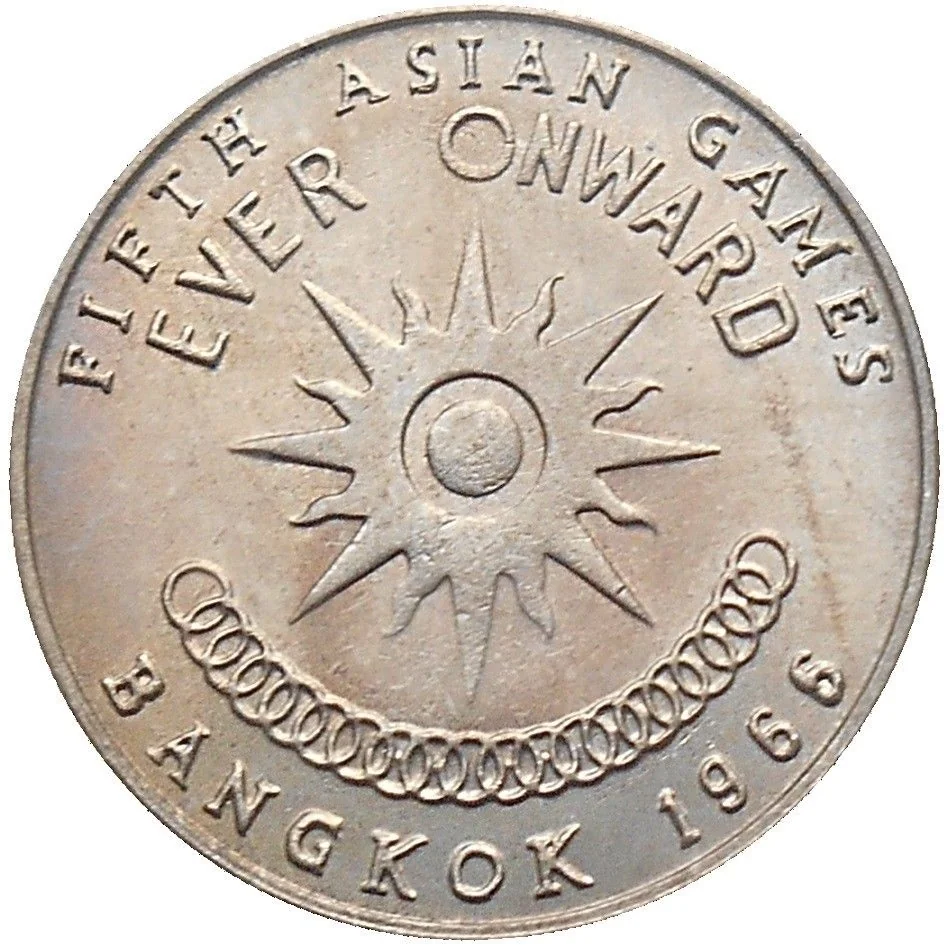
1 Baht – Thailand
Circulating commemorative coins
Commemoration: 1966 Asian Games, Bangkok
Thailand
Context
Year: 1966
Thai Year: 2509
Issuer: Thailand 
Ruler: Bhumibol Adulyadej
Currency:
(since 1897)
Demonetized: Yes
Total mintage: 9,000,000
Material
Diameter: 26.9 mm
Weight: 7.3 g
Thickness: 1.8 mm
Shape: Round
Composition: Copper-nickel
Technique: Milled
Alignment: Coin alignment
flip
References
Y: #Click to copy to clipboard87
Numista: #9432
Value
Exchange value: 1 THB = $0.03
Obverse
Reverse
Description:
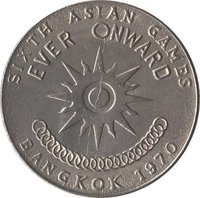
Asian Games symbol: a sun with 16 rays, motto above, 20 conjoined circles below, surrounded by inscriptions.
Inscription:
FIFTH ASIAN GAMES
EVER ONWARD
BANGKOK 1966
EVER ONWARD
BANGKOK 1966
Script: Latin
Edge
Reeded
Mintings
| Year | Mint Mark | Mintage | Quality | Collection |
|---|---|---|---|---|
| 1966 | — | 9,000,000 |
Historical background
In 1966, Thailand's currency system was underpinned by the baht, which was pegged to the U.S. dollar at a fixed rate of 20.80 baht to one dollar. This peg, managed by the Bank of Thailand, was a cornerstone of the nation's economic policy, providing crucial stability for trade and investment during a period of regional uncertainty. The arrangement reflected Thailand's close alignment with Western economic systems and was supported by substantial foreign exchange reserves, bolstered by U.S. military spending related to the Vietnam War.
Economically, the fixed exchange rate facilitated a period of growth and modernization, as it controlled inflation and attracted foreign capital. However, it also imposed constraints, requiring strict fiscal and monetary discipline to maintain the parity. The government had to carefully balance its policies to avoid pressure on the baht, as any significant trade deficit or capital flight could threaten the nation's reserve levels and the credibility of the peg.
Politically and strategically, the currency's stability in 1966 was intertwined with Thailand's role as a key U.S. ally in Southeast Asia. The influx of dollars from American military activity provided a direct boost to the economy and the central bank's reserves, further cementing the baht's fixed rate. This environment set the stage for the continued industrialization of the Thai economy, though the rigidity of the peg would later be tested and ultimately abandoned in favor of a managed float during the Asian financial crisis of 1997.
Economically, the fixed exchange rate facilitated a period of growth and modernization, as it controlled inflation and attracted foreign capital. However, it also imposed constraints, requiring strict fiscal and monetary discipline to maintain the parity. The government had to carefully balance its policies to avoid pressure on the baht, as any significant trade deficit or capital flight could threaten the nation's reserve levels and the credibility of the peg.
Politically and strategically, the currency's stability in 1966 was intertwined with Thailand's role as a key U.S. ally in Southeast Asia. The influx of dollars from American military activity provided a direct boost to the economy and the central bank's reserves, further cementing the baht's fixed rate. This environment set the stage for the continued industrialization of the Thai economy, though the rigidity of the peg would later be tested and ultimately abandoned in favor of a managed float during the Asian financial crisis of 1997.
🌱 Common