

5 escudos – Portugal
Add to wishlist
Portugal
Context
Years: 1963–1986
Issuer: Portugal
Period:
(1926—1974)
Currency:
(1911—2001)
Demonetization: 28 February 2002
Total mintage: 374,248,999
Material
Diameter: 24.5 mm
Weight: 7 g
Thickness: 1.3 mm
Shape: Round
Composition: Copper-nickel (25% Nickel)
Technique: Milled
Alignment: Coin alignment
flip
References
KM: #
Numista: #772
Value
Exchange value: 5 PTE
Inflation-adjusted value: 520.64 PTE
Obverse
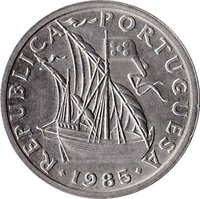
Description:
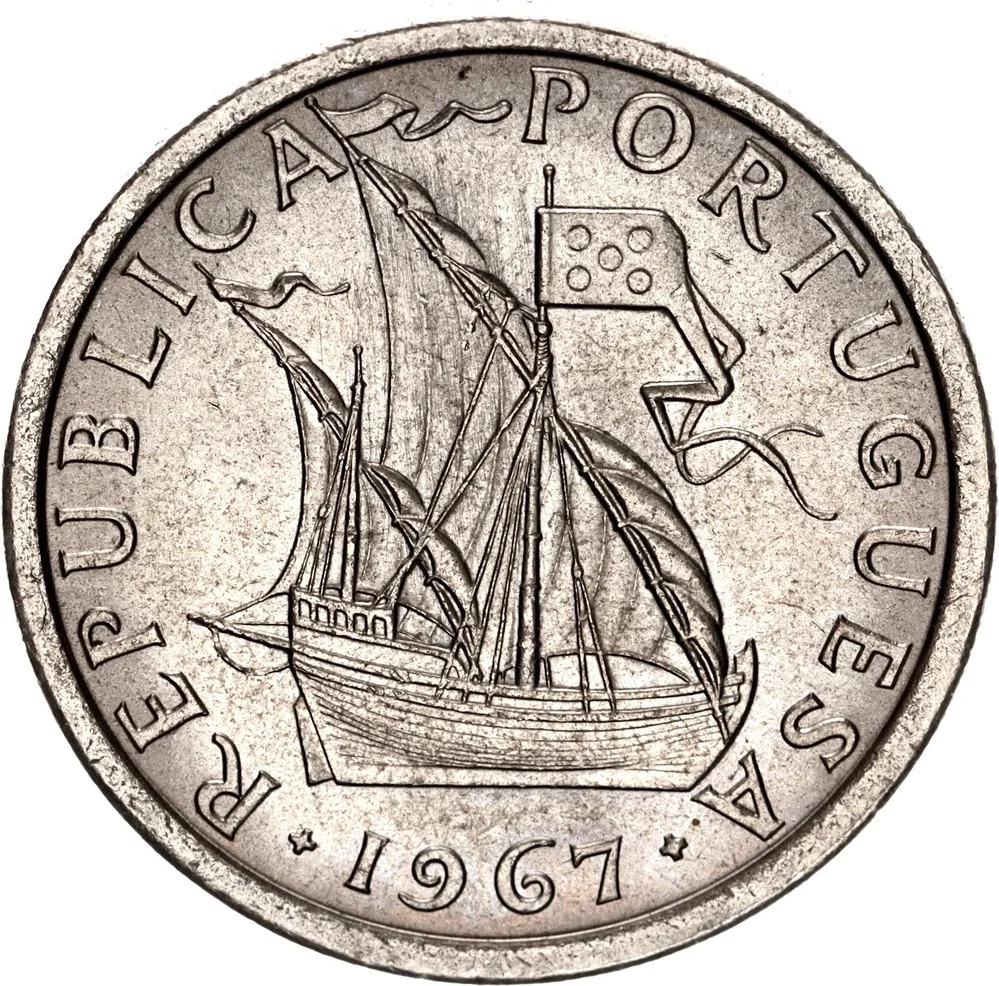
A ship sailing right.
Inscription:
REPUBLICA PORTUGUESA
+ 1973 +
+ 1973 +
Translation:
Portuguese Republic
+ 1973 +
+ 1973 +
Script: Latin
Language: Portuguese
Engraver: Jaime Martins Barata
Reverse
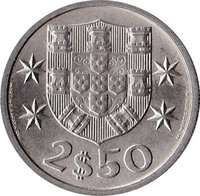
Description:
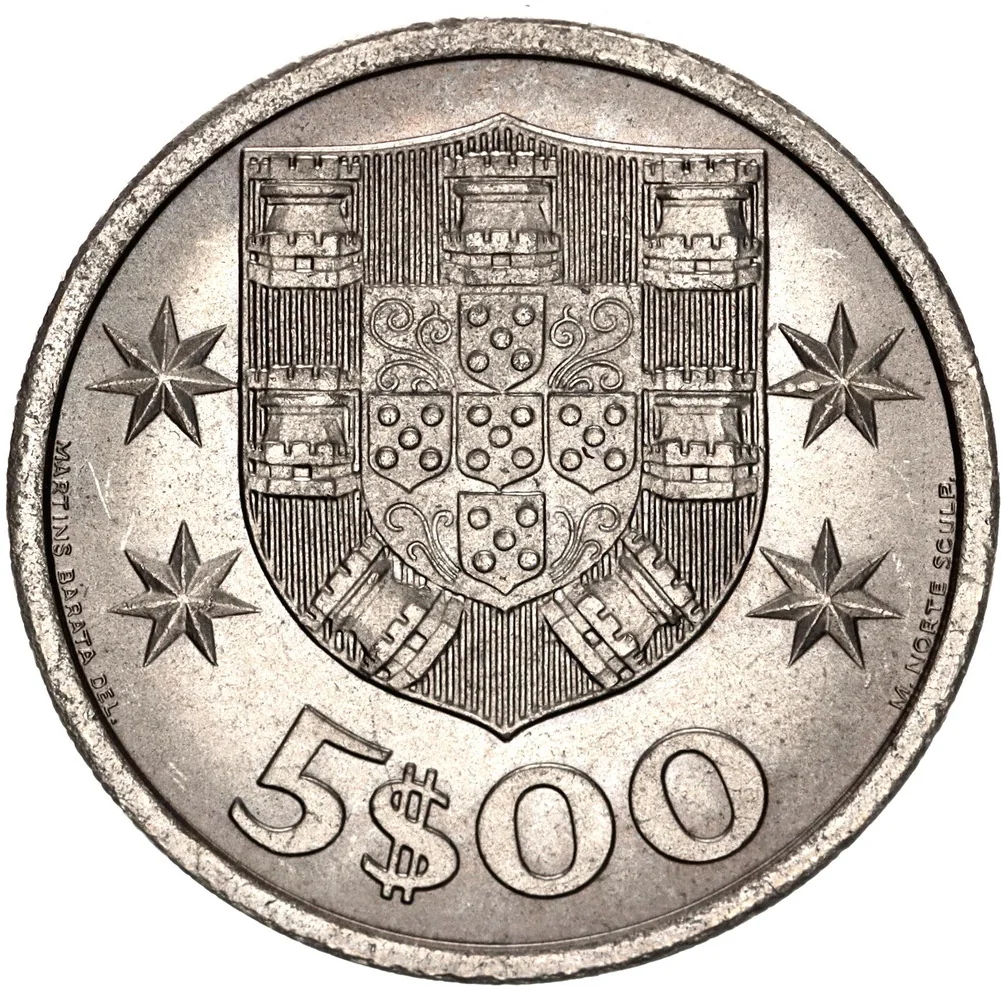
Portuguese coat of arms and four stars, value below.
Inscription:
5$00
MARTINS BARATA DEL. M. NORTE SCULP.
MARTINS BARATA DEL. M. NORTE SCULP.
Script: Latin
Engraver: Marcelino Norte de Almeida
Edge
Reeded
Categories
| Symbols> Coat of Arms |
| Transportation> Watercraft |
Mints
| Name | Mark |
|---|---|
| Imprensa Nacional - Casa da Moeda | — |
Mintings
| Year | Mint Mark | Mintage | Quality | Collection |
|---|---|---|---|---|
| 1963 | — | 2,200,000 | ||
| 1964 | — | 4,268,000 | ||
| 1965 | — | 7,294,000 | ||
| 1966 | — | 8,119,999 | ||
| 1967 | — | 8,128,000 | ||
| 1968 | — | 5,023,000 | ||
| 1969 | — | 3,571,000 | ||
| 1970 | — | 1,200,000 | ||
| 1971 | — | 2,721,000 | ||
| 1972 | — | 1,880,000 | ||
| 1973 | — | 2,836,000 | ||
| 1974 | — | 3,984,000 | ||
| 1975 | — | 7,496,000 | ||
| 1976 | — | 11,379,000 | ||
| 1977 | — | 29,058,000 | ||
| 1978 | — | 672,000 | ||
| 1979 | — | 19,546,000 | ||
| 1980 | — | 46,244,000 | ||
| 1981 | — | 15,267,000 | ||
| 1982 | — | 31,318,000 | ||
| 1983 | — | 51,056,000 | ||
| 1984 | — | 46,794,000 | ||
| 1985 | — | 45,441,000 | ||
| 1986 | — | 18,753,000 |
Historical background
In 1963, Portugal's currency situation was defined by the Escudo, which operated under a tightly controlled and complex system emblematic of the authoritarian Estado Novo regime. The escudo was not a freely convertible currency and its value was maintained through a web of exchange controls, multiple exchange rates, and strict capital restrictions. The Banco de Portugal, under government direction, managed a fixed parity with the U.S. dollar (officially 28.75 Escudos to 1 USD), but this official rate was largely reserved for essential imports and strategic transactions. For most other international trade and travel, a less favorable "free market" rate applied, creating a de facto dual-currency environment.
This system served the regime's primary economic goals: protecting Portugal's limited gold and foreign exchange reserves, financing its colonial wars in Africa, and maintaining a stable facade for political purposes. The controls aimed to prevent capital flight, subsidize key industries, and manage a persistent structural trade deficit. However, it also led to significant distortions, including a thriving black market for foreign currency and limited integration with the global economy. The escudo's artificial stability masked underlying weaknesses, such as low industrialization, reliance on agricultural and colonial exports, and mounting military expenditures.
Overall, the 1963 currency regime reflected Portugal's insulated and stagnant economy under the Estado Novo. While it provided short-term stability, it hindered modernization and foreign investment. The rigid controls and economic strain of colonial conflicts would, over the next decade, contribute to the mounting pressures that culminated in the Carnation Revolution of 1974 and subsequent major monetary and economic reforms.
This system served the regime's primary economic goals: protecting Portugal's limited gold and foreign exchange reserves, financing its colonial wars in Africa, and maintaining a stable facade for political purposes. The controls aimed to prevent capital flight, subsidize key industries, and manage a persistent structural trade deficit. However, it also led to significant distortions, including a thriving black market for foreign currency and limited integration with the global economy. The escudo's artificial stability masked underlying weaknesses, such as low industrialization, reliance on agricultural and colonial exports, and mounting military expenditures.
Overall, the 1963 currency regime reflected Portugal's insulated and stagnant economy under the Estado Novo. While it provided short-term stability, it hindered modernization and foreign investment. The rigid controls and economic strain of colonial conflicts would, over the next decade, contribute to the mounting pressures that culminated in the Carnation Revolution of 1974 and subsequent major monetary and economic reforms.
Series: System 1969-1980
🌱 Very Common