

1 Colón – Costa Rica
Costa Rica
Context
Years: 1965–1978
Issuer: Costa Rica 
Issuing organization: Central Bank of Costa Rica
Period:
(since 1948)
Currency:
(since 1896)
Demonetized: Yes
Total mintage: 54,033,000
Material
References
KM: #Click to copy to clipboard186.2-186.
Numista: #7666
Value
Exchange value: 1 CRC
Obverse
Description:
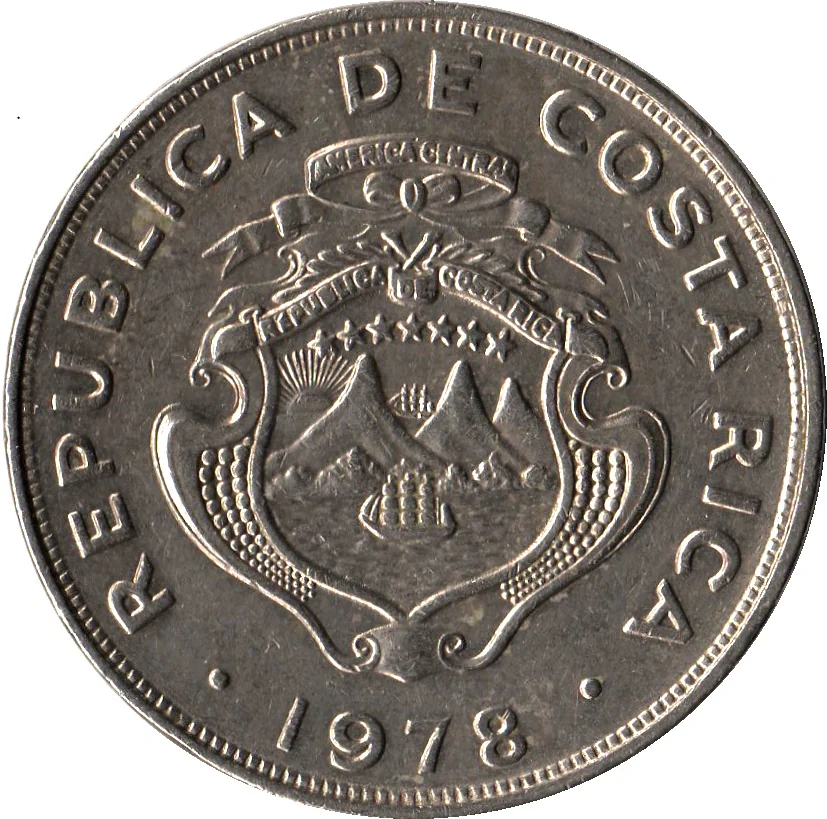
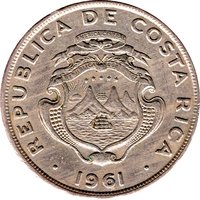
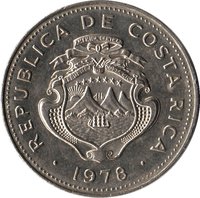
The Costa Rican coat of arms features seven stars for its provinces, three volcanoes for its mountain ranges, two ships for its position between two oceans, and a sunrise. The stars increased from five to seven in 1964 when Puntarenas and Limón became provinces.
Inscription:
REPUBLICA DE COSTA RICA
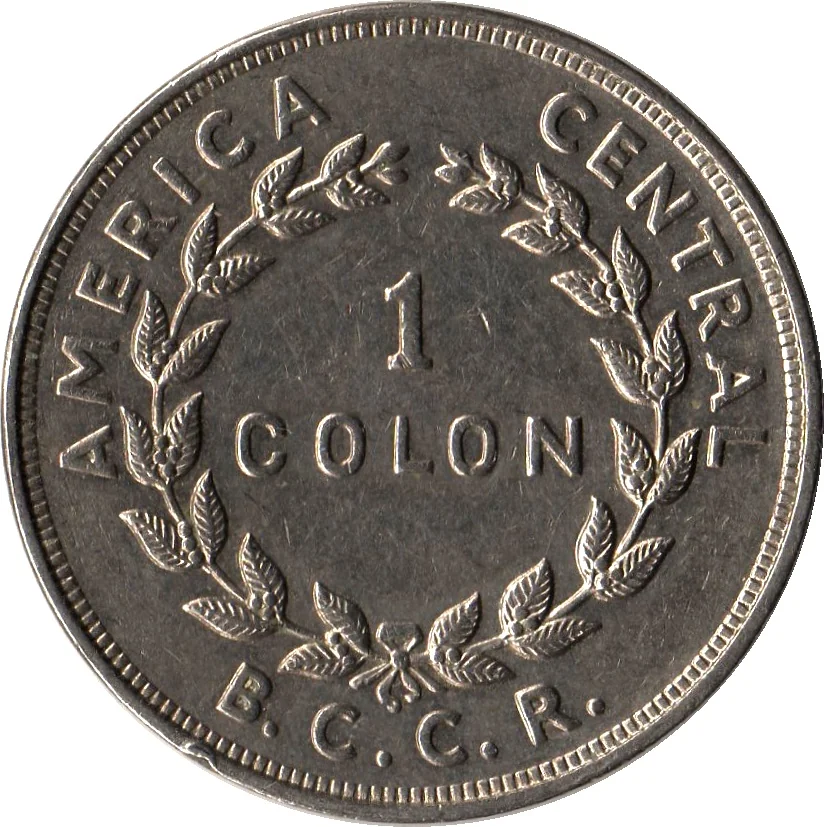
AMERICA CENTRAL
REPUBLICA DE COSTA RICA
• 1954 •
AMERICA CENTRAL
REPUBLICA DE COSTA RICA
• 1954 •
Translation:
REPUBLIC OF COSTA RICA
CENTRAL AMERICA
REPUBLIC OF COSTA RICA
• 1954 •
CENTRAL AMERICA
REPUBLIC OF COSTA RICA
• 1954 •
Script: Latin
Language: Spanish
Reverse
Edge
Smooth with inscription
Legend:
BCCR - BCCR - BCCR - BCCR -
Translation:
Victorious - Victorious - Victorious - Victorious -
Language: Arabic
Categories
| Symbols> Coat of Arms |
| Geography> Mountain |
| Symbol> Wreath |
| Transportation> Watercraft |
Mints
| Name | Mark |
|---|---|
| Casa de Moneda de Guatemala | — |
| Royal Canadian Mint of Ottawa | — |
| Sherritt Mint | — |
| United States Mint of Philadelphia | — |
| VDM Metals / Vereinigte Deutsche Metallwerke | — |
Mintings
| Year | Mint Mark | Mintage | Quality | Collection |
|---|---|---|---|---|
| 1965 | — | 1,000,000 | ||
| 1968 | — | 2,000,000 | ||
| 1970 | — | 2,000,000 | ||
| 1972 | — | 2,000,000 | ||
| 1974 | — | 2,000,000 | ||
| 1975 | — | 1,028,000 | ||
| 1976 | — | 12,000,000 | ||
| 1976 | — | 5,000 | Proof | |
| 1977 | — | 22,000,000 | ||
| 1978 | — | 10,000,000 |
Historical background
In 1965, Costa Rica's currency situation was defined by a fixed exchange rate system, with the colón pegged to the U.S. dollar at a rate of 6.65 colones per dollar. This stability was managed by the Central Bank of Costa Rica (BCCR), established just over a decade prior in 1950, which held exclusive authority over currency issuance and foreign exchange policy. The peg provided a foundation for economic planning and international trade, but it also required careful management of foreign reserves to maintain the fixed parity, especially as the country's import-driven economy was vulnerable to external shocks.
The period was one of economic transition and moderate growth, following the transformative reforms of the 1940s. However, underlying pressures were evident. A persistent trade deficit, driven by imports of consumer goods, machinery, and petroleum, steadily eroded foreign exchange reserves. Furthermore, the government's fiscal policy, often running deficits to fund expanding public sector programs and infrastructure, contributed to inflationary pressures that the fixed rate struggled to fully contain. This created a subtle but growing tension between the official exchange rate and the currency's real purchasing power.
Consequently, while no major devaluation occurred in 1965 itself, the year existed within a period of mounting strain on the monetary system. The fixed rate, while nominally stable, was increasingly maintained through exchange and import controls rather than pure market confidence. These controls, alongside a growing black market for dollars, signaled the system's fragility. The pressures culminated just a few years later, leading to a significant devaluation in 1974 when the colón was adjusted to 8.57 per dollar, marking the end of the long-standing 6.65 parity and a new chapter of monetary adjustment.
The period was one of economic transition and moderate growth, following the transformative reforms of the 1940s. However, underlying pressures were evident. A persistent trade deficit, driven by imports of consumer goods, machinery, and petroleum, steadily eroded foreign exchange reserves. Furthermore, the government's fiscal policy, often running deficits to fund expanding public sector programs and infrastructure, contributed to inflationary pressures that the fixed rate struggled to fully contain. This created a subtle but growing tension between the official exchange rate and the currency's real purchasing power.
Consequently, while no major devaluation occurred in 1965 itself, the year existed within a period of mounting strain on the monetary system. The fixed rate, while nominally stable, was increasingly maintained through exchange and import controls rather than pure market confidence. These controls, alongside a growing black market for dollars, signaled the system's fragility. The pressures culminated just a few years later, leading to a significant devaluation in 1974 when the colón was adjusted to 8.57 per dollar, marking the end of the long-standing 6.65 parity and a new chapter of monetary adjustment.
🌱 Very Common