

2 colones – Costa Rica
Add to wishlist
Costa Rica
Context
Year: 1961
Issuer: Costa Rica
Issuing organization: Central Bank of Costa Rica
Period:
(since 1948)
Currency:
(since 1896)
Demonetized: Yes
Total mintage: 1,000,000
Material
References
KM: #
Numista: #8887
Value
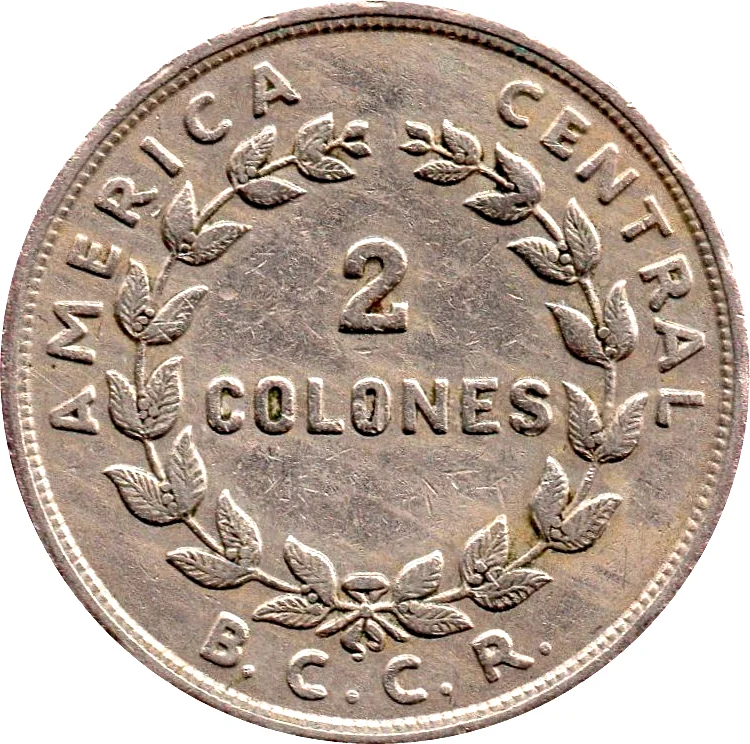
Exchange value: 2 CRC
Obverse
Description:
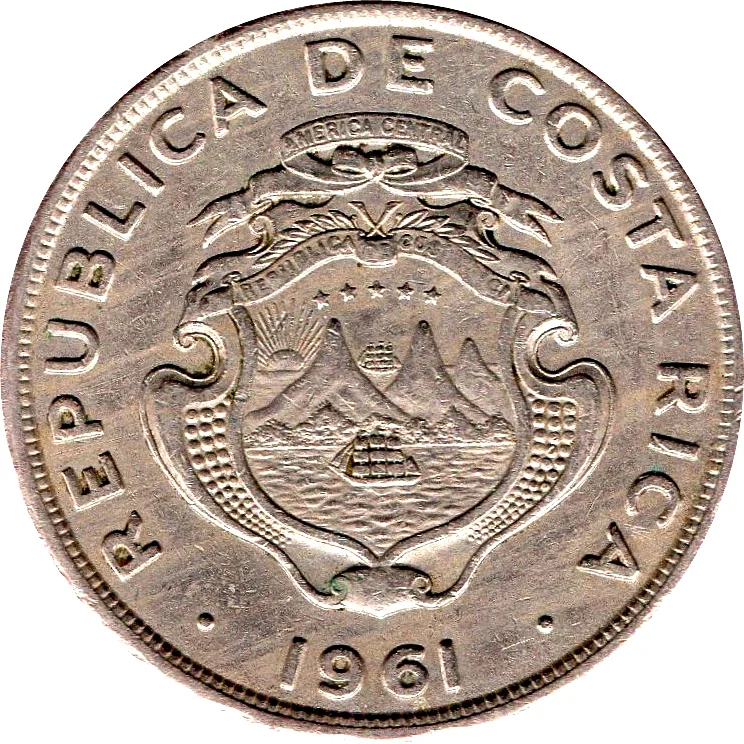
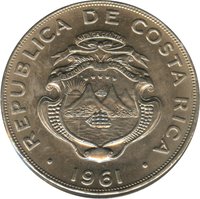
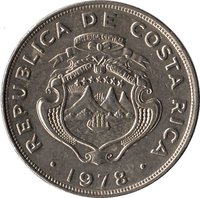
Costa Rica's coat of arms features five stars for its provinces, three volcanoes for its mountain ranges, two ships for its position between oceans, and a sunrise.
Inscription:
REPUBLICA COSTA RICA
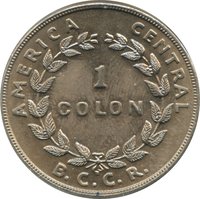
AMERICA CENTRAL
REPUBLICA COSTA RICA
. 1961 .
AMERICA CENTRAL
REPUBLICA COSTA RICA
. 1961 .
Translation:
REPUBLIC COSTA RICA
CENTRAL AMERICA
REPUBLIC COSTA RICA
. 1961 .
CENTRAL AMERICA
REPUBLIC COSTA RICA
. 1961 .
Script: Latin
Reverse
Edge
Categories
| Symbols> Coat of Arms |
| Symbol> Wreath |
Mints
| Name | Mark |
|---|---|
| United States Mint of Philadelphia | — |
Mintings
| Year | Mint Mark | Mintage | Quality | Collection |
|---|---|---|---|---|
| 1961 | — | 1,000,000 |
Historical background
In 1961, Costa Rica's currency situation was defined by the colón, which had been the national currency since 1896, replacing the Costa Rican peso. The colón was pegged to the United States dollar at a fixed exchange rate of ₡5.60 to US$1.00, a parity established in 1914 and maintained with remarkable stability for decades. This peg was managed by the Central Bank of Costa Rica (Banco Central de Costa Rica), founded in 1950, which held sufficient international reserves to defend the fixed rate and provide monetary stability crucial for the post-civil war era of development.
Economically, this period was one of transition and growth, driven by the diversification of exports beyond coffee and bananas into new sectors like sugar and beef. The stable colón facilitated this expansion by providing predictability for foreign investment and trade. However, the fixed exchange rate also required disciplined fiscal and monetary policy to avoid pressure on the peg, a challenge as the government pursued ambitious public spending on social programs and infrastructure under the model of a social democratic state.
Beneath this apparent stability, the foundations of the long-standing fixed rate were beginning to face subtle strains. The costs of the state-led development model and growing public sector were incrementally increasing fiscal pressures. While no currency crisis was imminent in 1961, the era of the "classic" colón was entering its later stages. The pressures that would eventually lead to a managed devaluation in 1974 and later a float were slowly accumulating, making 1961 a point of calm before future economic adjustments.
Economically, this period was one of transition and growth, driven by the diversification of exports beyond coffee and bananas into new sectors like sugar and beef. The stable colón facilitated this expansion by providing predictability for foreign investment and trade. However, the fixed exchange rate also required disciplined fiscal and monetary policy to avoid pressure on the peg, a challenge as the government pursued ambitious public spending on social programs and infrastructure under the model of a social democratic state.
Beneath this apparent stability, the foundations of the long-standing fixed rate were beginning to face subtle strains. The costs of the state-led development model and growing public sector were incrementally increasing fiscal pressures. While no currency crisis was imminent in 1961, the era of the "classic" colón was entering its later stages. The pressures that would eventually lead to a managed devaluation in 1974 and later a float were slowly accumulating, making 1961 a point of calm before future economic adjustments.
🌱 Common