

2 Paisas – Bombay Presidency
India
Context

Material
Diameter: 23 mm
Weight: 21.25 g
Thickness: 5.5 mm
Shape: Irregular round
Composition: Copper
Magnetic: No
Alignment: Coin alignment
flip
References
KM: #Click to copy to clipboard200
Numista: #75740
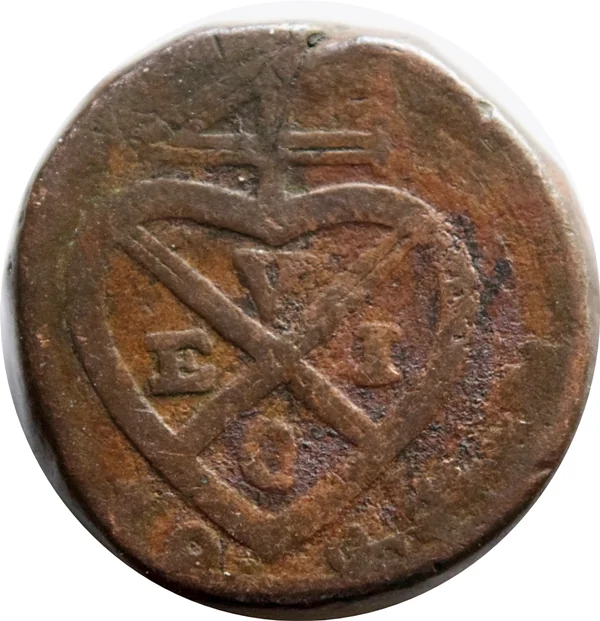
Obverse
Description:
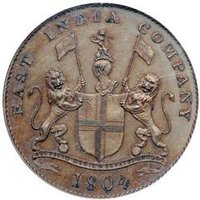
United East India Company balemark with date below, within a typically invisible raised circular border.
Inscription:
1828
VEIC
VEIC
Translation:
In the year 1828
Language: Latin
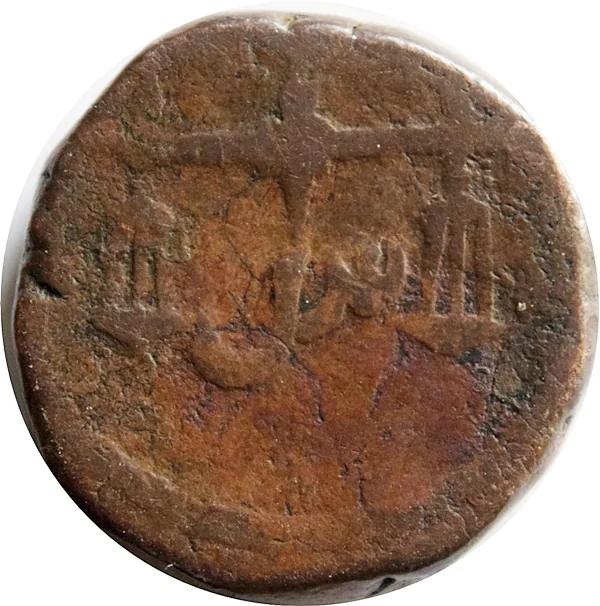
Reverse
Description:
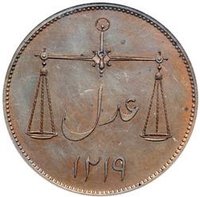
Balanced scales within a raised border, inscribed "Adil." No higher value exists.
Inscription:
عادل
Translation:
Just.
Language: Arabic
Edge
Plain
Mintings
| Year | Mint Mark | Mintage | Quality | Collection |
|---|---|---|---|---|
| 1808 | — | — | ||
| 1809 | — | — | ||
| 1810 | — | — | ||
| 1812 | — | — | ||
| 1813 | — | — | ||
| 1815 | — | — | ||
| 1816 | — | — | ||
| 1818 | — | — | ||
| 1819 | — | — | ||
| 1825 | — | — | ||
| 1826 | — | — | ||
| 1827 | — | — | ||
| 1828 | — | — | ||
| 1829 | — | — | ||
| — | — | — |
Historical background
In 1808, the Bombay Presidency was grappling with a severe and complex currency crisis, a legacy of its unique monetary history. Unlike Bengal, which had a relatively stable silver rupee, Bombay operated within a bimetallic system dominated by the silver rupee of the Mughals and the gold hons or pagodas of the Deccan. Furthermore, a vast array of foreign coins—Spanish dollars, Portuguese xeraphims, and Arabian riyals—circulated due to the Presidency's extensive maritime trade. The East India Company's attempts to standardise currency, notably through the 1793 "Bombay Rupee," had failed to establish public confidence, leading to widespread hoarding and the circulation of coins at wildly fluctuating market values rather than their official par.
The core of the 1808 situation was a critical shortage of authorised specie, exacerbated by the Company's high military expenditures for the ongoing Anglo-Maratha Wars. To finance these campaigns, the Bombay government had heavily resorted to issuing paper money—"Bombay Bank Notes"—but these notes were not universally accepted beyond the confines of the city and its immediate European merchants. This lack of trust, combined with the physical scarcity of sound coin, created a two-tier economy: a strained official system and a vibrant but chaotic bazaar system where money-changers (shroffs) wielded significant power, discounting paper and assessing the value of countless coin types based on weight and purity.
Consequently, commercial transactions were fraught with uncertainty and inefficiency, hindering both trade and revenue collection. The crisis underscored the Company's inability to impose monetary sovereignty and the urgent need for a unified, trusted currency. This pressing situation would ultimately propel the Presidency towards more decisive action, leading to the major currency reforms of 1818 following the Maratha defeat, which finally established a uniform silver rupee as the sole legal standard, aligning Bombay's system with that of Bengal.
The core of the 1808 situation was a critical shortage of authorised specie, exacerbated by the Company's high military expenditures for the ongoing Anglo-Maratha Wars. To finance these campaigns, the Bombay government had heavily resorted to issuing paper money—"Bombay Bank Notes"—but these notes were not universally accepted beyond the confines of the city and its immediate European merchants. This lack of trust, combined with the physical scarcity of sound coin, created a two-tier economy: a strained official system and a vibrant but chaotic bazaar system where money-changers (shroffs) wielded significant power, discounting paper and assessing the value of countless coin types based on weight and purity.
Consequently, commercial transactions were fraught with uncertainty and inefficiency, hindering both trade and revenue collection. The crisis underscored the Company's inability to impose monetary sovereignty and the urgent need for a unified, trusted currency. This pressing situation would ultimately propel the Presidency towards more decisive action, leading to the major currency reforms of 1818 following the Maratha defeat, which finally established a uniform silver rupee as the sole legal standard, aligning Bombay's system with that of Bengal.
💎 Extremely Rare