

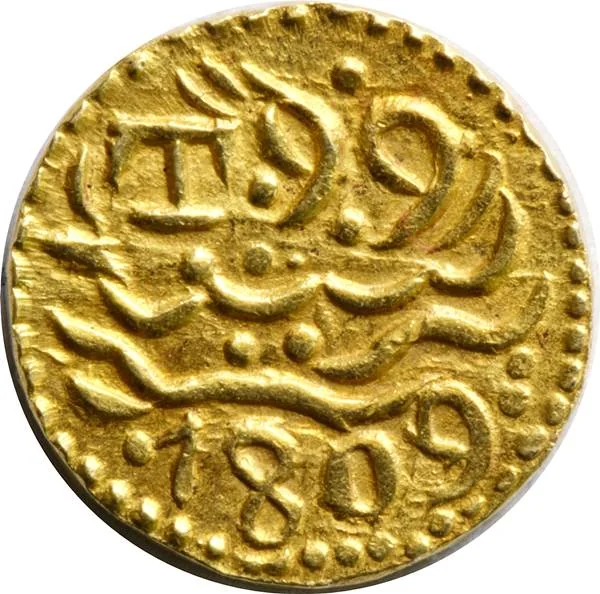
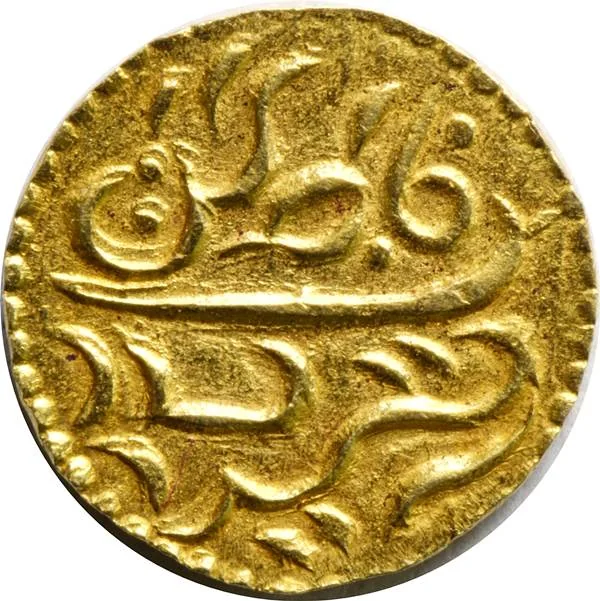

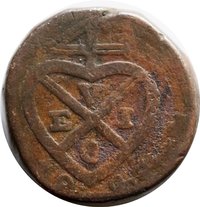
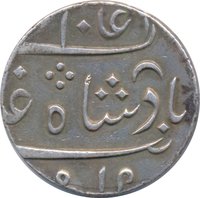
Obverse
Description:
Sikka nishini Tellicherry 1799, date within beaded rim.
Inscription:
T 99
1809
1809
Translation:
T 99
1809
1809
Language: Swedish
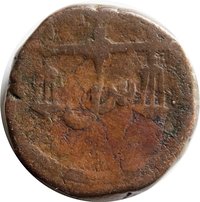
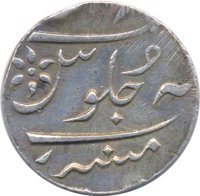
Reverse
Description:
Zarb Tellicherry julus, beaded rim.
Edge
Plain
Mintings
| Year | Mint Mark | Mintage | Quality | Collection |
|---|---|---|---|---|
| 1809 | — | — |
Historical background
In 1809, the Bombay Presidency was grappling with a chaotic and multi-layered currency system, a direct legacy of its commercial history and recent political changes. The region was a confluence of various monetary streams: the Company's own silver rupee (influenced by the Mughal standard), gold pagodas from the south, fractions of the Portuguese xerafim, and a plethora of local and regional coins issued by former Maratha rulers and other Indian powers. This proliferation created severe complications for trade and revenue collection, as the value of coins depended not only on metal content but also on their origin, age, and fluctuating exchange rates between gold, silver, and copper.
The situation was exacerbated by the recent extension of British territory following the conclusion of the Second Anglo-Maratha War (1803-1805). The annexation of vast areas like Gujarat and the Deccan brought these diverse and entrenched currency systems under the Company's administration, making the need for standardization urgent. Furthermore, a shortage of small-denomination copper coins for everyday transactions plagued the local economy, leading to the circulation of fragmented and often debased coins, while the Presidency's merchants and bankers (shroffs) played an indispensable but unofficial role in assessing and exchanging this complex medley of specie.
Recognizing the impediment to commerce and governance, the Bombay Government was actively seeking solutions in this period. While a uniform system for the entire Presidency was still years away, 1809 fell within a period of experimentation and deliberation. The authorities were particularly concerned with establishing a reliable silver standard and suppressing the circulation of forged or clipped coins. These efforts laid the groundwork for the more comprehensive reforms that would follow, culminating in the introduction of the distinctive "Bombay Rupee" in 1818, which finally provided a unified currency for the Presidency's territories.
The situation was exacerbated by the recent extension of British territory following the conclusion of the Second Anglo-Maratha War (1803-1805). The annexation of vast areas like Gujarat and the Deccan brought these diverse and entrenched currency systems under the Company's administration, making the need for standardization urgent. Furthermore, a shortage of small-denomination copper coins for everyday transactions plagued the local economy, leading to the circulation of fragmented and often debased coins, while the Presidency's merchants and bankers (shroffs) played an indispensable but unofficial role in assessing and exchanging this complex medley of specie.
Recognizing the impediment to commerce and governance, the Bombay Government was actively seeking solutions in this period. While a uniform system for the entire Presidency was still years away, 1809 fell within a period of experimentation and deliberation. The authorities were particularly concerned with establishing a reliable silver standard and suppressing the circulation of forged or clipped coins. These efforts laid the groundwork for the more comprehensive reforms that would follow, culminating in the introduction of the distinctive "Bombay Rupee" in 1818, which finally provided a unified currency for the Presidency's territories.
✨ Legendary