

5 Cents – East Africa
Context
Years: 1955–1963
Issuer: East Africa
Ruler: Elizabeth II
Currency:
(1921—1967)
Demonetized: Yes
Total mintage: 40,600,000
Material
Diameter: 25.3 mm
Weight: 5.67 g
Thickness: 1.5 mm
Shape: Round with a round hole
Composition: Bronze
Magnetic: No
Technique: Milled
Alignment: Medal alignment
flip
References
KM: #Click to copy to clipboard37
Numista: #7545
Obverse
Description:
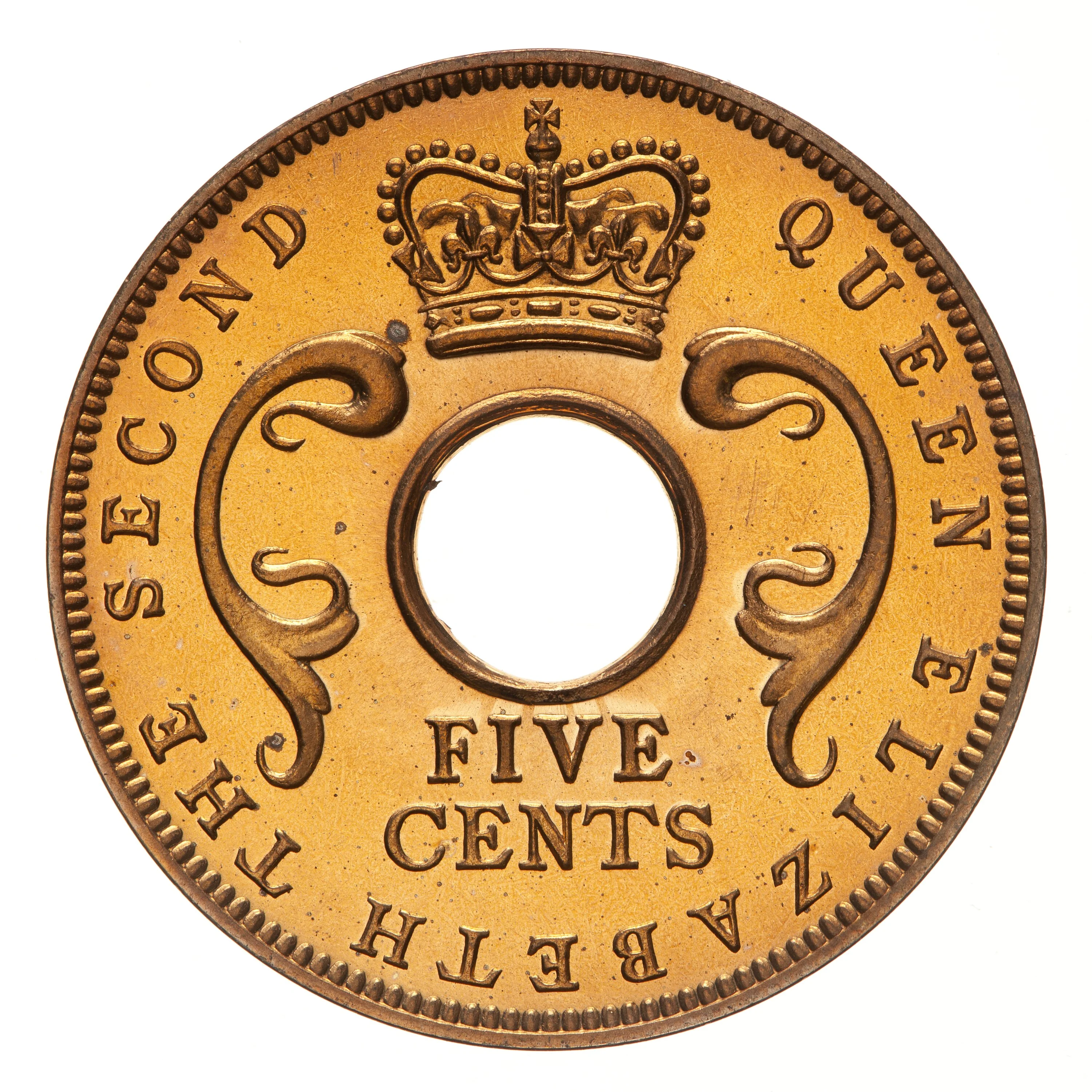
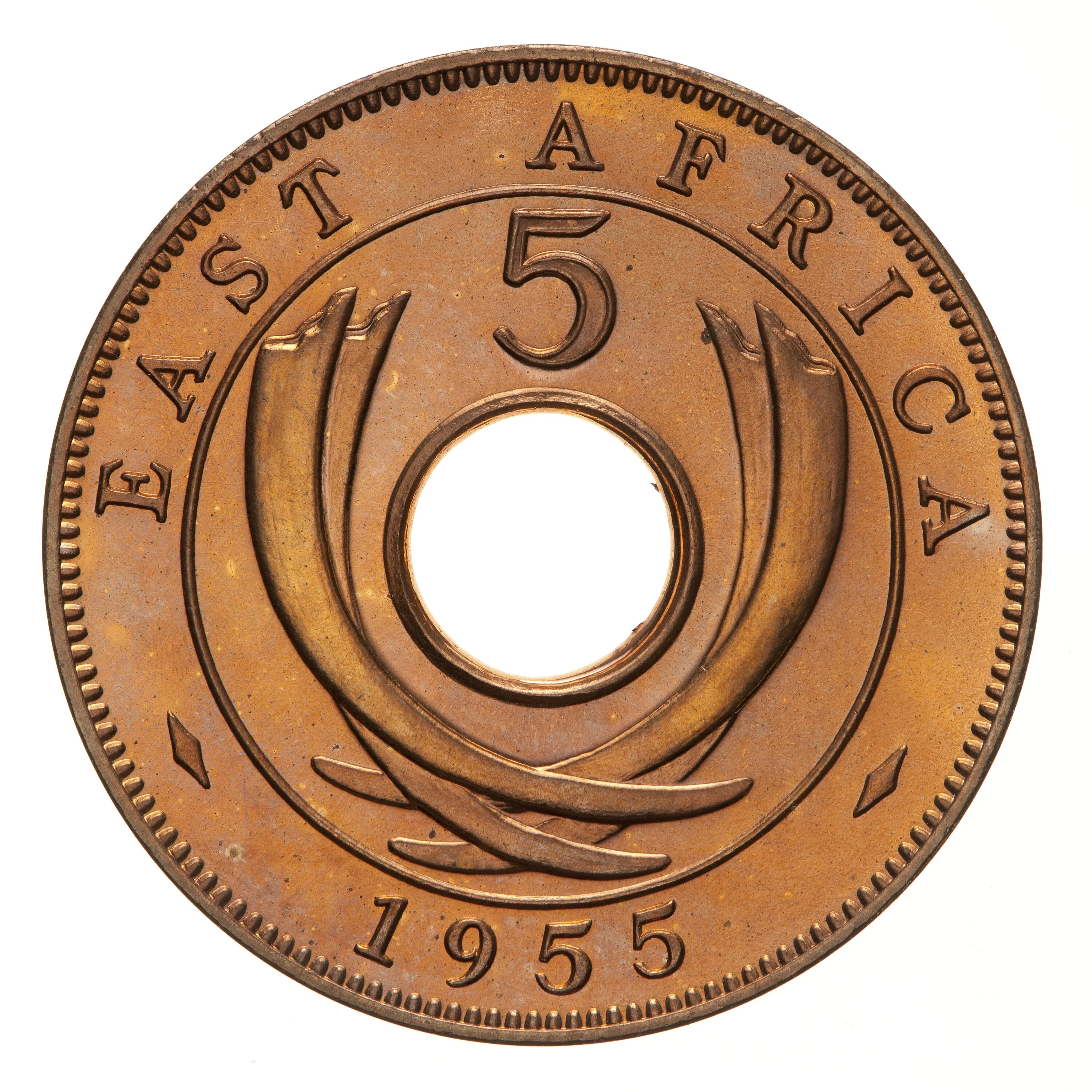
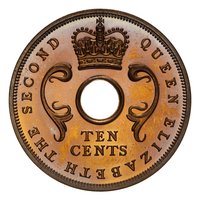
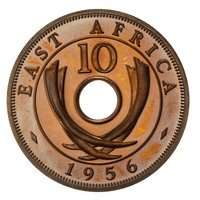
Central hole separates crown and value, encircled by legend.
Inscription:
QUEEN ELIZABETH THE SECOND
FIVE
CENTS
K M
FIVE
CENTS
K M
Script: Latin
Reverse
Edge
Plain
Mints
| Name | Mark |
|---|---|
| Royal Mint (Tower Hill) | — |
| Heaton and Sons / The Mint Birmingham | H |
| Kings Norton Metal Company | KN |
Mintings
Historical background
In 1955, the currency landscape of East Africa was defined by the dominance of the East African Shilling, managed by the East African Currency Board (EABC). Established in 1919 and reformed in the post-war period, the EABC provided a stable and unified currency for the British territories of Kenya, Uganda, Tanganyika, and Zanzibar. This system was a classic colonial currency board, where the local shilling was fully sterling-backed, ensuring fixed parity with the British Pound and facilitating seamless trade with the metropole. For colonial administrators and the significant European settler and Asian merchant communities, this arrangement provided monetary stability and predictability for export-oriented economies.
However, this imposed uniformity masked underlying economic tensions and political aspirations. The currency board system was inherently conservative, prioritizing the convertibility of the shilling into sterling over the ability to direct credit for local developmental needs. Monetary policy was effectively set in London, with no capacity for independent interest rate management or discretionary lending to foster regional industrialisation. Furthermore, while the shilling circulated uniformly, the benefits of the integrated economy were unevenly distributed, largely favouring the settler-dominated production centres in Kenya and the colonial administrative framework.
By the mid-1950s, this system existed in a state of advanced but quiet transition. The winds of political change were unmistakably blowing, with the Mau Mau Uprising in Kenya (1952-1960) underscoring the demand for self-determination. While formal independence for Tanganyika (1961), Uganda (1962), and Kenya (1963) still lay a few years ahead, the currency board's future was already in question. Discussions among emerging local elites and economists had begun to critically assess the limitations of a monetary system that could not serve sovereign national development goals. Thus, 1955 represents the late colonial peak of a unified currency, operating efficiently on the surface but facing an inevitable dissolution as the region moved decisively toward political independence and economic sovereignty.
However, this imposed uniformity masked underlying economic tensions and political aspirations. The currency board system was inherently conservative, prioritizing the convertibility of the shilling into sterling over the ability to direct credit for local developmental needs. Monetary policy was effectively set in London, with no capacity for independent interest rate management or discretionary lending to foster regional industrialisation. Furthermore, while the shilling circulated uniformly, the benefits of the integrated economy were unevenly distributed, largely favouring the settler-dominated production centres in Kenya and the colonial administrative framework.
By the mid-1950s, this system existed in a state of advanced but quiet transition. The winds of political change were unmistakably blowing, with the Mau Mau Uprising in Kenya (1952-1960) underscoring the demand for self-determination. While formal independence for Tanganyika (1961), Uganda (1962), and Kenya (1963) still lay a few years ahead, the currency board's future was already in question. Discussions among emerging local elites and economists had begun to critically assess the limitations of a monetary system that could not serve sovereign national development goals. Thus, 1955 represents the late colonial peak of a unified currency, operating efficiently on the surface but facing an inevitable dissolution as the region moved decisively toward political independence and economic sovereignty.
🌱 Very Common