

10 Cents – East Africa
Context
Years: 1956–1964
Issuer: East Africa
Ruler: Elizabeth II
Currency:
(1921—1967)
Demonetized: Yes
Total mintage: 6,001,000
Material
Diameter: 30 mm
Weight: 9.45 g
Thickness: 1.7 mm
Shape: Round with a round hole
Composition: Bronze
Magnetic: No
Technique: Milled
Alignment: Medal alignment
flip
References
KM: #Click to copy to clipboard38
Numista: #2863
Obverse
Description:
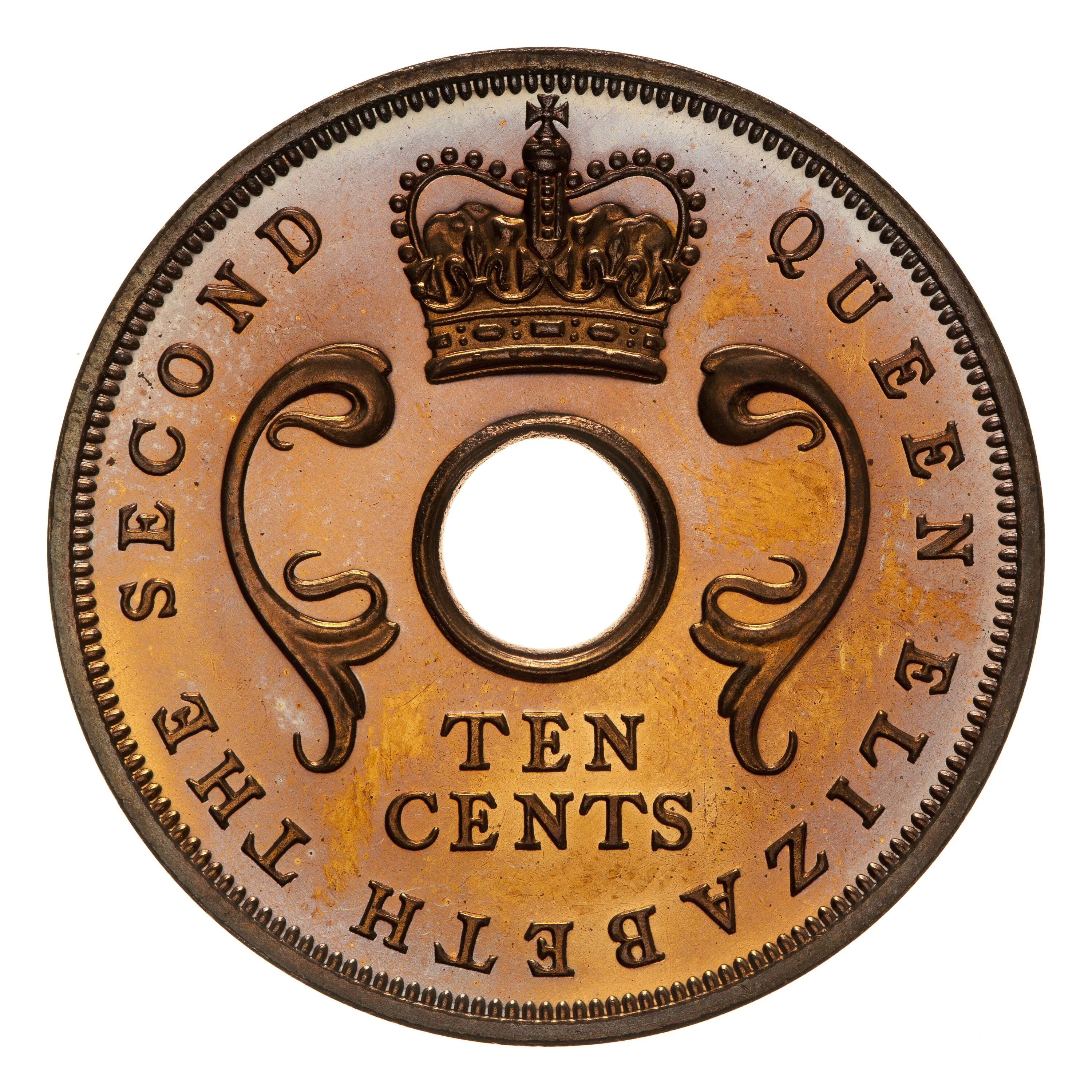
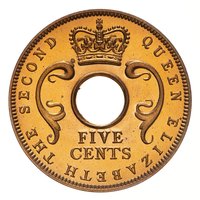
Crown above hole, "Queen Elizabeth the Second" around rim, denomination below.
Inscription:
QUEEN ELIZABETH THE SECOND
TEN
CENTS
TEN
CENTS
Script: Latin
Reverse
Description:
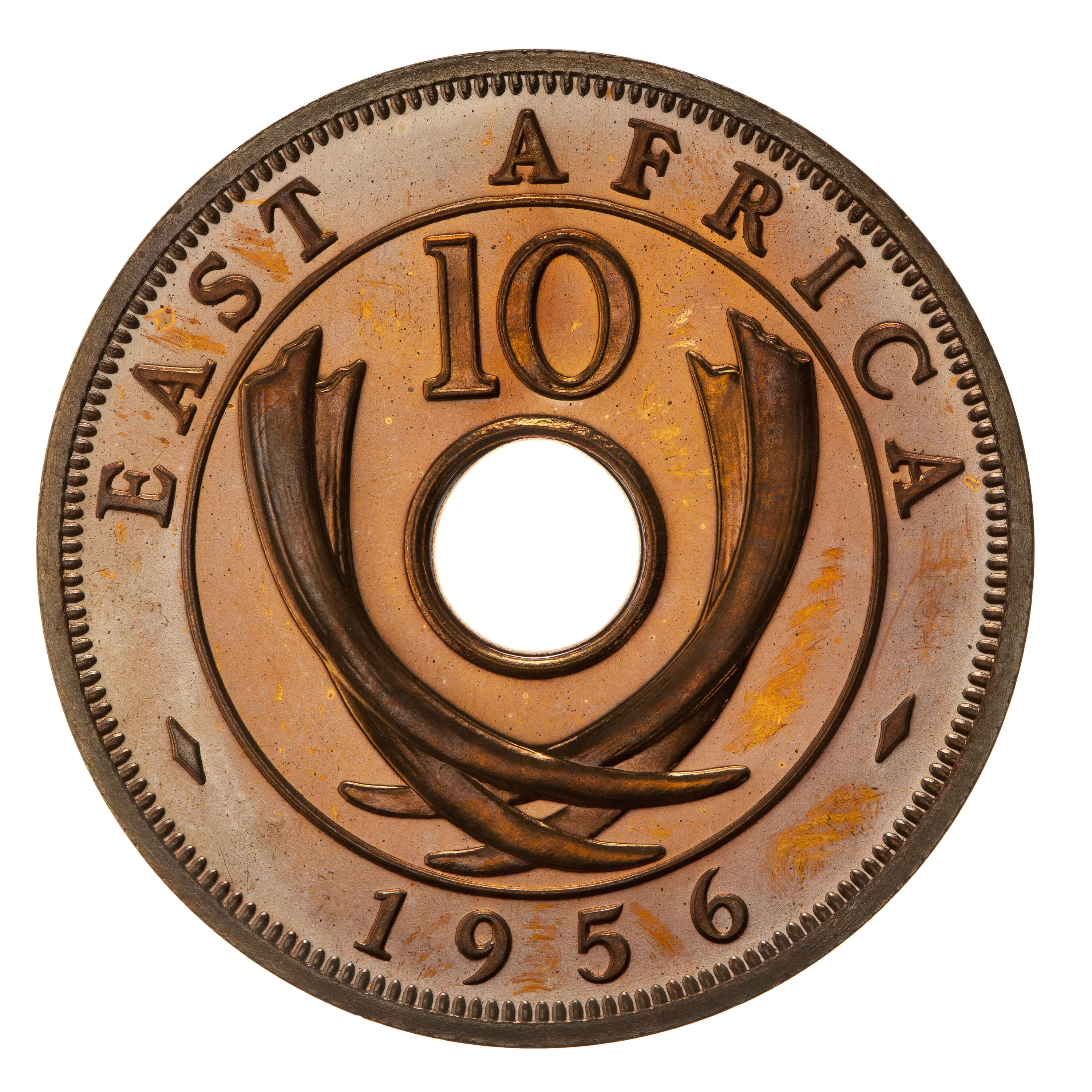
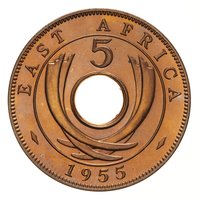
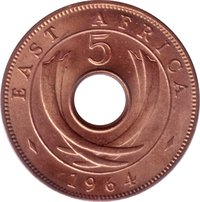
Tusks flank the center hole, with the denomination above, date below, and issuer name at the top.
Inscription:
EAST AFRICA 10 1956
Script: Latin
Edge
Plain
Mints
| Name | Mark |
|---|---|
| Royal Mint (Tower Hill) | — |
| Heaton and Sons / The Mint Birmingham | H |
Mintings
| Year | Mint Mark | Mintage | Quality | Collection |
|---|---|---|---|---|
| 1956 | — | 6,001,000 | ||
| 1956 | — | — | Proof | |
| 1964 | H | — |
Historical background
In 1956, the currency landscape of East Africa was defined by the East African Shilling, a unified currency managed by the East African Currency Board (EACB). Established in 1919 and headquartered in London, the EACB served the British territories of Kenya, Uganda, Tanganyika, and Zanzibar. This system was fundamentally colonial and sterling-pegged, meaning the East African Shilling had a fixed, guaranteed exchange rate with the British Pound Sterling. This arrangement facilitated trade with Britain and provided monetary stability, but it also meant that local monetary policy was entirely subordinated to the needs of the British economy, with no capacity for independent adjustment to regional conditions.
Economically, the currency board system was highly conservative, requiring full sterling-backing for all local currency issued. This limited credit creation and, critics argued, constrained development financing for infrastructure and growing industries in the territories. The period was one of significant economic change, driven by post-World War II commodity booms (like coffee and cotton) and infrastructure projects, yet the monetary system remained rigid. Furthermore, the unified currency facilitated inter-territorial trade and movement, but the benefits were uneven, often perceived to favour Kenya, where most commercial banking and financial activity was concentrated.
Politically, 1956 existed on the cusp of profound transformation. While nationalist movements were gaining momentum, full independence for the territories was still several years away. The currency board, a symbol of colonial economic control, was not yet a primary target for nationalist agitation, which focused more immediately on political representation and land rights. However, the inherent contradictions of a London-controlled currency in nations moving toward self-governance were becoming apparent. The stage was being set for the eventual dissolution of this monetary union in the late 1960s, as each new sovereign state would seek its own central bank and national currency as instruments of economic sovereignty.
Economically, the currency board system was highly conservative, requiring full sterling-backing for all local currency issued. This limited credit creation and, critics argued, constrained development financing for infrastructure and growing industries in the territories. The period was one of significant economic change, driven by post-World War II commodity booms (like coffee and cotton) and infrastructure projects, yet the monetary system remained rigid. Furthermore, the unified currency facilitated inter-territorial trade and movement, but the benefits were uneven, often perceived to favour Kenya, where most commercial banking and financial activity was concentrated.
Politically, 1956 existed on the cusp of profound transformation. While nationalist movements were gaining momentum, full independence for the territories was still several years away. The currency board, a symbol of colonial economic control, was not yet a primary target for nationalist agitation, which focused more immediately on political representation and land rights. However, the inherent contradictions of a London-controlled currency in nations moving toward self-governance were becoming apparent. The stage was being set for the eventual dissolution of this monetary union in the late 1960s, as each new sovereign state would seek its own central bank and national currency as instruments of economic sovereignty.
🌱 Common