

1000 pesos – Colombia
Add to wishlist
Colombia
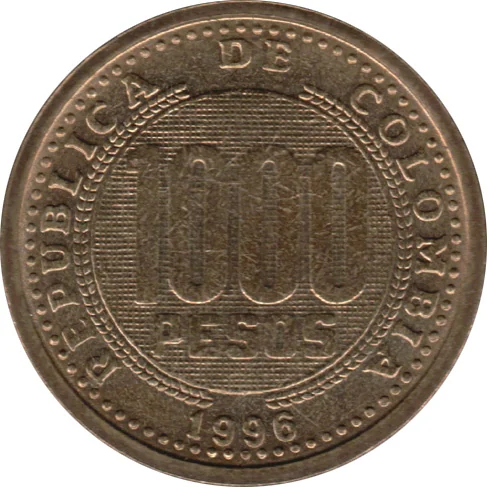
Obverse
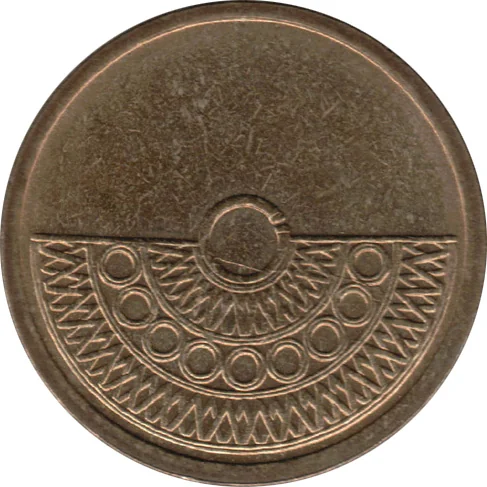
Reverse
Description:
Delicate lacework pattern
Edge
Reeded with inscription
Legend:
CULTURA SINU MIL PESOS
Translation:
Culture of the Bay, One Thousand Pesos
Language: Spanish
Mints
| Name | Mark |
|---|---|
| Fábrica de Moneda de Ibagué | — |
Mintings
| Year | Mint Mark | Mintage | Quality | Collection |
|---|---|---|---|---|
| 1996 | — | 60,000,000 | ||
| 1997 | — | 35,000,000 | ||
| 1998 | — | 85,300,000 |
Historical background
In 1996, Colombia's currency, the peso, was navigating a complex and volatile economic landscape. The country was in the midst of implementing a "crawling peg" exchange rate regime, a system where the central bank allowed the peso to depreciate gradually against the US dollar within a pre-announced band. This policy aimed to balance competing goals: maintaining export competitiveness through controlled devaluation while anchoring inflation expectations and preventing a sudden, destabilizing capital flight. However, this period was marked by significant external pressures, including high global interest rates and contagion from the 1994-1995 Mexican peso crisis ("Tequila Effect"), which heightened investor skittishness towards emerging markets like Colombia.
Domestically, the economy faced severe challenges that strained the peso. Inflation remained stubbornly high, ending 1996 at approximately 21.6%, eroding purchasing power and creating constant pressure on the exchange rate. Furthermore, the country was grappling with a deep-rooted armed conflict and the powerful influence of drug cartels, which created a pervasive climate of political risk and security concerns. These factors discouraged long-term foreign direct investment and contributed to capital outflows, forcing the Banco de la República to spend substantial international reserves to defend the peso's band, a costly and ultimately unsustainable effort.
The tensions of 1996 proved to be a prelude to a major shift in policy. The crawling peg system came under unsustainable pressure, culminating in a severe crisis the following year. In September 1997, the band was widened significantly, and by 1999, Colombia was forced to abandon the managed exchange rate altogether, transitioning to a free-floating currency regime. Thus, the currency situation in 1996 represents the final, strained years of a controlled exchange rate system, struggling against overwhelming internal and external forces that would soon necessitate a radical change in Colombia's monetary framework.
Domestically, the economy faced severe challenges that strained the peso. Inflation remained stubbornly high, ending 1996 at approximately 21.6%, eroding purchasing power and creating constant pressure on the exchange rate. Furthermore, the country was grappling with a deep-rooted armed conflict and the powerful influence of drug cartels, which created a pervasive climate of political risk and security concerns. These factors discouraged long-term foreign direct investment and contributed to capital outflows, forcing the Banco de la República to spend substantial international reserves to defend the peso's band, a costly and ultimately unsustainable effort.
The tensions of 1996 proved to be a prelude to a major shift in policy. The crawling peg system came under unsustainable pressure, culminating in a severe crisis the following year. In September 1997, the band was widened significantly, and by 1999, Colombia was forced to abandon the managed exchange rate altogether, transitioning to a free-floating currency regime. Thus, the currency situation in 1996 represents the final, strained years of a controlled exchange rate system, struggling against overwhelming internal and external forces that would soon necessitate a radical change in Colombia's monetary framework.
🌱 Very Common