

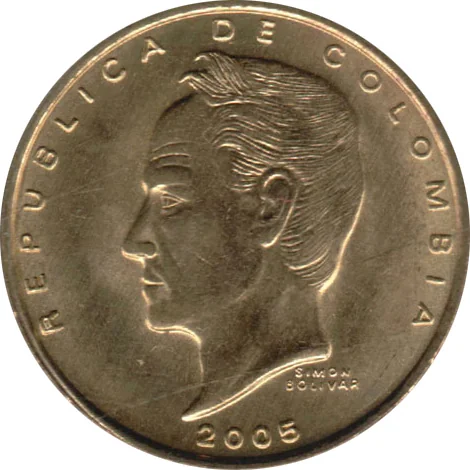
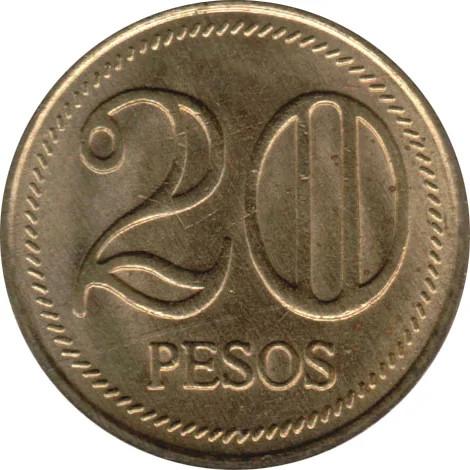
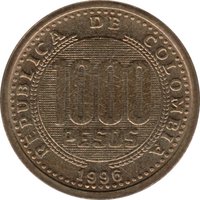
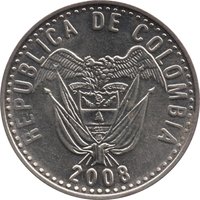
Obverse
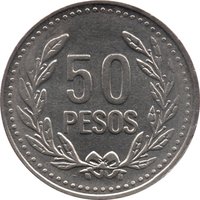
Reverse
Edge
Reeded
Categories
| Person> Politician |
Mintings
| Year | Mint Mark | Mintage | Quality | Collection |
|---|---|---|---|---|
| 2004 | — | 22,700,000 | ||
| 2005 | — | 56,100,000 | ||
| 2006 | — | 63,012,500 | ||
| 2007 | — | 87,300,000 | ||
| 2008 | — | 5,850,000 |
Historical background
In 2004, Colombia's currency situation was characterized by a period of significant appreciation and intense intervention by the central bank, Banco de la República. The Colombian peso (COP) strengthened markedly against the US dollar, driven by a combination of high commodity prices (particularly for oil and coal), improved investor confidence due to enhanced security under President Álvaro Uribe's democratic security policy, and substantial inflows of foreign direct investment and portfolio capital. This appreciation raised concerns among exporters and industrialists, who argued that an overly strong peso was eroding their international competitiveness and threatening the non-commodity sectors of the economy.
Faced with these pressures, the Banco de la República implemented a dual strategy of heavy direct intervention in the foreign exchange market and a gradual accumulation of international reserves. Throughout the year, the bank purchased billions of dollars to curb the peso's rise, aiming to moderate the pace of appreciation rather than reverse it. This intervention was largely sterilized—meaning the bank issued domestic debt to absorb the excess pesos created by the dollar purchases—to prevent the monetary influx from fueling inflation. The policy reflected a delicate balancing act between managing exchange rate volatility and maintaining inflation targets, which were a cornerstone of the bank's credible inflation-targeting regime established in the late 1990s.
The overall economic context of 2004 was one of robust growth, with GDP expanding by over 4%, and controlled inflation, which remained within the target range. Consequently, the currency dynamics were seen less as a crisis and more as a manageable challenge stemming from positive economic inflows. The situation underscored Colombia's increasing integration into global financial markets and the policy dilemmas that can arise from success, setting the stage for ongoing debates about the appropriate level of exchange rate management in a small, open, and commodity-exporting economy.
Faced with these pressures, the Banco de la República implemented a dual strategy of heavy direct intervention in the foreign exchange market and a gradual accumulation of international reserves. Throughout the year, the bank purchased billions of dollars to curb the peso's rise, aiming to moderate the pace of appreciation rather than reverse it. This intervention was largely sterilized—meaning the bank issued domestic debt to absorb the excess pesos created by the dollar purchases—to prevent the monetary influx from fueling inflation. The policy reflected a delicate balancing act between managing exchange rate volatility and maintaining inflation targets, which were a cornerstone of the bank's credible inflation-targeting regime established in the late 1990s.
The overall economic context of 2004 was one of robust growth, with GDP expanding by over 4%, and controlled inflation, which remained within the target range. Consequently, the currency dynamics were seen less as a crisis and more as a manageable challenge stemming from positive economic inflows. The situation underscored Colombia's increasing integration into global financial markets and the policy dilemmas that can arise from success, setting the stage for ongoing debates about the appropriate level of exchange rate management in a small, open, and commodity-exporting economy.

🌱 Very Common