

20 Francs – Belgium
Belgium
Context
Years: 1870–1882
Issuer: Belgium 
Ruler: Leopold II
Currency:
(1832—2001)
Demonetized: Yes
Total mintage: 17,711,755
Material
References
KM: #Click to copy to clipboard37
Numista: #7499
Value
Exchange value: 20 BEF
Bullion value: $967.03
Obverse
Description:
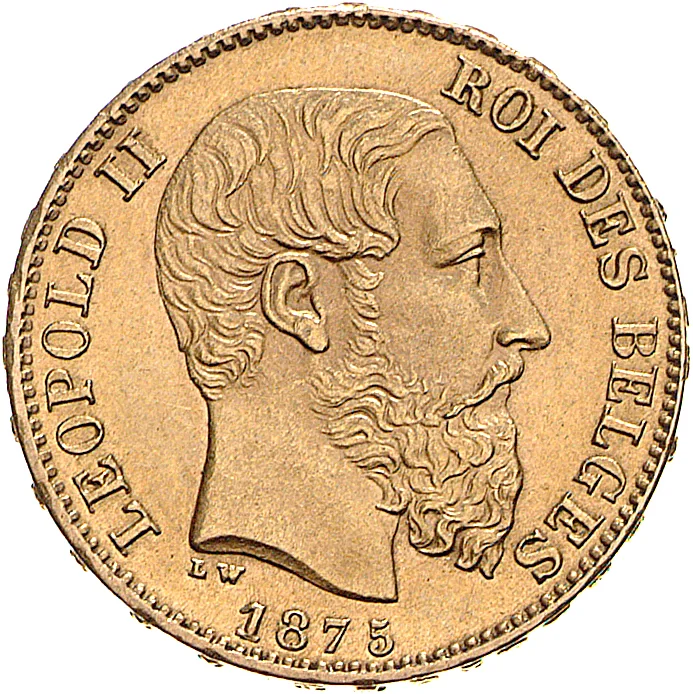
King Leopold II facing right with French lettering. Date and designer below.
Inscription:
LEOPOLD II ROI DES BELGES
L W
1874
L W
1874
Translation:
LEOPOLD II KING OF THE BELGIANS
L W
1874
L W
1874
Script: Latin
Language: French
Engraver: Léopold Wiener
Reverse
Description:
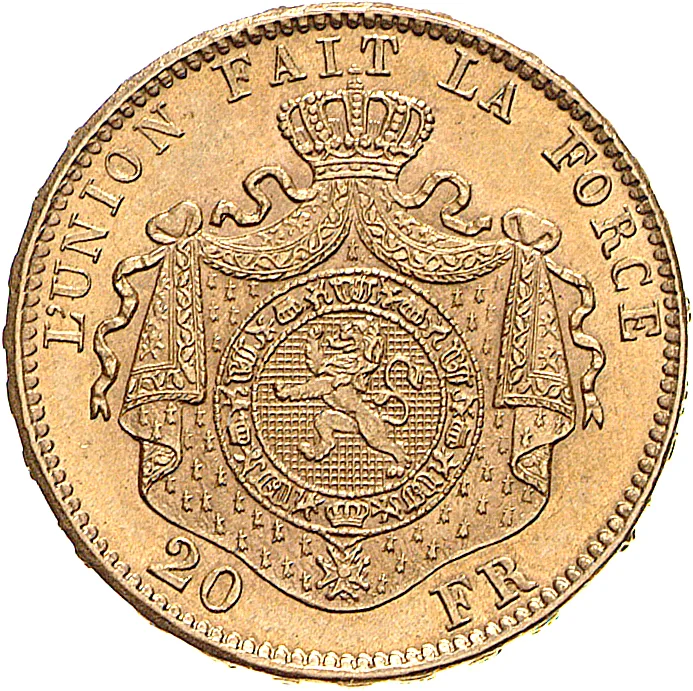
Belgian coat of arms, French motto above, value below.
Inscription:
L'UNION FAIT LA FORCE
20 FR
20 FR
Translation:
Union makes strength
20 Francs
20 Francs
Script: Latin
Language: French
Engraver: Léopold Wiener
Edge
Plain with raised lettering
Legend:
*****DIEU*PROTEGE*LA*BELGIQUE
Translation:
God Protect Belgium
Language: French
Categories
| Symbol> Crown |
| Symbols> Coat of Arms |
Mints
| Name | Mark |
|---|---|
| Royal Mint of Belgium | — |
Mintings
| Year | Mint Mark | Mintage | Quality | Collection |
|---|---|---|---|---|
| 1870 | — | — | ||
| 1871 | — | — | ||
| 1874 | — | 3,046,350 | ||
| 1875 | — | 4,134,253 | ||
| 1876 | — | 2,069,682 | ||
| 1877 | — | 5,906,070 | ||
| 1878 | — | 2,555,400 | ||
| 1882 | — | — |
Historical background
By 1870, Belgium’s currency situation was defined by its membership in the Latin Monetary Union (LMU), which it had helped found in 1865. This treaty created a bimetallic union with France, Switzerland, and Italy (and later Greece), standardizing gold and silver coinage to facilitate trade across borders. Belgian francs were minted to identical weight and fineness as French francs, making them legally interchangeable and ensuring monetary stability with its most important economic partners. The system was built on a fixed ratio between gold and silver (1:15.5), though this would soon face global pressures.
However, the bimetallic standard was under growing strain. The discovery of large silver deposits, particularly in the Americas, was driving down the metal's market value, threatening the official fixed ratio. This led to the phenomenon of "bad money driving out good," as people tended to hoard gold coins and use the cheaper silver for payments, causing a drain on gold reserves. In response, the LMU members, including Belgium, took defensive measures. In 1870, they collectively limited the minting of silver five-franc coins, effectively moving toward a "limping gold standard" where gold was the primary basis for currency, while existing silver coinage remained in circulation as subsidiary, token money.
Domestically, this international framework provided Belgium with a stable and credible currency crucial for its rapid industrialization and extensive export-oriented economy. The National Bank of Belgium, founded in 1850, managed the currency and reserves, operating within the LMU rules. Thus, in 1870, Belgium enjoyed a sophisticated and internationally integrated monetary system, but one that was acutely vulnerable to the shifting global valuations of precious metals, a challenge that would culminate in the LMU's eventual effective dissolution by the end of the century.
However, the bimetallic standard was under growing strain. The discovery of large silver deposits, particularly in the Americas, was driving down the metal's market value, threatening the official fixed ratio. This led to the phenomenon of "bad money driving out good," as people tended to hoard gold coins and use the cheaper silver for payments, causing a drain on gold reserves. In response, the LMU members, including Belgium, took defensive measures. In 1870, they collectively limited the minting of silver five-franc coins, effectively moving toward a "limping gold standard" where gold was the primary basis for currency, while existing silver coinage remained in circulation as subsidiary, token money.
Domestically, this international framework provided Belgium with a stable and credible currency crucial for its rapid industrialization and extensive export-oriented economy. The National Bank of Belgium, founded in 1850, managed the currency and reserves, operating within the LMU rules. Thus, in 1870, Belgium enjoyed a sophisticated and internationally integrated monetary system, but one that was acutely vulnerable to the shifting global valuations of precious metals, a challenge that would culminate in the LMU's eventual effective dissolution by the end of the century.
🌱 Common