

20 Centimes – Belgium
Belgium
Context
Years: 1954–1960
Issuer: Belgium 
Ruler: Baudouin I
Currency:
(1832—2001)
Demonetization: 1970
Total mintage: 57,660,000
Material
References
KM: #Click to copy to clipboard147.1
Numista: #748
Value
Exchange value: 0.20 BEF
Obverse
Description:
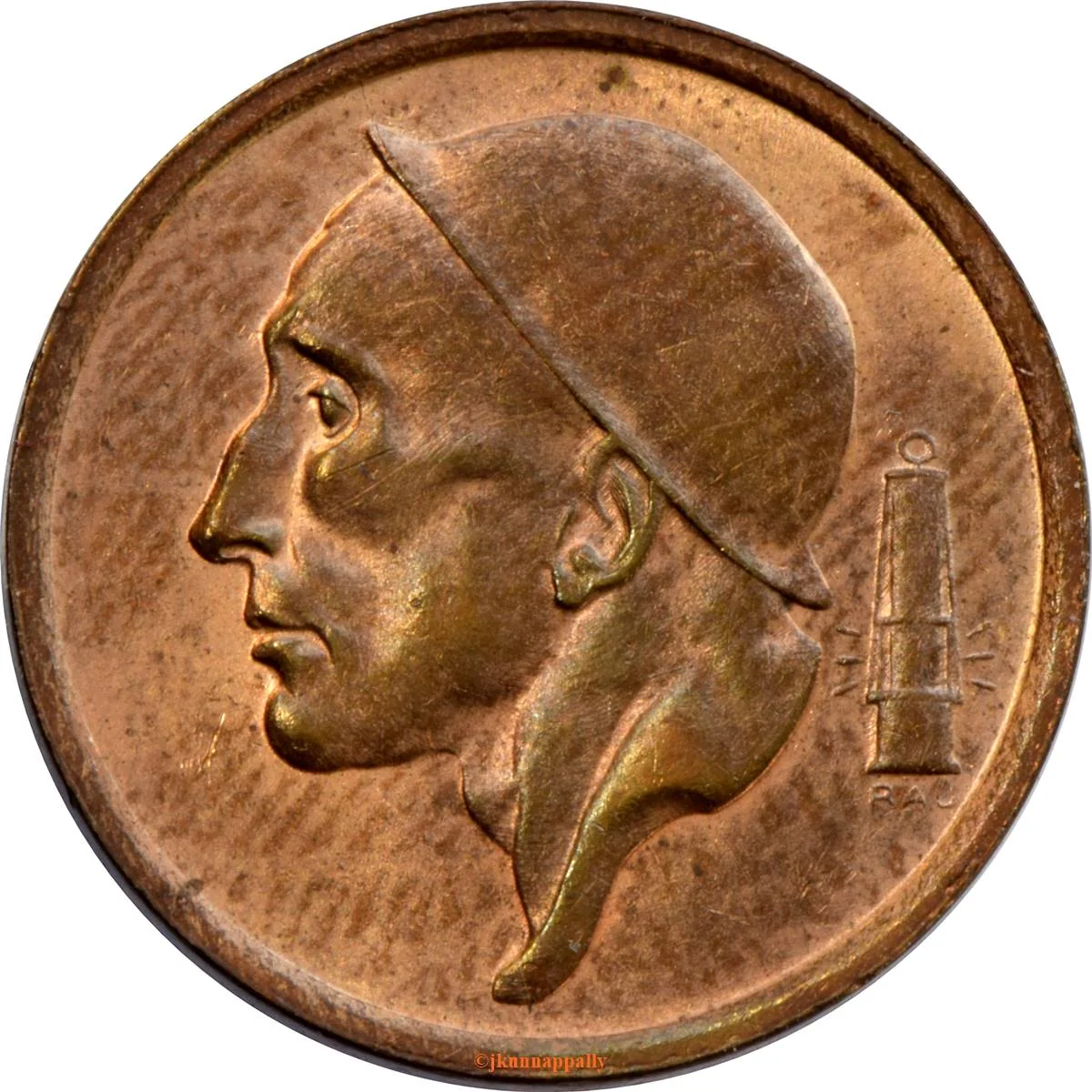
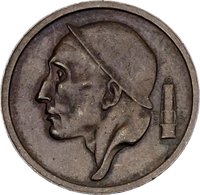
A miner, adapted from Constantin Meunier, faces left. A mining lamp is on the right, with the designer's name below.
Inscription:
RAU
Script: Latin
Engraver: Marcel Rau
Reverse
Description:
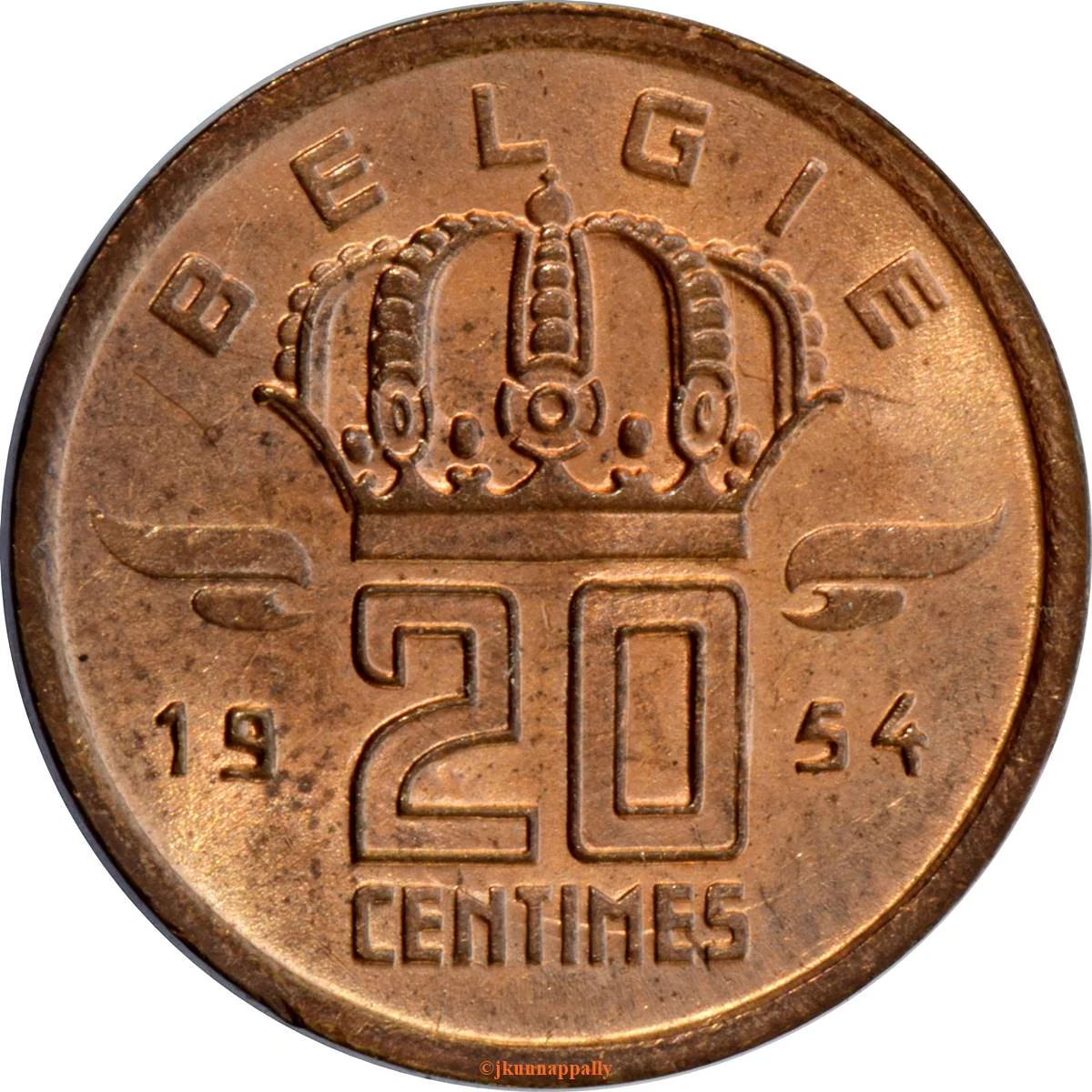
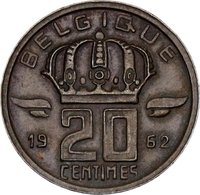
Crowned face value. Dutch legend above.
Inscription:
20
CENTIMES
BELGIE
1954
CENTIMES
BELGIE
1954
Translation:
20 Centimes Belgium 1954
Script: Latin
Engraver: Marcel Rau
Edge
Plain
Mints
| Name | Mark |
|---|---|
| Royal Mint of Belgium | — |
Mintings
| Year | Mint Mark | Mintage | Quality | Collection |
|---|---|---|---|---|
| 1954 | — | 50,130,000 | ||
| 1960 | — | 7,530,000 |
Historical background
In 1954, Belgium's currency situation was firmly embedded within the post-war Bretton Woods system, which pegged the Belgian franc to the US dollar and, by extension, to gold. The franc had undergone a significant devaluation in 1949, aligning with the British pound, which set a new official parity of 50 Belgian francs to one US dollar. This devaluation aimed to boost the competitiveness of Belgium's crucial export-oriented industries, such as steel and textiles, within the recovering European economy. The National Bank of Belgium managed this fixed exchange rate, maintaining strict capital controls to ensure monetary stability and protect the country's substantial gold reserves, which were among the largest per capita in the world.
Domestically, the currency was stable but not without underlying pressures. The early 1950s were a period of robust economic expansion—the "Golden Sixties" were dawning—driven by reconstruction and industrial growth. However, this prosperity began to generate inflationary tendencies, a concern for a nation that prized monetary orthodoxy and price stability. The coalition government, led by Prime Minister Achille Van Acker, had to balance the need for economic growth with the traditional Belgian fear of inflation, a legacy of the traumatic monetary reforms and devaluations following both World Wars.
Internationally, Belgium was an active proponent of European economic integration, which had direct implications for its currency. The country was a founding member of the European Coal and Steel Community (1951) and was preparing for further cooperation. Within the Benelux Economic Union (with the Netherlands and Luxembourg), discussions on monetary coordination were ongoing, foreshadowing later European monetary systems. Thus, in 1954, the Belgian franc was in a period of managed stability, serving as a foundation for national recovery while its policymakers looked toward a more integrated European economic future.
Domestically, the currency was stable but not without underlying pressures. The early 1950s were a period of robust economic expansion—the "Golden Sixties" were dawning—driven by reconstruction and industrial growth. However, this prosperity began to generate inflationary tendencies, a concern for a nation that prized monetary orthodoxy and price stability. The coalition government, led by Prime Minister Achille Van Acker, had to balance the need for economic growth with the traditional Belgian fear of inflation, a legacy of the traumatic monetary reforms and devaluations following both World Wars.
Internationally, Belgium was an active proponent of European economic integration, which had direct implications for its currency. The country was a founding member of the European Coal and Steel Community (1951) and was preparing for further cooperation. Within the Benelux Economic Union (with the Netherlands and Luxembourg), discussions on monetary coordination were ongoing, foreshadowing later European monetary systems. Thus, in 1954, the Belgian franc was in a period of managed stability, serving as a foundation for national recovery while its policymakers looked toward a more integrated European economic future.
🌱 Very Common