

20 centimes – Belgium
Add to wishlist
Belgium
Context
Years: 1953–1963
Issuer: Belgium
Ruler: Baudouin I
Currency:
(1832—2001)
Demonetization: 1970
Total mintage: 58,780,000
Material
References
KM: #
Numista: #1878
Value
Exchange value: 0.20 BEF
Obverse
Description:
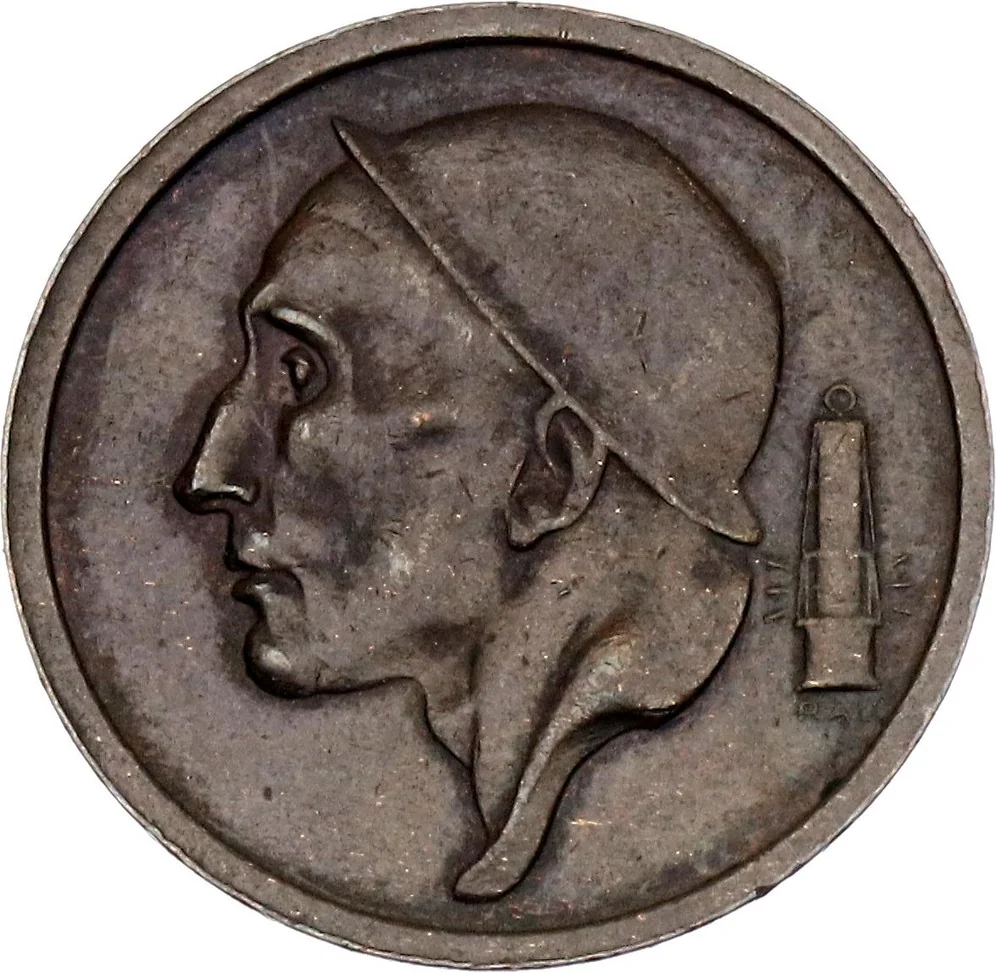
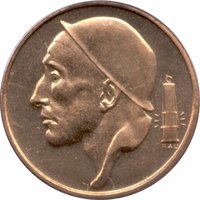
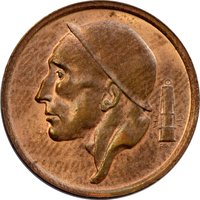
A miner, adapted from Constantin Meunier, faces left. A mining lamp is on the right, with the designer's name below.
Inscription:
RAU
Script: Latin
Engraver: Marcel Rau
Reverse
Description:
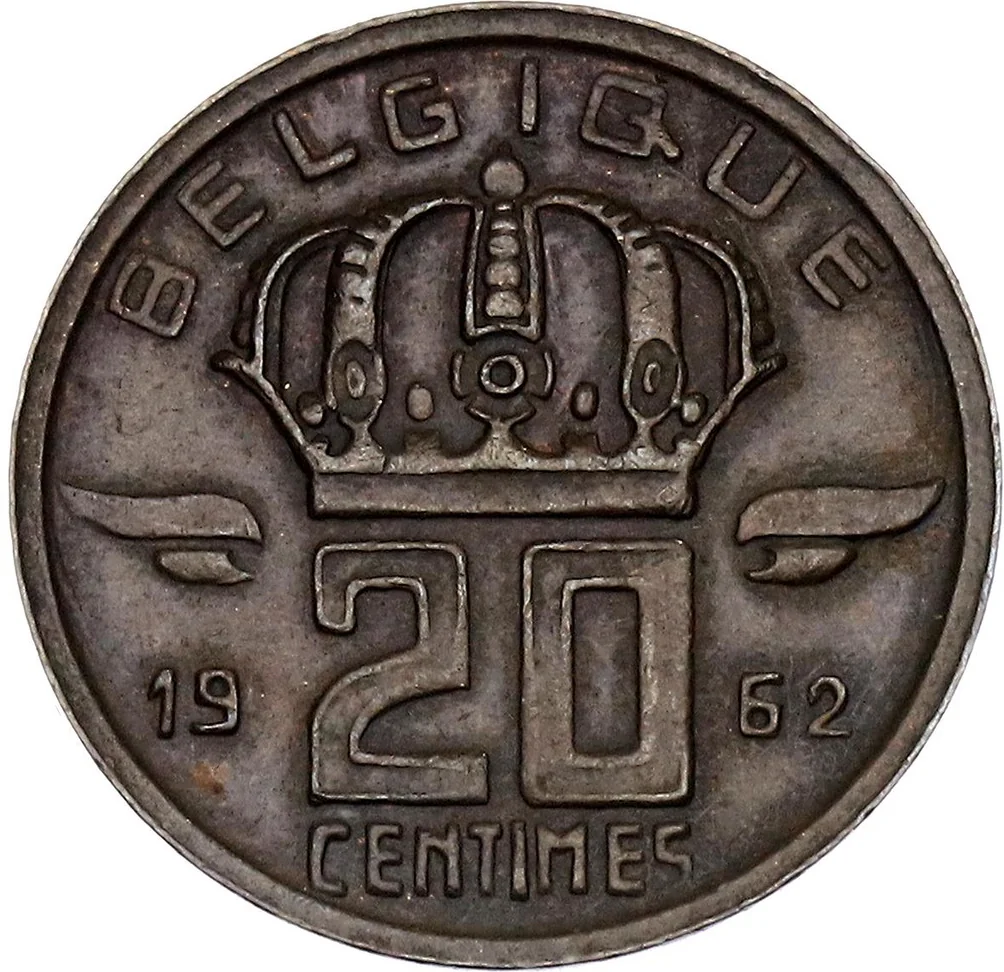
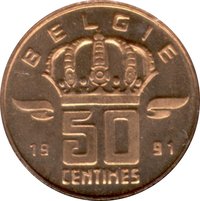
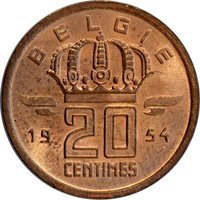
Face value with crowned portrait. French legend above.
Inscription:
BELGIQUE
1953
20
CENTIMES
1953
20
CENTIMES
Translation:
Belgium
1953
20
Centimes
1953
20
Centimes
Script: Latin
Language: French
Engraver: Marcel Rau
Edge
Plain
Mints
| Name | Mark |
|---|---|
| Royal Mint of Belgium | — |
Mintings
| Year | Mint Mark | Mintage | Quality | Collection |
|---|---|---|---|---|
| 1953 | — | 14,150,000 | ||
| 1954 | — | — | ||
| 1957 | — | 13,300,000 | ||
| 1958 | — | 8,700,000 | ||
| 1959 | — | 19,670,000 | ||
| 1962 | — | 410,000 | ||
| 1963 | — | 2,550,000 |
Historical background
In 1953, Belgium's currency situation was fundamentally shaped by the post-war Bretton Woods system, which pegged the Belgian franc to the US dollar and, by extension, to gold. The country had undergone a significant monetary reform in 1944, the Gutt Operation, which had successfully purged the economy of excess wartime liquidity and stabilized the franc. By the early 1950s, this provided a solid foundation, but the nation faced persistent challenges related to its external balance and the value of its currency within the fixed exchange rate framework.
The primary issue was a structural current account deficit, exacerbated by the need to import raw materials for reconstruction and the competitive pressures within the newly forming European Coal and Steel Community. While Belgium's reserves were relatively healthy, the deficit fueled concerns about the franc's stability and led to periodic speculative pressures. The government and the National Bank of Belgium were committed to maintaining the parity of 50 Belgian francs to one US dollar, a rate established in 1946, which required careful management of monetary policy and foreign exchange reserves.
To address these imbalances, Belgian authorities prioritized export-led growth and maintained a strict anti-inflationary policy. This approach, emphasizing fiscal discipline and wage moderation, aimed to restore competitiveness without devaluing the franc. The situation in 1953 was thus one of cautious stability, with the currency holding its official parity but under constant scrutiny due to trade weaknesses. This period set the stage for Belgium's later economic modernization and its deeper integration into European monetary arrangements in the decades to follow.
The primary issue was a structural current account deficit, exacerbated by the need to import raw materials for reconstruction and the competitive pressures within the newly forming European Coal and Steel Community. While Belgium's reserves were relatively healthy, the deficit fueled concerns about the franc's stability and led to periodic speculative pressures. The government and the National Bank of Belgium were committed to maintaining the parity of 50 Belgian francs to one US dollar, a rate established in 1946, which required careful management of monetary policy and foreign exchange reserves.
To address these imbalances, Belgian authorities prioritized export-led growth and maintained a strict anti-inflationary policy. This approach, emphasizing fiscal discipline and wage moderation, aimed to restore competitiveness without devaluing the franc. The situation in 1953 was thus one of cautious stability, with the currency holding its official parity but under constant scrutiny due to trade weaknesses. This period set the stage for Belgium's later economic modernization and its deeper integration into European monetary arrangements in the decades to follow.
🌱 Very Common