

25 Centimes – Belgium
Belgium
Context
Years: 1964–1975
Issuer: Belgium 
Ruler: Baudouin I
Currency:
(1832—2001)
Demonetization: 4 July 1980
Total mintage: 199,940,000
Material
Diameter: 16 mm
Weight: 1.8 g
Thickness: 1.28 mm
Shape: Round
Composition: Copper-nickel
Technique: Milled
Alignment: Coin alignment
flip
References
KM: #Click to copy to clipboard153
Numista: #751
Value
Exchange value: 0.25 BEF
Inflation-adjusted value: 2.15 BEF
Obverse
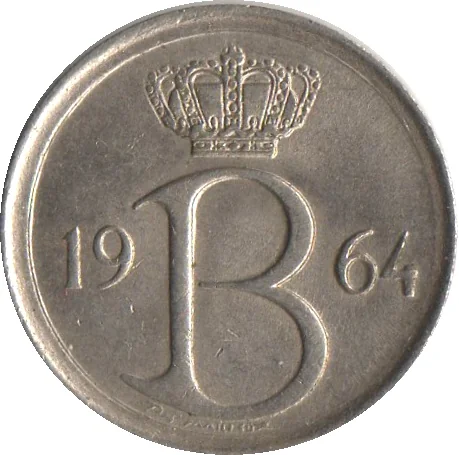
Description:
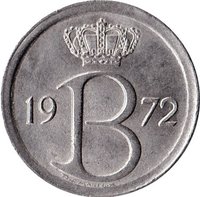
Crowned monogram divides date, designer's name below.
Inscription:
1964
B
Raf MAILLEUX
B
Raf MAILLEUX
Translation:
1964
B
Raf MAILLEUX
B
Raf MAILLEUX
Script: Latin
Engraver: Raf Mailleux
Reverse
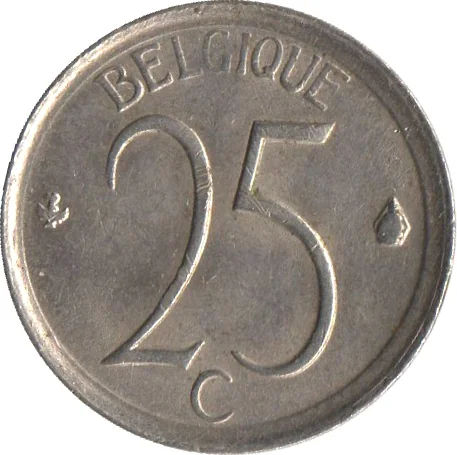
Description:
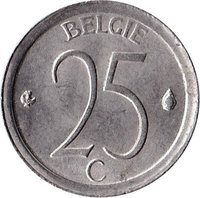
Central value, with privy (left) and mint mark (right); country name in French above.
Inscription:
BELGIQUE
25
C
25
C
Translation:
Belgium
25
C
25
C
Script: Latin
Language: French
Engraver: Raf Mailleux
Edge
Plain
Mints
| Name | Mark |
|---|---|
| Royal Mint of Belgium | — |
Mintings
| Year | Mint Mark | Mintage | Quality | Collection |
|---|---|---|---|---|
| 1964 | — | 21,770,000 | ||
| 1965 | — | 11,440,000 | ||
| 1966 | — | 19,990,000 | ||
| 1967 | — | 6,820,000 | ||
| 1968 | — | 25,250,000 | ||
| 1969 | — | 7,670,000 | ||
| 1970 | — | 27,000,000 | ||
| 1971 | — | 16,000,000 | ||
| 1972 | — | 20,000,000 | ||
| 1973 | — | 12,000,000 | ||
| 1974 | — | 20,000,000 | ||
| 1975 | — | 12,000,000 |
Historical background
In 1964, Belgium operated under the Bretton Woods system, which pegged the Belgian franc to the US dollar at a fixed rate of 50 francs per dollar, with gold convertibility. This stability was managed by the National Bank of Belgium and was crucial for the country's post-war economic reconstruction and its role as a founding member of the European Coal and Steel Community. The franc was considered a strong and stable currency, underpinned by Belgium's robust industrial exports and a generally positive balance of payments.
However, this external stability masked some underlying domestic tensions. The 1960s saw significant wage-price inflation, partly driven by the automatic wage indexation system (windex), which linked salaries to the cost of living. This created persistent inflationary pressure, as rising prices triggered automatic wage increases, which in turn fed back into higher production costs. While the fixed exchange rate provided discipline, it also limited the government's ability to use monetary policy to cool the domestic economy without risking deflation or unemployment.
The year 1964 itself was not one of dramatic currency crisis but rather a period of managing these simmering pressures within the constraints of Bretton Woods. Authorities focused on maintaining the franc's parity through conservative monetary policy and foreign exchange interventions. This environment of controlled tension would persist until the global Bretton Woods system began to unravel in the late 1960s, eventually forcing Belgium to participate in the European "snake in the tunnel" mechanism and later the European Monetary System, precursors to the euro.
However, this external stability masked some underlying domestic tensions. The 1960s saw significant wage-price inflation, partly driven by the automatic wage indexation system (windex), which linked salaries to the cost of living. This created persistent inflationary pressure, as rising prices triggered automatic wage increases, which in turn fed back into higher production costs. While the fixed exchange rate provided discipline, it also limited the government's ability to use monetary policy to cool the domestic economy without risking deflation or unemployment.
The year 1964 itself was not one of dramatic currency crisis but rather a period of managing these simmering pressures within the constraints of Bretton Woods. Authorities focused on maintaining the franc's parity through conservative monetary policy and foreign exchange interventions. This environment of controlled tension would persist until the global Bretton Woods system began to unravel in the late 1960s, eventually forcing Belgium to participate in the European "snake in the tunnel" mechanism and later the European Monetary System, precursors to the euro.
🌱 Very Common