

1000 Lire – Italy
Circulating commemorative coins
Commemoration: Centennial of Rome as Capital of Italy
Italy
Context

Material
References
KM: #Click to copy to clipboard101
Numista: #7454
Value
Exchange value: 1000 ITL
Bullion value: $35.42
Inflation-adjusted value: 22295.74 ITL
Obverse
Description:
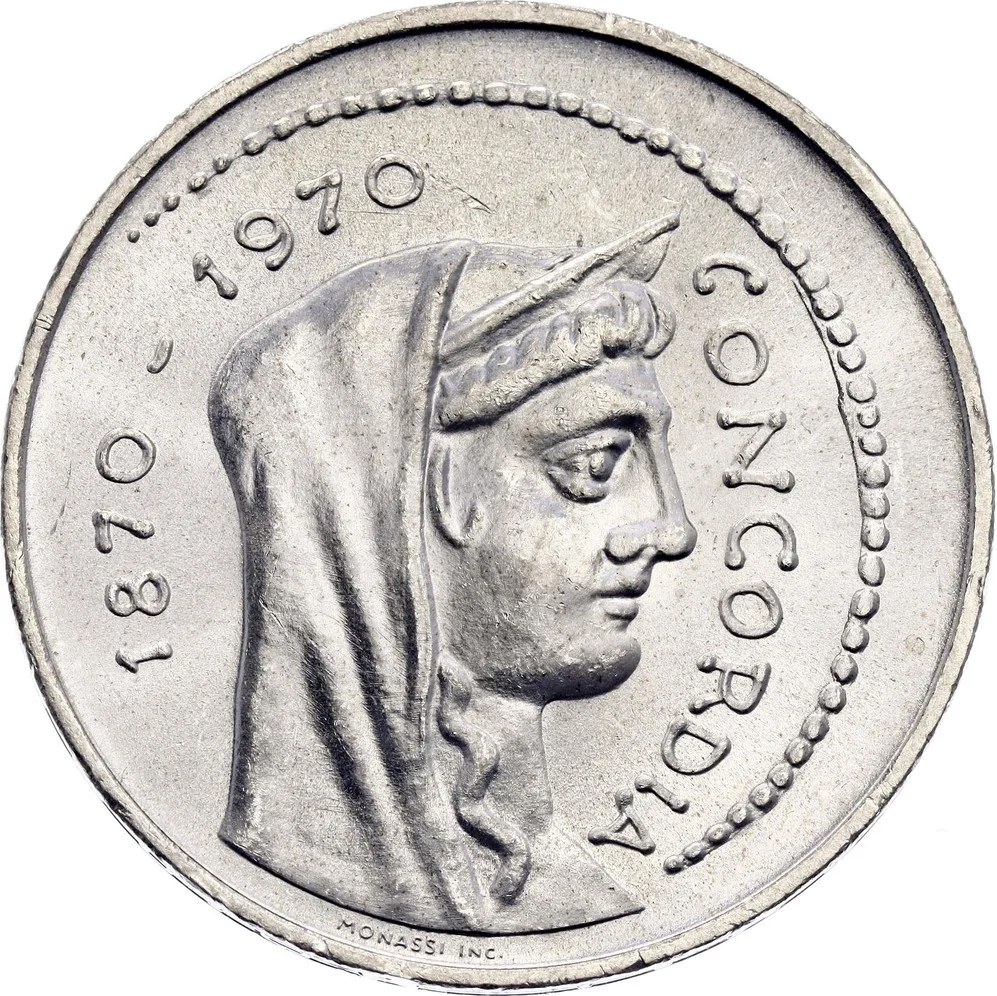
Goddess Concordia within a beaded circle, from a Roman denar of the Gens Aemilia.
Inscription:
1870-1970 CONCORDIA
Translation:
1870-1970 CONCORDIA
Script: Latin
Engraver: Laura Cretara
Reverse
Description:
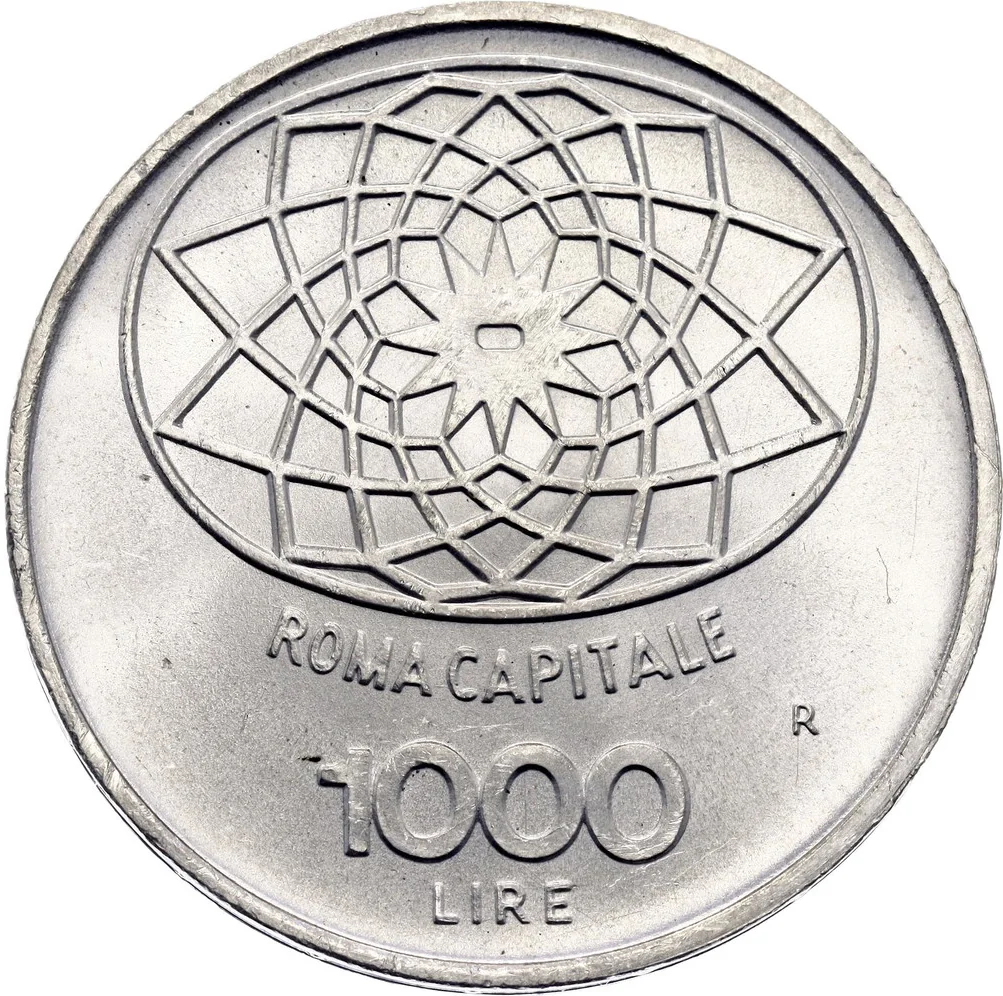
Michelangelo's Campidoglio pavement design, with mintmark at lower right.
Inscription:
ROMA CAPITALE
1000 R
LIRE
1000 R
LIRE
Translation:
ROME CAPITAL
1000 R
LIRE
1000 R
LIRE
Script: Latin
Language: Italian
Engraver: Guerrino Mattia Monassi
Edge
Mints
| Name | Mark |
|---|---|
| Rome | R |
Mintings
| Year | Mint Mark | Mintage | Quality | Collection |
|---|---|---|---|---|
| 1970 | R | 3,011,000 |
Historical background
Italy entered the 1970s in a state of profound economic and monetary instability, a period often termed the "Years of Lead." The fixed exchange rate system of Bretton Woods, which had provided post-war stability, was collapsing, placing pressure on the Italian lira. Domestically, the country was plagued by high inflation, fueled by rising global oil prices following the 1973 crisis, aggressive wage indexation (scala mobile), and significant public spending deficits. This "stagflation" – a combination of stagnant growth and high inflation – eroded the lira's purchasing power and competitiveness.
The currency situation was directly linked to Italy's political and social turmoil. Persistent budget deficits, driven by a sprawling state sector and inefficient public industries, were monetized by the Bank of Italy, further fueling inflation. Frequent strikes and powerful trade unions secured wage increases that often outpaced productivity gains, leading to a cost-push inflation spiral. This loss of confidence manifested in periodic lira crises, with speculative attacks forcing devaluations within the European "Snake" exchange rate mechanism, which Italy entered and exited repeatedly throughout the decade.
By the late 1970s, the situation reached a critical point. The lira had lost over half of its value against the US dollar since 1970, and Italy required emergency loans from the International Monetary Fund in 1974 and 1977 to support its balance of payments. These interventions came with strict conditions for austerity, highlighting the severity of the crisis. This turbulent decade ultimately set the stage for the drastic monetary reforms and fiscal discipline of the 1980s, and later, Italy's push for the stability promised by European Monetary Union as an escape from its chronic lira weakness.
The currency situation was directly linked to Italy's political and social turmoil. Persistent budget deficits, driven by a sprawling state sector and inefficient public industries, were monetized by the Bank of Italy, further fueling inflation. Frequent strikes and powerful trade unions secured wage increases that often outpaced productivity gains, leading to a cost-push inflation spiral. This loss of confidence manifested in periodic lira crises, with speculative attacks forcing devaluations within the European "Snake" exchange rate mechanism, which Italy entered and exited repeatedly throughout the decade.
By the late 1970s, the situation reached a critical point. The lira had lost over half of its value against the US dollar since 1970, and Italy required emergency loans from the International Monetary Fund in 1974 and 1977 to support its balance of payments. These interventions came with strict conditions for austerity, highlighting the severity of the crisis. This turbulent decade ultimately set the stage for the drastic monetary reforms and fiscal discipline of the 1980s, and later, Italy's push for the stability promised by European Monetary Union as an escape from its chronic lira weakness.
🌱 Common