

100 Lire (Guglielmo Marconi) – Italy
Circulating commemorative coins
Commemoration: 100th Anniversary of the birth of Guglielmo Marconi
Italy
Context

Material
References
KM: #Click to copy to clipboard102
Numista: #4254
Value
Exchange value: 100 ITL
Inflation-adjusted value: 1729.88 ITL
Obverse
Description:
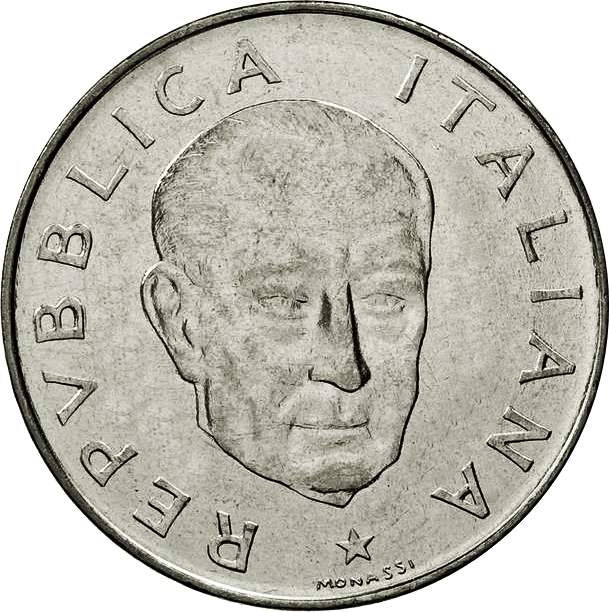
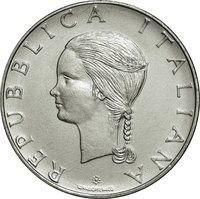
Head of radio inventor Guglielmo Marconi, above a star and engraver's name.
Inscription:
REPVBBLICA ITALIANA
MONASSI
MONASSI
Translation:
Italian Republic
Monetary Institute
Monetary Institute
Script: Latin
Language: Latin
Engraver: Guerrino Mattia Monassi
Reverse
Description:
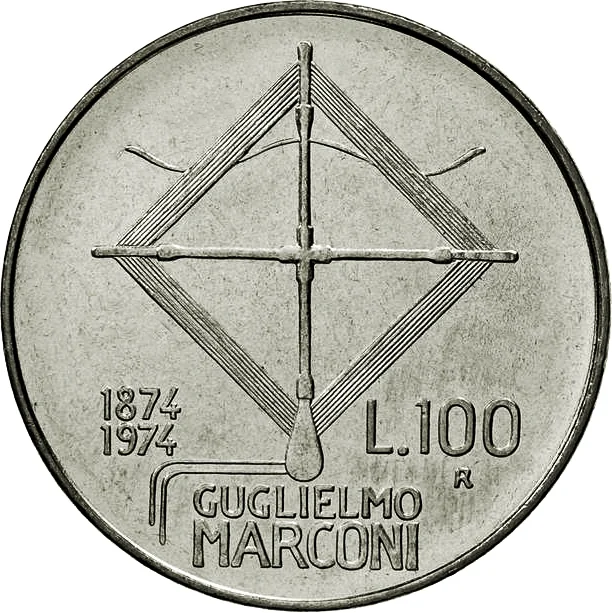
Marconi's radio antenna with a wave symbol at the top. Left: value "L. 100" and mint mark "R". Right: anniversary dates.
Inscription:
1874 1974
L.100
GUGLIELMO
MARCONI
L.100
GUGLIELMO
MARCONI
Script: Latin
Engraver: Guerrino Mattia Monassi
Edge
Reeded
Categories
| Event> Birth anniversary |
| Science> Technology |
Mints
| Name | Mark |
|---|---|
| Rome | R |
Mintings
| Year | Mint Mark | Mintage | Quality | Collection |
|---|---|---|---|---|
| 1974 | R | 50,000,000 |
Historical background
In 1974, Italy was in the throes of a severe economic and political crisis that placed immense pressure on its currency, the lira. The global backdrop was the 1973 oil shock, which drastically increased energy import costs and fueled rampant inflation, exceeding 19% annually. This "stagflation" environment—combining high inflation with stagnant growth and rising unemployment—eroded the lira's purchasing power domestically and weakened its position internationally. The country's chronic current account deficits worsened, draining foreign exchange reserves and leading to a loss of confidence in the lira as a stable store of value.
Politically, the period was marked by profound instability, with frequent changes in government and social unrest, which further undermined investor confidence. Speculative attacks against the lira intensified, as markets doubted the state's ability to control public finances and its complex system of wage indexation (scala mobile). Within the European "snake in the tunnel" exchange rate mechanism, the lira was under continuous strain, requiring repeated and costly interventions by the Bank of Italy to maintain its parity. These efforts ultimately proved unsustainable.
The situation culminated in a major currency crisis. In January 1974, Italy was forced to introduce a dual exchange rate system—one for commercial transactions and a floating, depreciated rate for financial transactions—in a desperate attempt to control capital flight and preserve reserves. This was a clear sign of distress. By the end of the year, despite the dual system, the lira had devalued significantly against key currencies like the US Dollar and the German Mark. The crisis of 1974 set the stage for even more drastic measures later in the decade, including an International Monetary Fund (IMF) loan in 1977, highlighting a profound loss of monetary sovereignty.
Politically, the period was marked by profound instability, with frequent changes in government and social unrest, which further undermined investor confidence. Speculative attacks against the lira intensified, as markets doubted the state's ability to control public finances and its complex system of wage indexation (scala mobile). Within the European "snake in the tunnel" exchange rate mechanism, the lira was under continuous strain, requiring repeated and costly interventions by the Bank of Italy to maintain its parity. These efforts ultimately proved unsustainable.
The situation culminated in a major currency crisis. In January 1974, Italy was forced to introduce a dual exchange rate system—one for commercial transactions and a floating, depreciated rate for financial transactions—in a desperate attempt to control capital flight and preserve reserves. This was a clear sign of distress. By the end of the year, despite the dual system, the lira had devalued significantly against key currencies like the US Dollar and the German Mark. The crisis of 1974 set the stage for even more drastic measures later in the decade, including an International Monetary Fund (IMF) loan in 1977, highlighting a profound loss of monetary sovereignty.
🌱 Very Common