

500 Lire (Dante Alighieri) – Italy
Circulating commemorative coins
Commemoration: 700th Anniversary of the birth of Dante Alighieri
Italy
Context

Material
References
KM: #Click to copy to clipboard100
Numista: #7346
Value
Exchange value: 500 ITL
Bullion value: $26.62
Inflation-adjusted value: 12862.00 ITL
Obverse
Description:
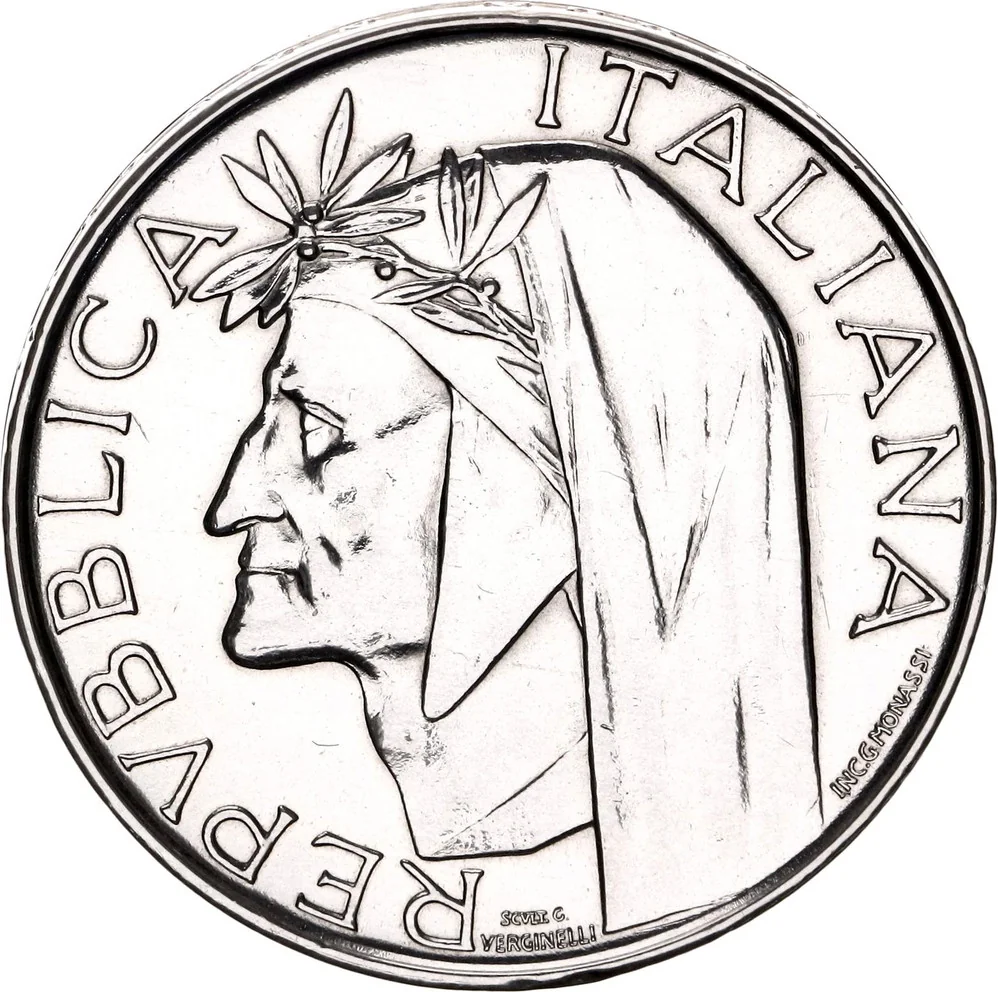
Dante Alighieri's head in left profile, wearing a laurel crown, with the engraver's name on two lines below.
Inscription:
REPVBBLICA ITALIANA
SCULT G•
VERGINELLI
INC•G•MONASSI
SCULT G•
VERGINELLI
INC•G•MONASSI
Translation:
Italian Republic
Sculptor G.
Verginelli
Engraver G. Monassi
Sculptor G.
Verginelli
Engraver G. Monassi
Script: Latin
Engraver: Guerrino Mattia Monassi
Designer: Goffredo Verginelli
Reverse
Description:
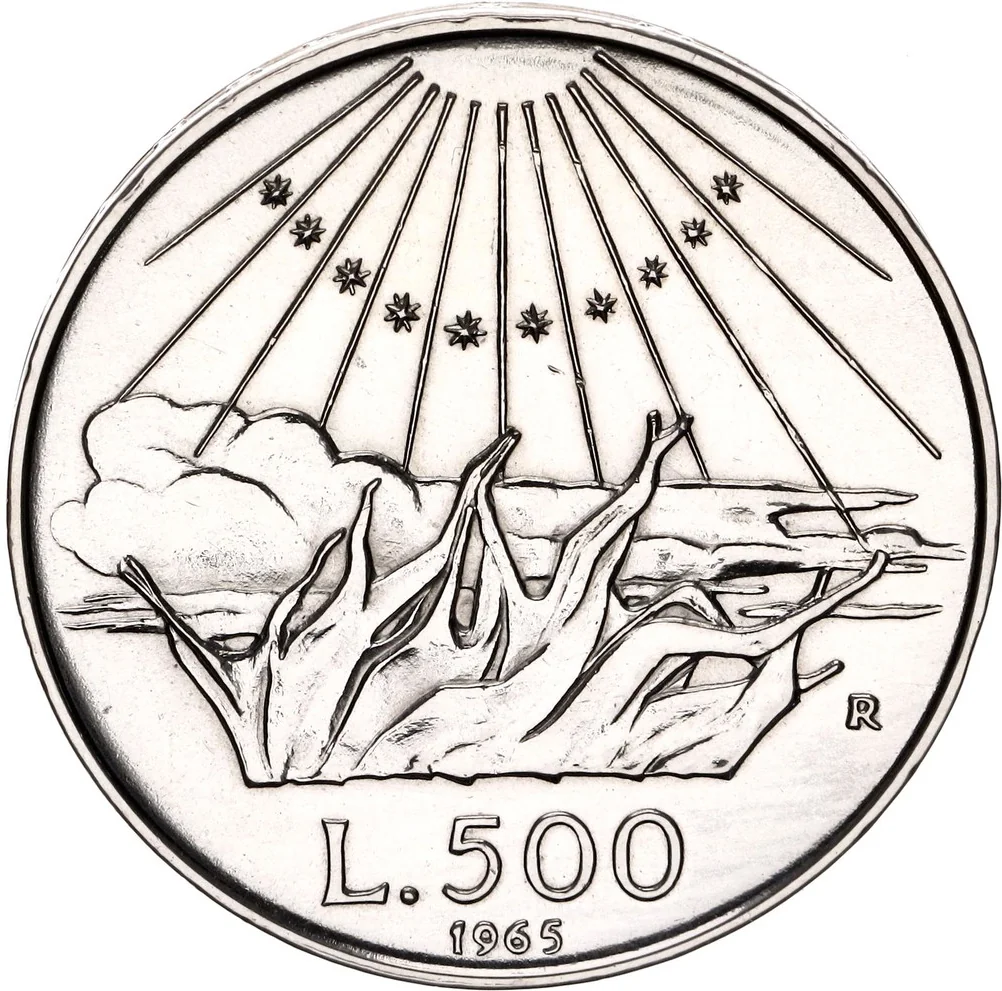
Flames, clouds, and sun rays with ten stars symbolize Hell, Purgatory, and Paradise from Dante's *Divine Comedy*. The value is in the exergue above the date, with the mintmark to the right of the flames.
Inscription:
R
L. 500
1965
L. 500
1965
Translation:
Five Hundred Lire
1965
1965
Script: Latin
Language: Italian
Engraver: Guerrino Mattia Monassi
Designer: Goffredo Verginelli
Edge
Inscription in relief
Legend:
7°CENTENARIO DELLA NASCITA DI DANTE
Translation:
Seventh Centenary of the Birth of Dante
Language: Italian
Categories
| Art> Literature |
| Event> Birth anniversary |
Mintings
| Year | Mint Mark | Mintage | Quality | Collection |
|---|---|---|---|---|
| 1965 | R | 5,000,000 |
Historical background
In 1965, Italy's currency situation was defined by its participation in the Bretton Woods system, which pegged the Italian lira (ITL) to the US dollar at a fixed exchange rate of 625 lire per dollar. This stability was underpinned by the post-war "Italian economic miracle," a period of rapid industrialization and export-led growth that had strengthened the country's foreign reserves and international credibility. However, this fixed parity was increasingly becoming a straitjacket. Domestically, strong economic growth was fueling wage pressures and inflation, which made Italian exports less competitive and began to erode the balance of payments surplus that had supported the lira's strength.
Beneath the surface of official stability, significant pressures were building. The year was marked by a growing divergence between domestic economic conditions—characterized by rising public spending, strong domestic demand, and creeping inflation—and the requirements of maintaining a rigid external parity. This tension led to recurrent speculative pressures against the lira in foreign exchange markets, as investors questioned the sustainability of the peg. The Bank of Italy was forced to frequently intervene, using its dollar reserves to defend the lira's value, a costly operation that highlighted the currency's underlying vulnerability.
Consequently, 1965 stands as a pivotal year marking the end of the lira's unshakeable post-war stability and the beginning of a period of sustained pressure. The challenges of that year foreshadowed the greater turmoil to come; within a few years, the contradictions would become unmanageable, leading to the "Hot Autumn" of labor unrest in 1969 and ultimately necessitating a devaluation of the lira in the early 1970s as the Bretton Woods system itself collapsed. Thus, 1965 was the calm before the storm, where the institutional framework of a fixed exchange rate still held, but the economic fundamentals were clearly signaling that change was inevitable.
Beneath the surface of official stability, significant pressures were building. The year was marked by a growing divergence between domestic economic conditions—characterized by rising public spending, strong domestic demand, and creeping inflation—and the requirements of maintaining a rigid external parity. This tension led to recurrent speculative pressures against the lira in foreign exchange markets, as investors questioned the sustainability of the peg. The Bank of Italy was forced to frequently intervene, using its dollar reserves to defend the lira's value, a costly operation that highlighted the currency's underlying vulnerability.
Consequently, 1965 stands as a pivotal year marking the end of the lira's unshakeable post-war stability and the beginning of a period of sustained pressure. The challenges of that year foreshadowed the greater turmoil to come; within a few years, the contradictions would become unmanageable, leading to the "Hot Autumn" of labor unrest in 1969 and ultimately necessitating a devaluation of the lira in the early 1970s as the Bretton Woods system itself collapsed. Thus, 1965 was the calm before the storm, where the institutional framework of a fixed exchange rate still held, but the economic fundamentals were clearly signaling that change was inevitable.
🌱 Common