

5 Groschen – Austria
Austria

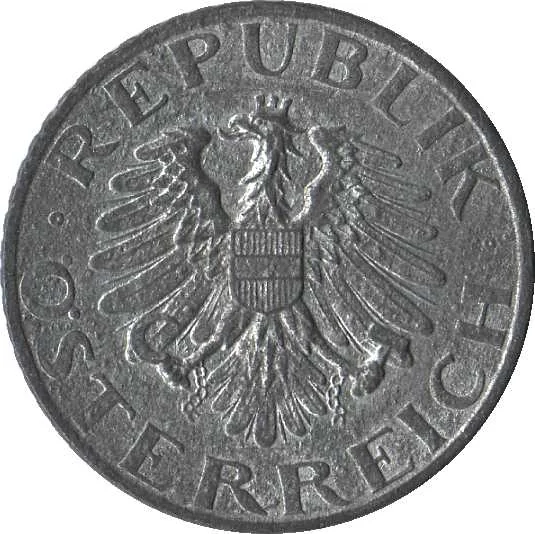
Obverse
Description:
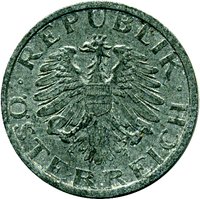
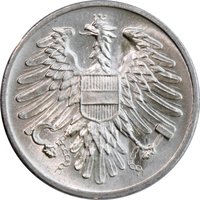
Austrian coat of arms (eagle with shield, hammer, and sickle) encircled by the country name.
Inscription:
· REPUBLIK ·
ÖSTERREICH
ÖSTERREICH
Translation:
· REPUBLIC ·
AUSTRIA
AUSTRIA
Script: Latin
Language: German
Engraver: Michael Powolny
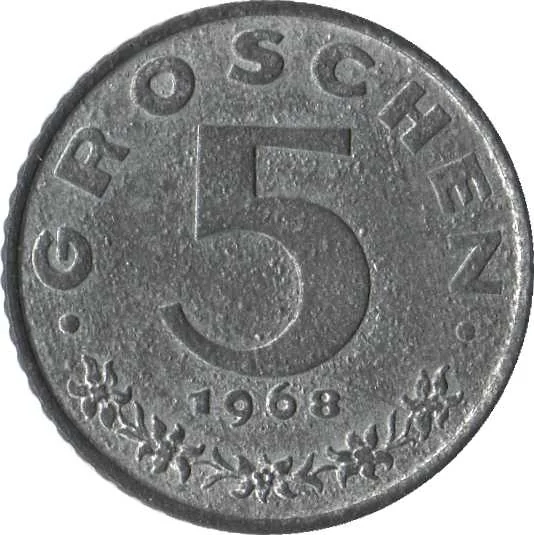
Reverse
Description:
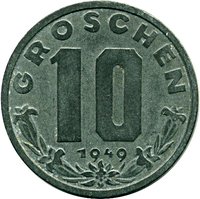
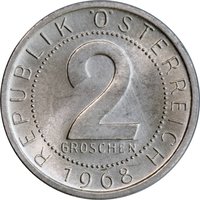
Large numeral, word above, date below.
Inscription:
GROSCHEN
5
1968
5
1968
Script: Latin
Engraver: Alfred Hofmann
Edge
Reeded
Categories
| Animal> Bird> Eagle |
| Symbols> Coat of Arms |
| Symbol> Hammer and sickle |
Mints
| Name | Mark |
|---|---|
| Münze Österreich | — |
Mintings
| Year | Mint Mark | Mintage | Quality | Collection |
|---|---|---|---|---|
| 1948 | — | 17,269,000 | ||
| 1950 | — | — | Proof | |
| 1950 | — | 19,426,431 | ||
| 1951 | — | 12,454,569 | ||
| 1951 | — | — | Proof | |
| 1953 | — | 14,931,000 | ||
| 1955 | — | 12,288,000 | ||
| 1957 | — | 26,809,000 | ||
| 1957 | — | — | Proof | |
| 1961 | — | 3,429,000 | ||
| 1962 | — | 5,999,000 | ||
| 1963 | — | 13,293,000 | ||
| 1963 | — | — | Proof | |
| 1964 | — | 4,659,000 | ||
| 1964 | — | — | Proof | |
| 1965 | — | 13,704,000 | ||
| 1965 | — | — | Proof | |
| 1966 | — | 9,348,000 | ||
| 1966 | — | — | Proof | |
| 1967 | — | 4,404,000 | ||
| 1967 | — | — | Proof | |
| 1968 | — | 31,418,400 | ||
| 1968 | — | 15,600 | Proof | |
| 1969 | — | 44,000 | Proof | |
| 1970 | — | 144,000 | Proof | |
| 1971 | — | 125,000 | Proof | |
| 1972 | — | 10,979,000 | ||
| 1972 | — | 116,000 | Proof | |
| 1973 | — | 12,000 | Proof | |
| 1973 | — | 10,336,000 | ||
| 1974 | — | 2,911,000 | ||
| 1974 | — | 87,000 | Proof | |
| 1975 | — | 51,000 | Proof | |
| 1975 | — | 7,102,000 | ||
| 1976 | — | 8,079,000 | ||
| 1976 | — | 45,000 | Proof | |
| 1977 | — | 1,600,000 | ||
| 1977 | — | 45,000 | Proof | |
| 1978 | — | 44,000 | Proof | |
| 1978 | — | 2,657,000 | ||
| 1979 | — | 4,927,000 | ||
| 1979 | — | 44,000 | Proof | |
| 1980 | — | 3,100,000 | ||
| 1980 | — | 48,000 | Proof | |
| 1981 | — | 450,000 | ||
| 1981 | — | 49,000 | Proof | |
| 1982 | — | 3,950,000 | ||
| 1982 | — | 50,000 | Proof | |
| 1983 | — | 501,000 | ||
| 1983 | — | 65,000 | Proof | |
| 1984 | — | 988,000 | ||
| 1984 | — | 65,000 | Proof | |
| 1985 | — | 1,914,000 | ||
| 1985 | — | 45,000 | Proof | |
| 1986 | — | 100,800 | ||
| 1986 | — | 42,000 | Proof | |
| 1987 | — | 1,458,000 | ||
| 1987 | — | 42,000 | Proof | |
| 1988 | — | 1,261,000 | ||
| 1988 | — | 42,000 | Proof | |
| 1989 | — | 2,604,000 | ||
| 1989 | — | 38,000 | Proof | |
| 1990 | — | 2,608,000 | ||
| 1990 | — | 35,000 | Proof | |
| 1991 | — | 2,400,000 | ||
| 1991 | — | 27,000 | Proof | |
| 1992 | — | 671,000 | ||
| 1993 | — | 63,000 | Proof | |
| 1994 | — | 50,000 | Proof |
Historical background
In the aftermath of World War II, Austria, like Germany, was divided into four Allied occupation zones. The currency situation was chaotic and inflationary. The pre-war Reichsmark remained in circulation but had been severely debased by Nazi war financing, leading to a vast oversupply of money and a thriving black market where goods were traded for cigarettes, coffee, or barter. This monetary overhang stifled legitimate economic activity and reconstruction, as the currency held no public trust and prices were unstable.
To address this crisis, the Austrian government, with the approval of the Allied Council, enacted the Schilling Law of November 1947. This was a decisive currency reform, though less radical than the concurrent German model. The core measures included a 1:1 exchange of old Reichsmarks for new Austrian Schillings, but only for the first 150 Schillings per person. Amounts above that were exchanged at a rate of 1:3, effectively wiping out two-thirds of the excess money supply. Simultaneously, a one-time capital levy was imposed on bank deposits and securities to further absorb liquidity and fund reconstruction.
The 1948 currency reform, while initially causing hardship, was largely successful in stabilizing the Austrian economy. It swiftly restored the value of money, eliminated the monetary overhang, and within months drastically reduced black market activity. This created the essential foundation for the revival of normal trade and price mechanisms. The newly stable Schilling, coupled with the imminent arrival of Marshall Plan aid from 1948 onward, set the stage for Austria's remarkable post-war economic recovery and the beginning of its "Wirtschaftswunder" (economic miracle).
To address this crisis, the Austrian government, with the approval of the Allied Council, enacted the Schilling Law of November 1947. This was a decisive currency reform, though less radical than the concurrent German model. The core measures included a 1:1 exchange of old Reichsmarks for new Austrian Schillings, but only for the first 150 Schillings per person. Amounts above that were exchanged at a rate of 1:3, effectively wiping out two-thirds of the excess money supply. Simultaneously, a one-time capital levy was imposed on bank deposits and securities to further absorb liquidity and fund reconstruction.
The 1948 currency reform, while initially causing hardship, was largely successful in stabilizing the Austrian economy. It swiftly restored the value of money, eliminated the monetary overhang, and within months drastically reduced black market activity. This created the essential foundation for the revival of normal trade and price mechanisms. The newly stable Schilling, coupled with the imminent arrival of Marshall Plan aid from 1948 onward, set the stage for Austria's remarkable post-war economic recovery and the beginning of its "Wirtschaftswunder" (economic miracle).
🌱 Very Common