

10 Groschen – Austria
Austria

Obverse
Description:
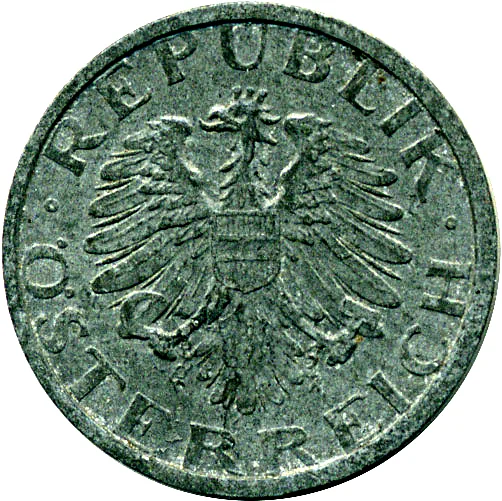
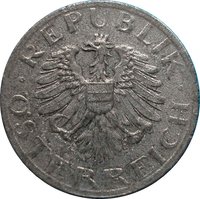
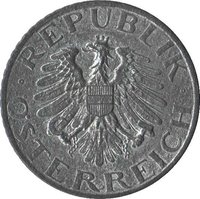
Austria's coat of arms features an eagle holding the national shield.
Inscription:
· REPUBLIK ·
ÖSTERREICH
ÖSTERREICH
Translation:
· REPUBLIC ·
AUSTRIA
AUSTRIA
Script: Latin
Language: German
Engraver: Michael Powolny
Reverse
Description:
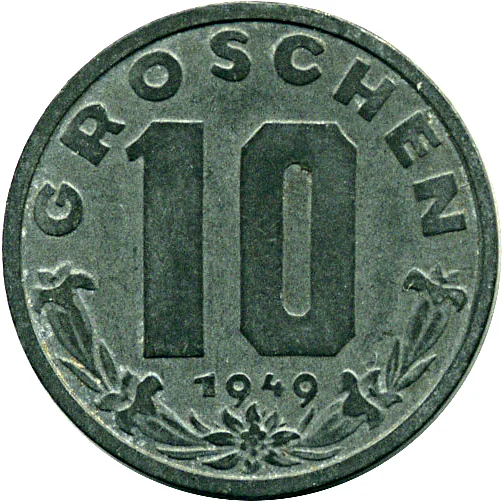
Four gentians, one edelweiss.
Inscription:
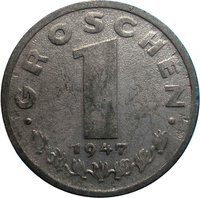
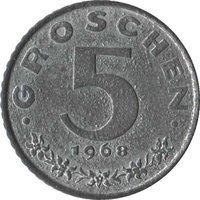
GROSCHEN
10
1949
10
1949
Script: Latin
Engraver: Adolf Ludwig Hofmann
Edge
Plain
Categories
| Animal> Bird> Eagle |
| Symbols> Coat of Arms |
| Symbol> Hammer and sickle |
Mints
| Name | Mark |
|---|---|
| Münze Österreich | — |
Mintings
| Year | Mint Mark | Mintage | Quality | Collection |
|---|---|---|---|---|
| 1947 | — | 6,844,580 | ||
| 1947 | — | — | Proof | |
| 1948 | — | 66,205,000 | ||
| 1948 | — | — | Proof | |
| 1949 | — | 51,202,000 | ||
| 1949 | — | — | Proof |
Historical background
In the immediate aftermath of World War II, Austria, like much of Europe, faced a dire economic crisis characterized by severe inflation, a crippling black market, and a critical shortage of goods. The official Reichsmark, still in circulation from the Nazi era, had lost public confidence and was being massively hoarded, particularly by Soviet occupation forces who used it to purchase Austrian assets. This led to a grotesque monetary overhang where far more currency chased far fewer goods, pushing the formal economy to the brink of collapse while a barter and black market economy flourished, undermining reconstruction efforts.
To break this cycle, the Austrian government, with the approval of the Allied Control Council, enacted a radical currency reform in November 1947. The core of the Schillinggesetz was the introduction of a new Austrian schilling to replace the Reichsmark. However, the conversion was harsh and restrictive: for every 100 Reichsmarks, individuals could exchange only 3 schillings in cash and 70 schillings into a blocked bank account, with the remaining 27 Reichsmarks effectively lost. This drastic reduction in the money supply was designed to wipe out the monetary overhang, destroy the value of hoarded currency, and restore scarcity value to money.
The reform achieved its primary goal of ending hyperinflation and stabilizing the currency, laying the essential monetary foundation for Austria's later economic recovery. However, the short-term consequences were severe for ordinary citizens, as personal savings were largely eradicated overnight. The move also intensified political tensions between the Western Allies and the Soviet Union, which opposed the reform and continued to use old Reichsmarks in its zone, creating a temporary dual-currency system. Ultimately, the 1947 currency reform was a painful but necessary shock therapy that allowed Austria to begin its journey toward the social market economy of the post-war era.
To break this cycle, the Austrian government, with the approval of the Allied Control Council, enacted a radical currency reform in November 1947. The core of the Schillinggesetz was the introduction of a new Austrian schilling to replace the Reichsmark. However, the conversion was harsh and restrictive: for every 100 Reichsmarks, individuals could exchange only 3 schillings in cash and 70 schillings into a blocked bank account, with the remaining 27 Reichsmarks effectively lost. This drastic reduction in the money supply was designed to wipe out the monetary overhang, destroy the value of hoarded currency, and restore scarcity value to money.
The reform achieved its primary goal of ending hyperinflation and stabilizing the currency, laying the essential monetary foundation for Austria's later economic recovery. However, the short-term consequences were severe for ordinary citizens, as personal savings were largely eradicated overnight. The move also intensified political tensions between the Western Allies and the Soviet Union, which opposed the reform and continued to use old Reichsmarks in its zone, creating a temporary dual-currency system. Ultimately, the 1947 currency reform was a painful but necessary shock therapy that allowed Austria to begin its journey toward the social market economy of the post-war era.
🌱 Very Common