

2 Groschen – Austria
Austria

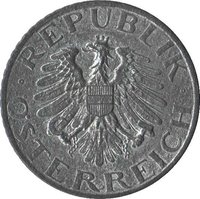
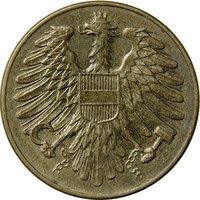
Obverse
Description:
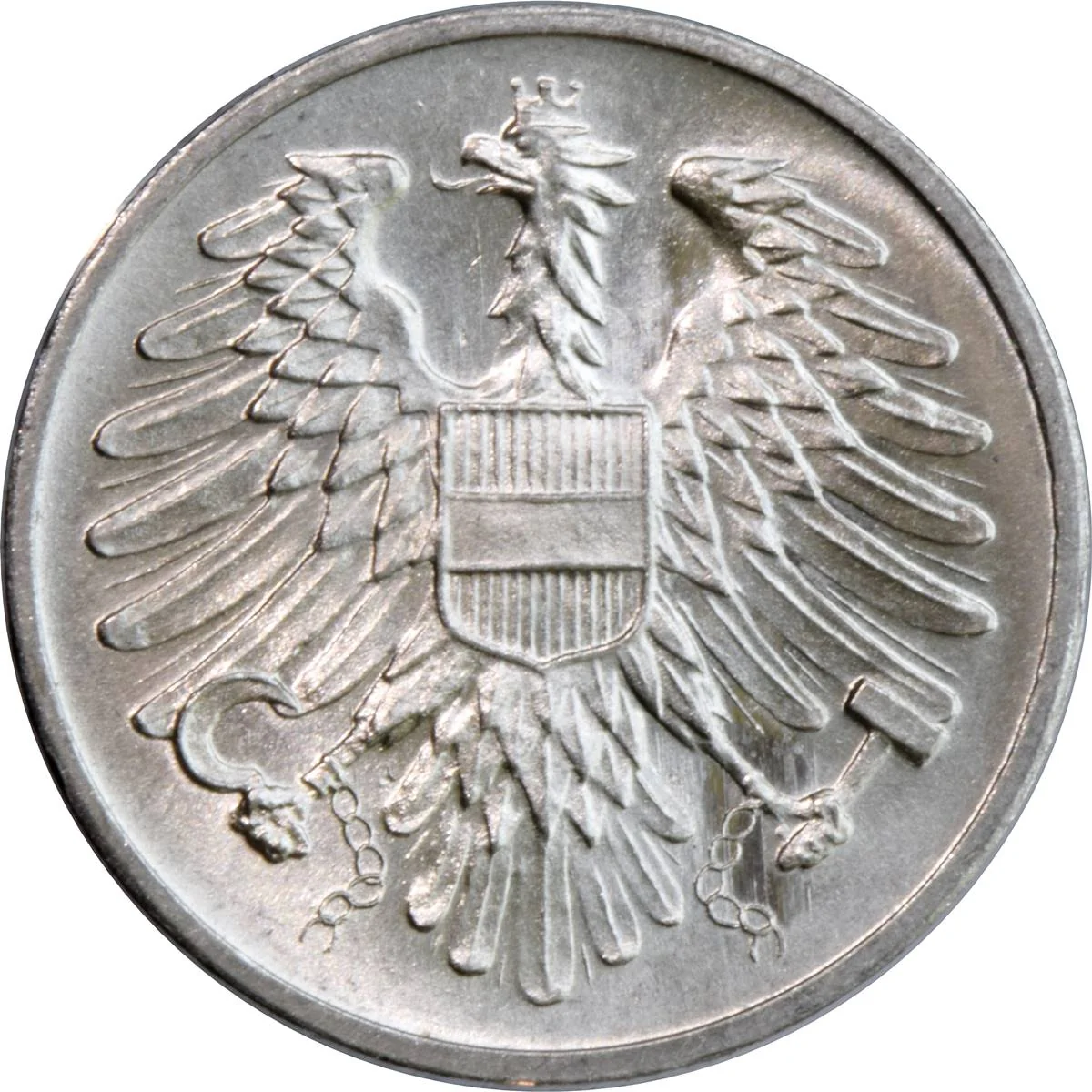
Austria's coat of arms features an eagle holding the national shield.
Engraver: Michael Powolny
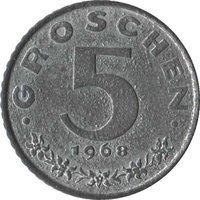
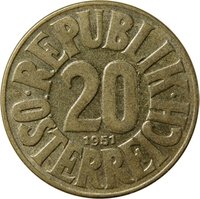
Reverse
Description:
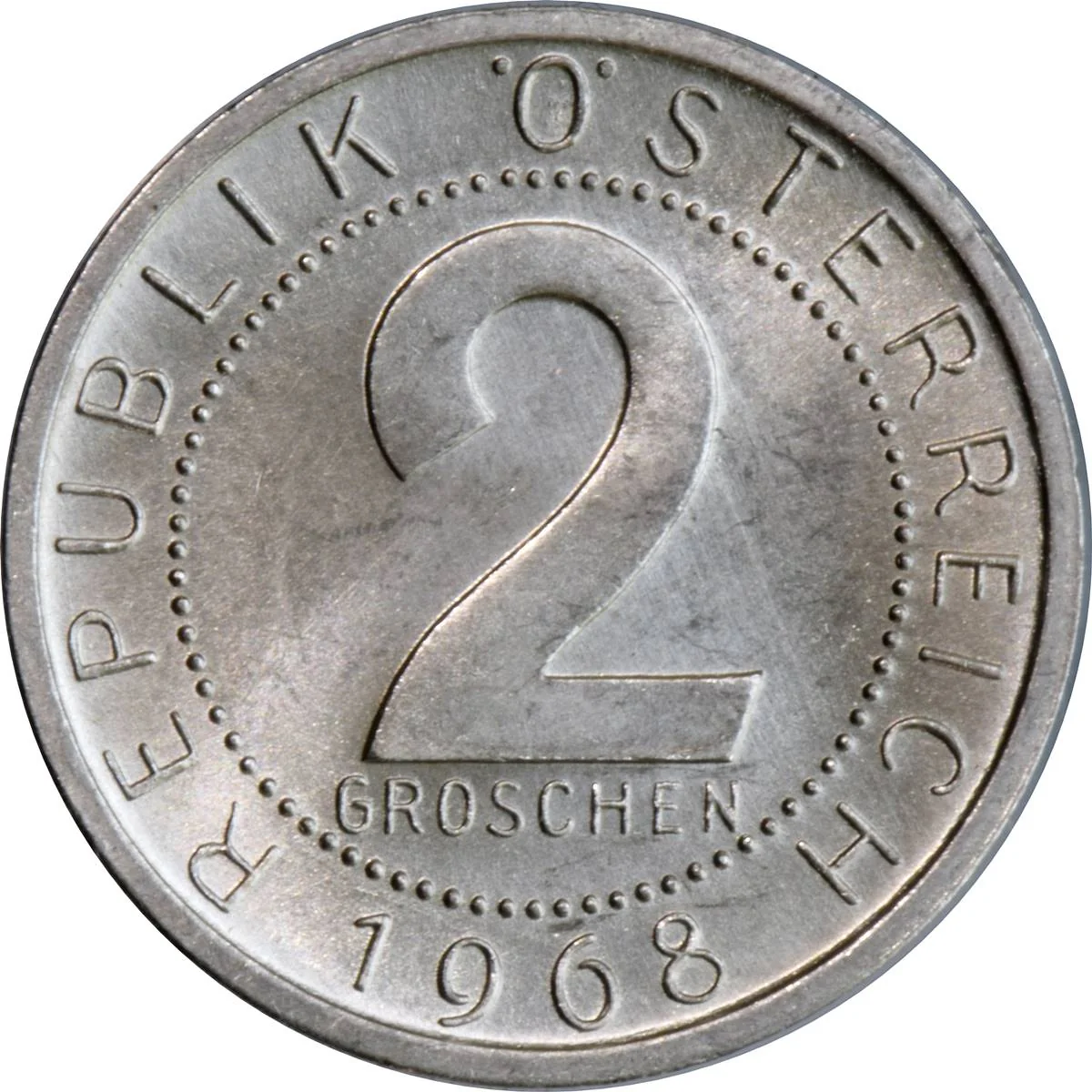
State name encircled by dots, denomination above, date below.
Inscription:
REPUBLIK ÖSTERREICH
2
GROSCHEN
1968
2
GROSCHEN
1968
Translation:
REPUBLIC OF AUSTRIA
2
GROSCHEN
1968
2
GROSCHEN
1968
Script: Latin
Language: German
Engraver: Benno Rost
Edge
Plain
Categories
| Animal> Bird |
| Symbols> Coat of Arms |
| Symbol> Hammer and sickle |
Mints
| Name | Mark |
|---|---|
| Münze Österreich | — |
Mintings
| Year | Mint Mark | Mintage | Quality | Collection |
|---|---|---|---|---|
| 1950 | — | 21,862,000 | ||
| 1950 | — | — | Proof | |
| 1951 | — | — | Proof | |
| 1951 | — | 7,377,000 | ||
| 1952 | — | 37,851,000 | ||
| 1952 | — | — | Proof | |
| 1954 | — | 46,167,000 | ||
| 1954 | — | — | Proof | |
| 1957 | — | — | Proof | |
| 1957 | — | 26,923,000 | ||
| 1962 | — | — | Proof | |
| 1962 | — | 6,692,000 | ||
| 1964 | — | — | Proof | |
| 1964 | — | 173,000 | ||
| 1965 | — | 14,475,000 | ||
| 1965 | — | — | Proof | |
| 1966 | — | 7,454,000 | ||
| 1966 | — | — | Proof | |
| 1967 | — | 13,000 | Proof | |
| 1968 | — | 1,803,400 | ||
| 1968 | — | 21,000 | Proof | |
| 1969 | — | 57,000 | Proof | |
| 1970 | — | 260,000 | Proof | |
| 1971 | — | 145,000 | Proof | |
| 1972 | — | 132,000 | Proof | |
| 1972 | — | 2,763,000 | ||
| 1973 | — | 5,883,000 | ||
| 1973 | — | 149,000 | Proof | |
| 1974 | — | 1,387,000 | ||
| 1974 | — | 93,000 | Proof | |
| 1975 | — | 1,096,000 | ||
| 1975 | — | 52,000 | Proof | |
| 1976 | — | 2,755,000 | ||
| 1976 | — | 45,000 | Proof | |
| 1977 | — | 1,837,000 | ||
| 1977 | — | 47,000 | Proof | |
| 1978 | — | 44,000 | Proof | |
| 1978 | — | 1,527,000 | ||
| 1979 | — | 2,434,000 | ||
| 1979 | — | 44,000 | Proof | |
| 1980 | — | 1,893,000 | ||
| 1980 | — | 48,000 | Proof | |
| 1981 | — | 950,000 | ||
| 1981 | — | 49,000 | Proof | |
| 1982 | — | 3,950,000 | ||
| 1982 | — | 50,000 | Proof | |
| 1983 | — | 2,665,000 | ||
| 1983 | — | 65,000 | Proof | |
| 1984 | — | 500,000 | ||
| 1984 | — | 65,000 | Proof | |
| 1985 | — | 1,060,000 | ||
| 1985 | — | 45,000 | Proof | |
| 1986 | — | 1,798,000 | ||
| 1986 | — | 42,000 | Proof | |
| 1987 | — | 958,000 | ||
| 1987 | — | 42,000 | Proof | |
| 1988 | — | 39,000 | Proof | |
| 1988 | — | 1,061,000 | ||
| 1989 | — | 950,000 | ||
| 1989 | — | 38,000 | Proof | |
| 1990 | — | 35,000 | Proof | |
| 1991 | — | 2,600,000 | ||
| 1991 | — | 27,000 | Proof | |
| 1992 | — | 25,000 | In sets | |
| 1992 | — | 25,000 | Proof | |
| 1993 | — | 35,000 | In sets | |
| 1993 | — | 28,000 | Proof | |
| 1994 | — | 25,000 | In sets |
Historical background
In 1950, Austria was navigating a fragile post-war recovery, with its currency situation defined by the ongoing circulation of two distinct monetary units: the official Austrian Schilling (ÖS) and the occupying Allied Military Schilling (AM Schilling). The Austrian National Bank had been re-established in 1945 and reintroduced the Schilling, but the country, divided into four Allied occupation zones, also used currency issued by the Allied Military authorities. This dual system created practical complexities and symbolized Austria's limited sovereignty, as the nation remained under Allied control until the State Treaty of 1955.
Economically, the immediate post-war period was marked by severe shortages, a large black market, and inflationary pressures, though these were less catastrophic than the hyperinflation of the 1920s. A critical step toward stabilization was the "Schilling Law" of November 1947, which implemented a harsh currency conversion. This reform drastically reduced the money supply by limiting the exchange of old Reichsmarks and Allied Military Schillings for new Austrian Schillings, effectively wiping out a significant portion of cash savings to curb inflation. By 1950, this austerity measure had laid a foundation for price stability, but the economy remained weak, heavily dependent on Marshall Plan aid which began in 1948.
Therefore, the currency situation in 1950 was one of cautious transition from crisis management to nascent stability. The Austrian Schilling was gaining full authority, but within the context of a controlled economy still burdened by war damage, reconstruction costs, and occupation. The year fell within the pivotal period where the groundwork for the future "economic miracle" (Wirtschaftswunder) of the 1950s was being laid, with a stabilized currency as its essential precondition, even as the nation awaited full political and economic independence.
Economically, the immediate post-war period was marked by severe shortages, a large black market, and inflationary pressures, though these were less catastrophic than the hyperinflation of the 1920s. A critical step toward stabilization was the "Schilling Law" of November 1947, which implemented a harsh currency conversion. This reform drastically reduced the money supply by limiting the exchange of old Reichsmarks and Allied Military Schillings for new Austrian Schillings, effectively wiping out a significant portion of cash savings to curb inflation. By 1950, this austerity measure had laid a foundation for price stability, but the economy remained weak, heavily dependent on Marshall Plan aid which began in 1948.
Therefore, the currency situation in 1950 was one of cautious transition from crisis management to nascent stability. The Austrian Schilling was gaining full authority, but within the context of a controlled economy still burdened by war damage, reconstruction costs, and occupation. The year fell within the pivotal period where the groundwork for the future "economic miracle" (Wirtschaftswunder) of the 1950s was being laid, with a stabilized currency as its essential precondition, even as the nation awaited full political and economic independence.
🌱 Very Common